
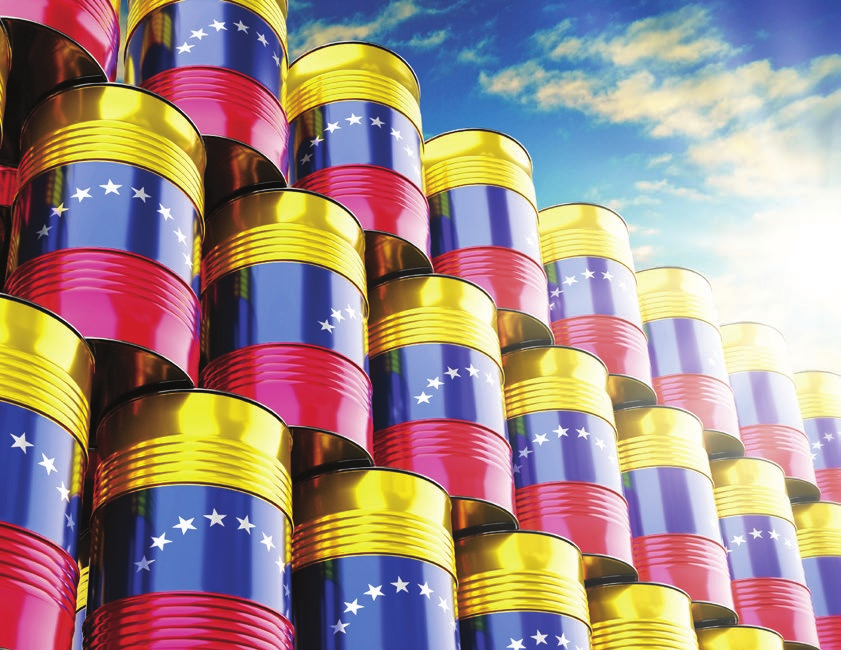
How recent events in Venezuela will affect global energy depends on how much the energy industry is willing to get involved in Venezuela.
So far, it doesn’t look good.
“The main thing to watch out for over the medium to longer term is, first, whether there really is going to be an investment opportunity in Venezuela, and second, who are going to be the takers,” said Abhi Rajendran.
Rajendran is director of research at energy information and analysis firm Energy Intelligence, and a nonresident fellow at the Center for Energy Studies at Rice University’s Baker Institute for Public Policy.
Companies face a high level of uncertainty around U.S.-Venezuela relations, Venezuela’s internal politics and the outlook for the Venezuelan energy sector, Rajendran noted. Chevron is a logical player in future developments because it has maintained operations in the country, he said.
“For someone who isn’t there already to start investing, sort of from scratch, is a different story,” he observed.
Any meaningful revitalization of Venezuelan production will require political stability in the country, operational security guarantees and sizable new investment, analysts agree. Expect the price tag number to be high, Rajendran said.
“Looking out over the next five to 10 years, we’re probably looking at maybe $75 billion to $100 billion, or maybe even more,” he predicted.
Rystad Energy released an analysis in January on the projected costs of increasing Venezuela’s oil output. It calculated that about $53 billion of upstream and infrastructure investment would be needed over the next 15 years to lift Venezuela’s crude production to 1.1 million barrels per day and keep it there.
Exceeding 1.4 million bpd would require adding more than 500,000 bpd to current output levels. That’s possible, Rystad Energy found, but would take a stable investment of $8 billion to $9 billion per year from 2026 to 2040, on top of hold-the-line capital requirements.
Venezuelan production “could then recover to 2 million bpd by 2032 and to 3 million bpd by 2040 … The total oil and gas capex required over the 2026-2040 period to reach that target is estimated at $183 billion, with cumulative service purchases of an estimated $156 billion, after internal E&P operator spending is removed,” it reported.
Political Instability
Even if that kind of capital investment is available, questions about operating conditions and Venezuela’s political stability will remain, Rajendran noted. The situation could change abruptly, so investors and oil industry participants would want long-term assurances.
“What is going to be some of the risk mitigation offered by Washington?” Rajendran asked.
“In three years, you could have a completely different administration in Washington with a completely different viewpoint,” he said.
Brad W. Setser, senior fellow at the Council on Foreign Relations in New York, noted the “economics of this investment are very different from those of the tight or shale oil plays now dominant inside the United States, which generate higher upfront returns. The big oil firms will need clarity on Venezuela’s long-term political future before they are willing to commit serious amounts of their own capital without a U.S. guarantee.”
David Goldwyn and Andrea Clabough of the Atlantic Council Global Energy Center observed that international oil companies and other outside industry participants will want a number of changes before risking involvement with the Venezuelan energy sector.
“Ideally, IOCs would like to see a scenario where most sanctions (on Venezuelan exports) are lifted or significantly eased, along with reassurance that a reversal would not occur anytime soon.
“In addition, they are looking for a revamped Venezuelan regulatory framework for its energy sector, including changes to regulations governing operations, trading and exports, terms for joint ventures, asset ownership and legal rights,” they noted.
U.S. President Donald Trump met with oil company executives at the White House in early January and encouraged them to invest in reviving Venezuelan oil production. Enthusiasm among the company leaders was scarce.
In a widely reported remark, ExxonMobil CEO Darren Woods said, “If we look at the commercial constructs and frameworks in place today in Venezuela – today, it’s uninvestable.”
Chevron Vice Chairman Mark Nelson was more hopeful about bumping up his company’s production in Venezuela.
“We have a path forward here very shortly to be able to increase our liftings from those joint ventures 100 percent, essentially effective immediately … We are also able to increase our production within our own disciplined investment schemes by about 50 percent just in the next 18 to 24 months,” he said.
The Chinese Connection
Some industry experts noted the polite response but lack of firm commitments from oil firms at the White House meeting. Not surprisingly, Chinese companies were absent. China has been a major investor in and supporter of the Venezuelan oil sector, as well as a major customer for Venezuelan oil, Rajendran said. CNPC, Sinopec and other Chinese oil companies have maintained operations in the country.
“Through 2015, China provided Venezuela at least $60 billion in oil- backed loans via state-run banks, primarily (through) China Development Bank,” the U.S.-China Economic and Security Review Commission reported in January.
“Chinese policy banks loaned more to Venezuela than (to) any other Latin American country; at least $10 billion in Chinese bank loans is outstanding. China also purchases most of Venezuela’s oil, which accounts for over half of Venezuela’s fiscal revenue, despite U.S. sanctions,” it noted.
Rajendran said, “If Washington wants to have a renaissance story in Venezuelan oil, they’ll have to keep the Chinese interested. It doesn’t work without” that.
Market Conditions
Prospects for increased investment in Venezuela energy also face economic headwinds, especially in the oil and gas industry. Global oil prices generally are forecast to decline by $5 to $10/barrel in 2026, and the world oil market remains significantly oversupplied.
“This is not an environment where companies are just going to open their wallets,” Rajendran noted.
“We forecast that global investment was down a couple of percent in 2025, and it will be down again this year,” he said.
Beyond a large infusion of cash over many years, revitalizing Venezuela’s energy sector will require a substantial investment of technical expertise and personnel. Will oil companies feel secure about sending their employees into the country?
“It’s not about just throwing dollars over the wall,” Rajendran said.
Analyst predictions for a near-term increase in Venezuelan crude oil production range from zero to more than 500,000 bpd. Enverus Intelligence Research projected the country’s oil output will reach 1.5 million bpd by 2035. Rajendran estimated that Venezuela is producing just over 800,000 bpd, currently.
“The low-hanging fruit is maybe 200,000 to 300,000 barrels a day (increase),” he said.
“Raising from 800,000 barrels (per day) to 1.2 million, 1.3 maybe, or even 1.4 million at most, we think is doable – 1.2 (million) is probably a good number for what can be squeezed out” in the near term, he said.
Any increased production will enter a global oil market already saturated with oil. Additional Venezuelan output will especially affect the market for heavy crude, specifically for U.S. refiners and Western Canadian crude, Enverus noted.
“Even with accelerated sanctions relief, we still see 1–2 million barrels per day of global oversupply in the first half of 2026 and limited incremental volumes from Venezuela,” said Al Salazar, EIR head of macro research and director.
“Sanctions relief will redirect Venezuelan crude toward the U.S. Gulf Coast, increasing competition among heavy barrels and widening Western Canadian Select (price) differentials” with other oil supplies.
Absorbing another half-million barrels a day into the global oil market wouldn’t be automatic, Rajendran noted, especially if China isn’t standing in the customer line.
“Can you create a market for another 500,000 barrels a day of Venezuelan crude? That’s a real question,” he said.
“There’s some other things to think about – like Venezuela is a major supplier to Cuba, and Cuba is now in the crosshairs,” he added.
The outlook for Venezuela’s energy sector might have an easy two-word summary – “It’s complicated” – but the path toward industry reinvigoration and increased production appears filled with serious obstacles.
“Our view is still quite a skeptical one in terms of a true turnaround in Venezuela,” Rajendran said.