
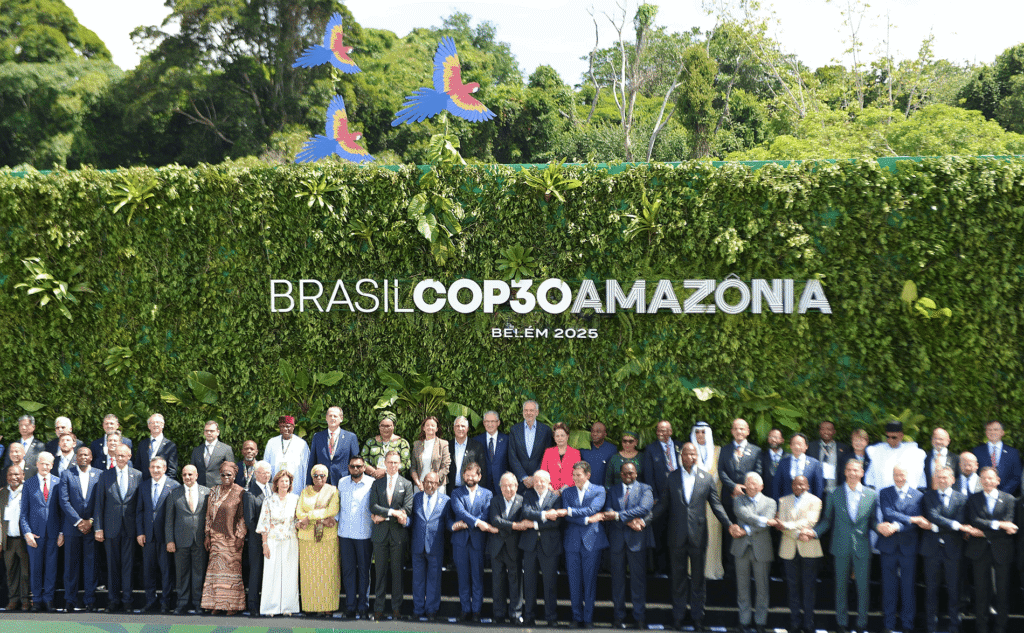
Brazil hosted the 30th U.N. Climate summit Conference of Parties in early November in Belém, the gateway to the Amazon River. Delegates from 194 countries and regions attended. Organizers called the meeting for “Global Mutirão,” which means “collective action” in the indigenous Tupi-Guarani language. They touted several achievements but failed to deliver a roadmap to phase out fossil fuels, as the host country Brazil and several other progressive countries had hoped.
Countries, companies, and international organizations are adjusting their positions and actions toward the COP and climate and energy transition initiatives. The United States did not participate in COP30 – its first absence from the conference in the past 30 years.
Key Achievements
Many believe the most significant victory for COP30 was renewed support from the majority of the member countries to continue the fight against climate change. As host, Brazil was the driving force and called for that aforementioned collective action as the world faces strong headwinds against energy transition and climate change initiatives. Simon Stiell, the United Nation’s climate change executive secretary, said during his closing speech that “COP30 showed that climate cooperation is alive and kicking, keeping humanity in the fight for a livable planet.”
By the time the event took place, 122 countries, representing some 75 percent of global emissions, had submitted “Nationally Determined Contributions” to reduce their greenhouse emissions. NDCs are based on the goals set by each country. Before COP30 started, only 79 countries had submitted their NDCs. Participating countries also see the quality for NDCs as much higher than previous submissions, with the aggregate ambition to limit temperature to within 2.1 to 3.2-degrees Celsius by 2100. This is a significant improvement over the temperature increase projected 10 years ago, when the average global temperature was on a trajectory to rise between 2.8 and 4.8 degrees by 2100, if no action would have been taken. COP30 admitted for the first time that the world is more likely to overshoot the 1.5-degree Celsius target set originally in Paris 2015.
COP30 established a 5+1 framework to coordinate “high ambition” governments, businesses, and civil society for actions across sectors and regions. The 5+1 represents:
1. Energy, industry, and transport (19 countries pledged to quadruple sustainable fuels use by 2035)
2. Forests, oceans and biodiversity
3. Agriculture and food systems
4. Cities, infrastructure, and water
5. Human and social development
The +1 axis crosscuts the other five axes: Financing, technology, and capacity-building.
Brazil also launched the Tropical Forest Forever Facility to raise funds for forest protection. Brazil, Indonesia, France, Germany, and Norway pledged a total of $6.7 billion. China and the United Kingdom showed willingness to join the funding pledges in 2026.
Meaningful Disappointments
Brazil led the initiative with regard to fossil fuels and deforestation, as member countries failed to reach a consensus during the conference. Brazil and a number of countries from the High Ambition Coalition tried to push for a detailed roadmap to transition away from fossil fuels. This mandatory global roadmap, packaged in what some felt was strict phase-out language, was opposed by Russia, Saudi Arabia, China, India, and Nigeria. Opponents argued that forced transition would lead to economic stagnation and energy insecurity. Instead, they prefer that individual countries choose their own energy transition steps. China also seemed reluctant to take on a more active leadership role in the fight against climate change.
(See related article this issue on Brazil’s post-COP30 energy trajectory.)
According to the Financial Times, quoting Akash Deep, the world has retired about 300 gigawatts of coal-fired power since Paris 2015, but the world added 600 gigawatts of new coal-fired power plants along the way, with 600 gigawatts more in the pipeline. This reflected the difficulty in phasing out fossil fuels.
The Guest List
With 56,118 registered attendees, COP30 became the second most-attended COP after COP28 in Dubai, which attracted more than 80,000. More than 5,000 people joined virtually.
According to conference organizers, 57 heads of state and government attended COP30, including Brazilian President Luiz Inácio Lula da Silva, U.K. Prime Minister Keir Starmer, President Emmanuel Macron from France, Chancellor Friedrich Merz of Germany, European Commission President Ursula von der Leyen, and U.N. Secretary-General António Guterres. California’s Governor Gavin Newson attended part of COP30 to show that not all Americans agree with President Trump’s withdrawal from the Paris Agreement.
According to Carbon Brief, China sent the second largest delegation with 789 representatives. Brazil topped the charts with 3,805 attendees, many media, NGOs, and nonprofits also sent several representatives to attend.
Just before the conference started, there were reports that the small city of Belém did not have enough hotel beds to host all the attendees and room prices skyrocketed. Brazil offered free cabins on cruise ships moored in the city to enable delegates from low-income countries to attend.
Looking Ahead
COP31 will be another milestone for the world at large, and the energy world in particular. Turkey will host COP31 in 2026 and will be responsible for setting the agenda. In a unique arrangement, Australia has been appointed the country to lead the negotiations leading to COP31. Australia and several Pacific Island countries will help identify the financial needs for Small Island Developing States in preparation for the discussion on the issue during COP31.
At that point, the Trump administration will be in the middle of its second term, with a clear policy promoting energy addition, rather than energy transition. How will the rest of the world adjust their approach and actions to continue the fight against climate change?