Cindy A. Yeilding coined the term “The Explorer’s Mindset” in her 2002 AAPG Distinguished Lecture.
As Mark Shann would say, “You need to call it something to be able to define it,” in his reference to “disruptive discoveries,” like Zama, the discoveries that abruptly change the resource curves in relatively mature basins.
So how is “The Explorer’s Mindset” defined?
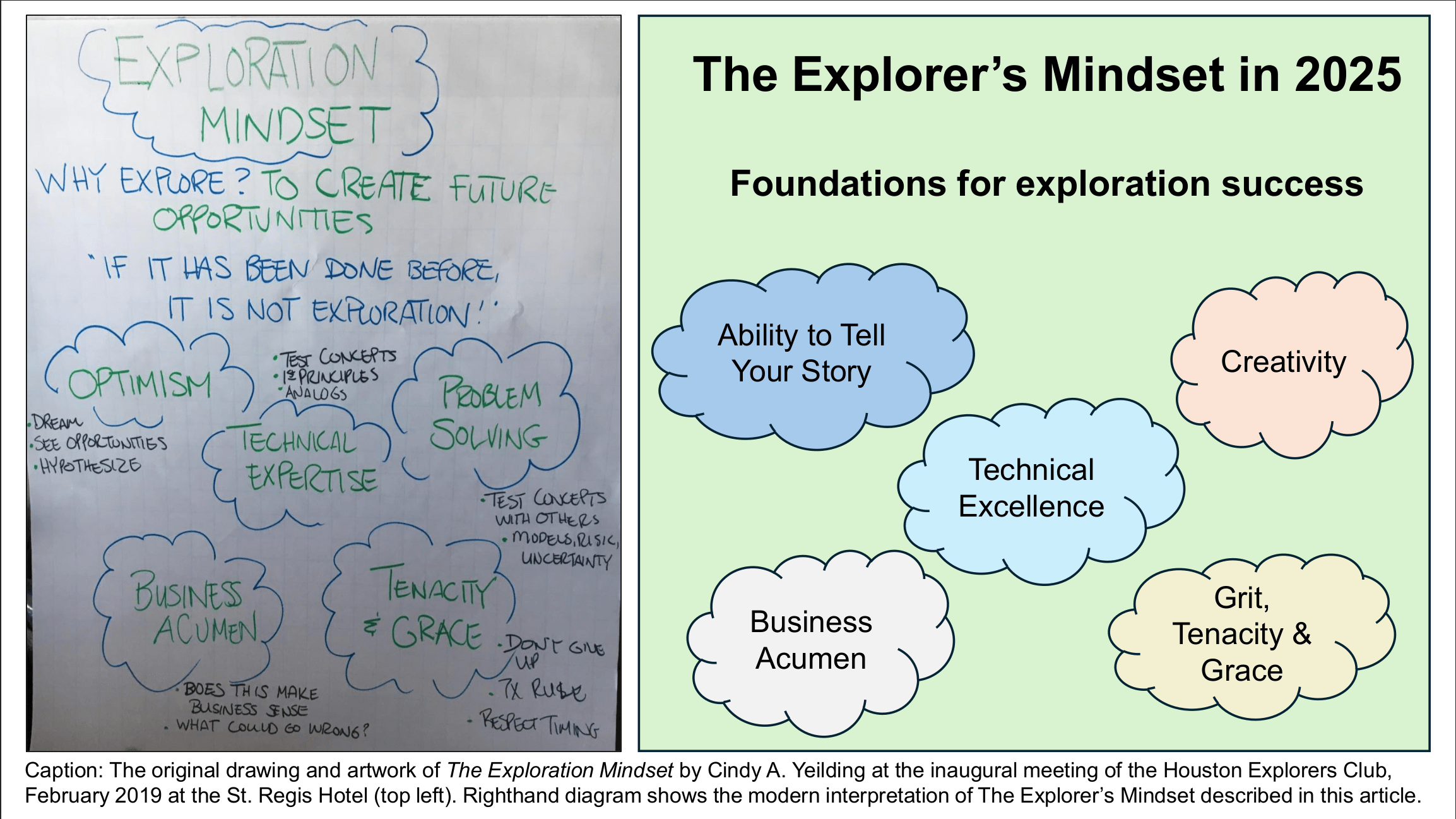
It is five main traits that distinguish exceptionally successful explorers: Technical excellence. Creativity. Business acumen. Ability to tell a story. Grit, tenacity and grace.
Technical Excellence
Let’s start with technical excellence. You need to be really good at your job. Not only do you need to understand the petroleum system – what makes a winning play (and have abundant analogues from which to draw inspiration) – but you also need to deftly navigate the available software of the generation. You need to be able to show the scientific evidence for your prospect, and sometimes this comes down to knowing which attribute to use. Heather Bedle (a frequent Geophysical Corner contributor) is well known for her ability to use software and attributes to be able to show the geology so clearly in her subsurface examples. I just watched her present this morning on the latest seismic attributes to our “Conjugate Basins, Tectonics and Hydrocarbons Consortium” at University of Houston. The attributes she chose make the geology so obvious to the audience, which is convincing. No doubt, this expertise has taken decades of mastery using software and understanding which attributes will best show the petroleum elements the best, for instance, sand in a deepwater channel belt.
Creativity
In my book, “The Explorer’s Mindset: Lessons in Leadership in Applied Geoscience and the Energy Industry,” so many interviews emphasize the importance of creativity in the geosciences. Creativity is important because subsurface data can often be interpreted using more than one scenario, putting a premium on the explorer’s ability to think broadly and effectively account for different interpretations. This ability is critical because, when the well comes in, and it wasn’t the most likely scenario, but rather the second or third, management will understand that you communicated these other scenarios pre-drill. Again, much of our data in geoscience can be interpreted in multiple ways. The solutions are non-unique. Just ask anyone who has worked potential fields for their career. Creativity is not easily taught, nor is it easily learned, but it can be developed to steer the explorer away from sheepy thinking – better known as “group think” – that disincentivizes personal responsibility. This is a topic for another post.
Business Acumen
If the prospect success case won’t increase free cash flow – the main factor that increases value for any company regardless of industry – the well will not get drilled. Further, the overall business plan must satisfy the traditional triad: it must be technically possible, economically feasible (that’s where FCF comes in), and societally acceptable.
Being good at business means that a lot of subsurface experts must exercise new muscles – those of finance, valuation, accounting and modeling. Marlan Downey said it best: “Geology is a science; exploration is a business.”
Ability to Tell a Story
At first, this one is tough to describe and is often misinterpreted. Most explorers often go straight to “salesmanship,” but this can be misleading. This trait of successful explorers is best described as the ability to bring people along in the story of the prospect, to show without a lot of hoopla and drama the pluses, minuses, aspects, deficiencies, uncertainties. To make the audience of funders or senior management comfortable with delivering capital in the range of $1 million, $10 million or $100 million on an exploration well.
And when an explorer first tells this story to a potential group of financers, he or she might get a, “No way!” So they ask again, in a different way. Or, they fix some of the problems associated with the prospect, working and working and working on one or two of the key risks flagged by the initial group. The explorer tells his story again. And maybe a few more times. Sometimes it takes seven times to get to a “Yes,” but it can take even more tries. Like, hundreds of tries in the case of Liza.
Often, this doesn’t mean that your prospect is bad. It just means it didn’t fit the investment criteria of your capital providers. So keep trying, but not doing it the same way over and over again. Get creative with your approach.
Grit, Tenacity, Grace
Which brings me to the final trait described by Cindy in her 2002 AAPG Distinguished Lecture: grit and tenacity, paired with grace.
These three traits are often glamorized, but they don’t need to be. Many of the most successful explorers are just good at showing up, day after day, year after year. Many weren’t brilliant at the start. But they took time to hone their exploration skills, getting better and improving, learning from mistakes and loving the process of oil and gas finding as they did. Over time, this gave them an edge over other explorers to see possibilities others don’t see, as Cindy mentioned. This is what grit, tenacity and grace look like over the long-term, and how many great explorers have drilled success after success after success.
Cindy A. Yeilding gave the inaugural lecture at the Houston Explorers Club in 2019 at the St. Regis Hotel in Houston on “The Explorer’s Mindset,” a topic that was first introduced at a very broad scale as an AAPG Distinguished Lecture. It is still very much in vogue today. In fact, even more so. The latest generation of oil and gas finders (that is, recent graduates) has not been adequately coached in the Explorer’s Mindset. They have been shown how to mine oil and gas through hydraulic fracturing – a relatively low-risk, and in some cases, high-profit, business.
But capital has also been incinerated during the Shale Revolution. Just look at what happened to public and private companies at that time and all of the consolidation and bankruptcies that ensued. Not all unconventional-focused companies will be as successful as Dunn’s CrownRock.
The Magic of Naysaying
So now you know the five main traits defining the Explorer’s Mindset. How will you apply them and demonstrate them to your teams? Don’t you think it’s time we started thinking outside the box, using the Explorer’s Mindset, to find the next big game-changing discoveries?
Cindy offers a poignant, pragmatic and inspiring conclusion: “It’s magic when people say, ‘That will never happen,’ because explorers like me hear ‘great opportunity’ in those words. An explorer’s role is to create value where others don’t, or where others think it is not possible. So, explorers typically receive responses to their new ideas, like:
– “That technology will never work at scale.”
– “It might work but it will never make money.”
Or the ever-popular: “Whatcha’ been smoking?”
As a lifelong explorer and opportunity generator, I see exploration as a search for potential value from the artful application of new concepts and ideas. What do explorers do? We challenge dogma and biases to create new opportunities. We underpin our work with excellent scientific principles and solid economics. We characterize risks and uncertainties. We also fail – a lot! A successful explorer will learn from these experiences, integrate them into her exploration toolkit and regroup.”
This is the first of a new regular series on The Explorer’s Mindset prepared for AAPG Explorer. This column is based on the second edition of the book, The Explorer’s Mindset: Lessons in Leadership in Applied Geoscience and the Energy Industry. In the installments to follow, we’ll be looking at the traits of successful explorers, their leadership qualities and what has enabled them to make game-changing discoveries.