

Unless you are a migratory bird, a sea turtle or a geomagnetist, you probably pay little attention to the Earth’s magnetic field. As geoscientists, we know how important the magnetic field is – how it is generated and how it changes. And yet, we know little about the details of these processes. Geophysical surveys, measurements of strike and dip and horizontal drilling – to name a few – all require calibrations to Earth’s magnetic direction.
How It Began
Earth’s magnetic field is generated by the motion of liquid iron in the outer core, a phenomenon called “geodynamo” and formulated by Walter Elsasser in the 1940s.
The magnetosphere is the largest physical division of Earth, extending into outer space and enveloping Earth in the form of Van Allen radiation belts and protecting life on Earth against harmful charged particles from the solar wind.
When did the magnetosphere first form? In an article in Chinese National Science Review, John Tarduno and colleagues argued that minute magnetic inclusions in zircon crystals present in Jack Hills sandstone in Australia, dated as 4.2 billion years old, indicated the establishment of the magnetosphere – much like the atmosphere, oceans and solid-earth – shortly after Earth’s formation 4.55 billion years ago.
These researchers also point out that the geodynamic nearly collapsed between 590 and 560 million years ago but that the magnetic field has increasingly been strengthened in the Phanerozoic era over the past 540 million years.
From Canada to Siberia
The earliest positioning of the magnetic pole dates to 1831 by James Clark Ross. This was followed by direct measurements of the North Magnetic Pole. In recent decades, global models of the magnetic field have used measurements made by a network of ground observatories (currently 200 worldwide) and low-orbiting satellites. Magnetic field measurements from 1600 to 1831 are derived from estimations.
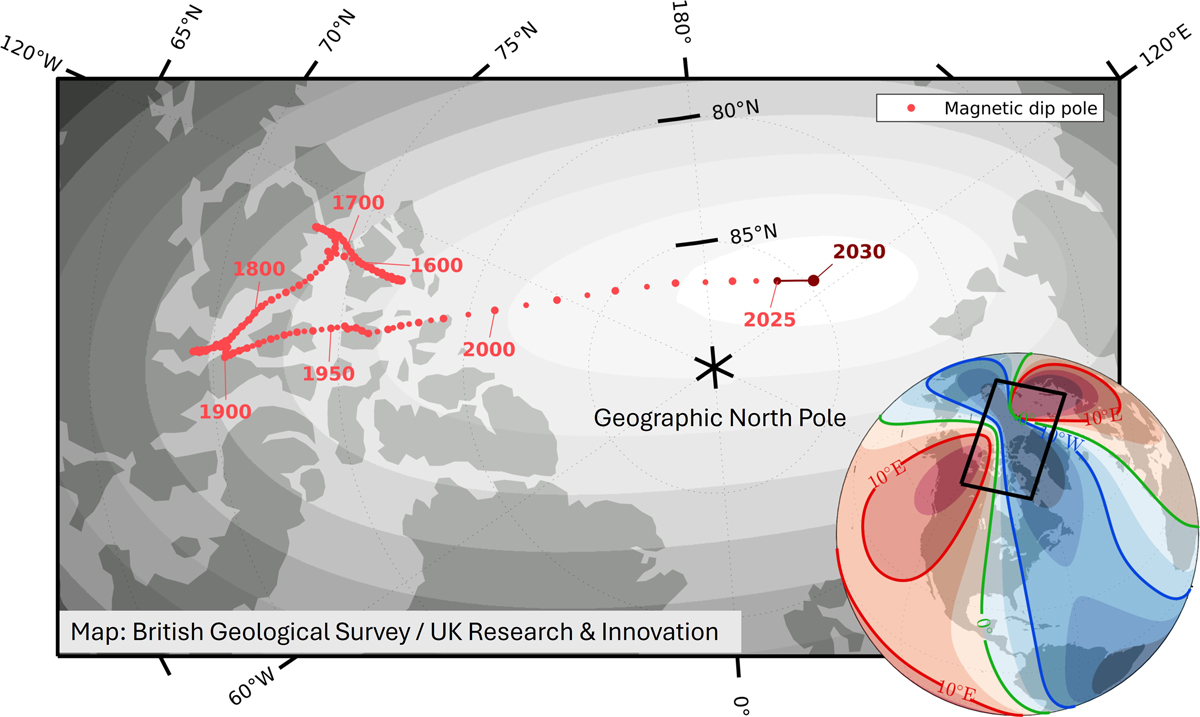
The records show that the magnetic North Pole has been moving from the Canadian Arctic to Siberia. Initially, it was shifting at slow speeds of one to 15 kilometers per year, but it sped up to 50 to 60 kilometers per year from 1990 to 2005. In 2017, the magnetic North Pole crossed the international date line. Measurements for the past four years indicate a slowdown to about 35 kilometers per year, but these measurements are still higher than the recorded historic rates.
Philip Livermore and colleagues in Nature Geoscience suggested that this shift from Canada to Siberia is related to two lobes of negative magnetic flux on the core-mantle boundary: The one under Canada is getting weaker, while the Siberian lobe is intensifying. A study by Chris Finlay and colleagues published in Physics of Earth and Planetary Interiors supports this model. Using data from the Swarm satellite mission, the researchers found that between 2014 and 2025, the Canadian magnetic lobe diminished in size by 0.65 percent and decreased from 58,832 nanotesla to 58,031 nanotesla, while the Siberian lobe grew in area by 0.42 percent and was intensified from 61,359 nanotesla to 61,619 nanotesla. Interestingly, the South Magnetic Pole has been shifting at much slower rates.
Recent measurements also indicate that the South Atlantic magnetic anomaly, where Earth’s magnetic field is the weakest, has expanded in the past decade by 0.9 percent and is at 22,094 nanotesla. While this anomaly does not currently pose any threat to life on Earth, it does affect satellites in space. For instance, the International Space Station uses extra shielding, and the Hubble Space Telescope shuts down during their passage above the South Atlantic anomaly.
An Imminent Magnetic Reversal?
Is Earth transitioning to a magnetic reversal? It is hard to say. Of course, Earth’s magnetic poles have flip-flopped thousands of times during the planet’s history at various rates. In the past 83 million years alone, there have been at least 183 reversals, but prior to that, from 121 to 83 million years or Cretaceous Normal Superchron, Earth’s magnetic field was unusually stable for about 37 million years. We are currently in the Brunhes Normal Chron which started about 78,000 years ago.
Scientists do not agree on how long it takes for a full magnetic reversal: The estimates range from a couple of centuries to more than 10,000 years.
Contrary to the popular belief that magnetic pole reversals cause mass extinctions, the geologic record does not support this. However, if a magnetic reversal occurs, especially rapidly, it will cause serious problems with navigation, electric facilities and satellites, not to mention potential health hazards and disruptions to migratory animals.