
Meeting the world’s crude oil and natural gas demand for the next 25 years could defy human ingenuity.
Producers are trying to move beyond that limitation.
Artificial intelligence tools now affect every area of oil and gas operations, in ways significant to subtle. For the energy industry, one of AI’s most important possibilities is its potential to boost production from known reserves.
A short version of the current situation: The world will be challenged to replace hydrocarbon reserves and sustain enough production to meet global oil and gas demand to the middle of this century. And exploration isn’t coming to the rescue.
Is AI the answer?
The Looming Supply Gap
Energy data and consulting firm Wood Mackenzie estimates that cumulative global oil demand will be almost 1 trillion barrels through 2050. That’s generally in line with other forecasts of world oil consumption rising toward 110 million barrels per day.
With the world going through a slower than expected energy transition, any peak in annual oil consumption might be a decade away, not occurring until the early- to mid2030s, the company predicts.
In its latest World Energy Outlook, the International Energy Agency even includes a case for world oil production continuing to increase to 2050, to 113 million b/d.
Current industry efforts will recover an average 29 percent of oil in place from major fields, in Woodmac’s analysis, and 15 percent of that has already been produced. Output from assets now onstream or slated for development will gradually decline from more than 100 million b/d today to 50 million b/d in 2050 – a cumulative 650 billion barrels of production, it found.
That would leave the world with a supply gap of more than 300 billion barrels.
“Traditional exploration will play its part but can’t get anywhere near bridging a gap of this scale. Even the 21st century’s biggest new play, Guyana, with (an estimated) 15 billion barrels of oil, barely makes a dent,” Woodmac noted.
Current discoveries from exploration don’t come close to offsetting worldwide energy consumption. And the outlook isn’t great – lower prices and reduced revenues threaten to shrink exploration drilling further, at least in the near term.
Efficiency Gains
This situation helps explain why the energy industry is so intent on bringing AI and machine learning tools to bear on enhancing production. There’s no desperation, but there is a definite sense of urgency in identifying the best approaches.
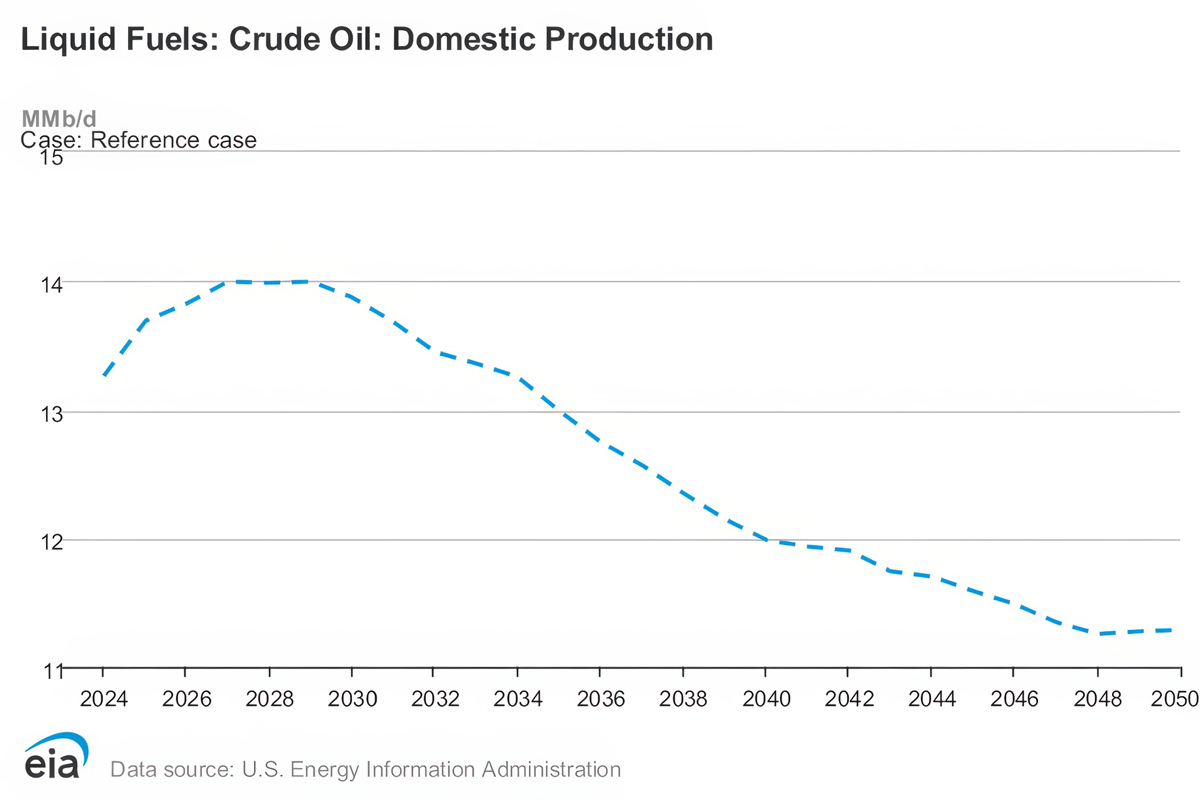
production peaks around 14 million barrels/day then declines by over 2.5 million b/d to 2050.
An early lesson: efficiency is hugely important.
Efficiency gains plus best practices in production have the potential to increase oil and gas recovery in a dramatic way, Wood Mackenzie believes. With its new Analogues AI tool, the company analyzed more than 35,000 existing fields using comprehensive datasets.
“In one of Wood Mackenzie’s first practical deployments of this analysis, we revealed that optimized recovery from existing fields could yield an additional 470 billion to over 1 trillion barrels of oil,” said Josh Dixon, Woodmac senior research analyst, upstream.
Devon Energy, an independent producer with more than $31 billion in assets, operates in numerous play areas in the central United States, including Permian Basin and Eagle Ford unconventional resources.
“Devon is scaling automation and AI across our operations to reduce downtime, improve fault detection and drive measurable gains in production and efficiency,” said Trey Lowe, senior vice president and chief technology officer.
“These technologies are helping us flatten base declines and extend the productive life of our assets,” he said.
The use of AI, combined with design improvements and simul-fracs, has reduced Devon’s drilling costs by 12 percent and its completions costs by 15 percent since last year, Lowe said.
Devon’s Delaware Basin operations in southeast New Mexico and west Texas include about 400,000 net acres across multiple producing zones, with a focus on the oil-rich Wolfcamp, Bone Spring, Avalon and Delaware formations.
“We’re leveraging AI to benchmark and accelerate drilling in the Delaware Basin. These tools help us drill, trip and run casing up to 30-percent faster, saving millions and enabling more efficient capital deployment, which strengthens our long-term production outlook” said Tom Hellman, senior vice president of Exploration and Production Operations.
So far, overall production and efficiency gains from AI aren’t huge, although they can have an outsized impact. In addition to improving production rates, recent examples show AI adding a 5 to 20-percent increase in drilling efficiency, with a meaningful reduction in deviation/off-target results.
In the Delaware, “we used AI to develop a new, smart gas-lift technology that continuously optimizes gas-lift injection rates,” said John Raines, Devon’s senior vice president of asset management.
“The pilot for this initiative delivered a 3-percent to 5-percent production uplift, and as we roll it out to other applicable basins, it’s supporting our broader strategy to sustain production more efficiently,” he added.
Expected Evolution
Devon’s results can’t be seen as typical. Today’s AI capabilities haven’t been used in oil and gas production long enough to know what “typical” looks like. Also, new AI tools are still being developed and implemented. But the results do reflect the positive experience reported by producers adopting AI into their operations.
Earlier this year, Wood Mackenzie introduced its Analogues tool to benchmark best-practice recovery factors. The company reported it uses “a machine learning method known as clustering to identify each field’s closest matches across 60 different attributes” including rock properties, fluid characteristics and commercial factors.
“AI-powered tools are becoming essential for identifying advantaged resources, those that are low cost, low carbon, reliable and fast to market. AI is being deployed across the industry, with service companies and (operators) using this technology to revolutionize everything from seismic processing to drilling optimization.
“What we have brought to the table is a toolkit to assist geologists and engineers to reduce uncertainty and explore performance upside, and AI is placed front and center,” Dixon said.
He said the AI approach tries to eliminate the human bias inherent in traditional filtering approaches. It considers holistic reservoir characteristics rather than single parameters, high-grades results and uses advanced gapfilling techniques to create complete datasets for analysis.
Wood Mackenzie claims to have modeled every significant producing field in the world at this point. For each one, the AI tool identified the top 100 most similar assets globally. Then statistical analysis benchmarked performance across different groupings, Dixon explained.
This benchmarking against best-performing comparisons suggested a 6-percent to 12-percent additional recovery potential, by using production technologies and practices already proven and deployed elsewhere, he added.
“While a seemingly modest improvement, that would translate to approximately one trillion additional barrels, almost doubling remaining recovery potential from existing assets,” Dixon noted.
“In short, just getting industry best practice deployed much more widely can unlock almost as much again in recovery potential within the world’s oil fields,” he said.