
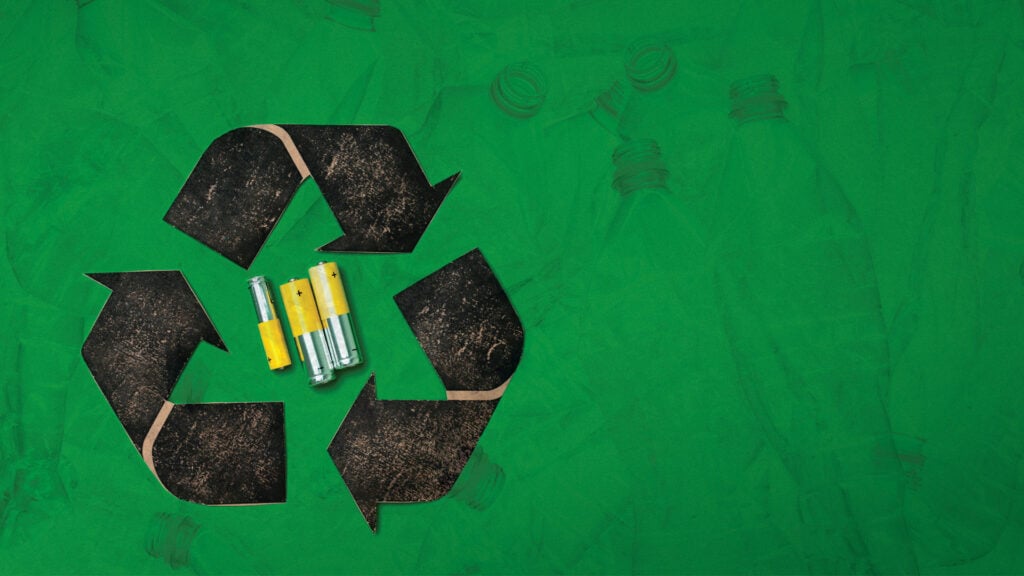
We need more materials and power for today’s world and the world of tomorrow. While some have yet to be discovered, we also need to reuse old items more frequently – for example, plastics and batteries.
Plastics can take between 100 and 1,000 years to degrade, and during the degradation process, they split into tons of tiny particles the size of dust, called microplastics. This plastic dust is everywhere – in every ecosystem in the world, inside the bodies of marine animals and inside our own organs.
The consequences of these microplastics in our livers, kidneys and even some placentas are poorly understood at best. Finding a way to remove these materials from our environment and reuse them has been a topic of conversation for years. Several factors though, including physics, costs and time, have stood in the way of regular plastic recycling.
First, not all plastics are created equal when it comes to recycling. Plastic recycling requires a good deal of sorting to find the right quality and type of plastic. It also needs a lot of energy to work, and it steadily degrades output materials because the process begins with chemical and mechanical breakdown of the raw materials.
Canadian company Denovia Labs is turning that on its head with its PL-1000 reactor. The system uses AI to boost sorting efficiency and a depolymerization breakthrough that unzips the molecular chains of the plastic at room temperature, which removes the need for high temperatures and melting. The company’s recovery rate is 86 percent for high-quality outputs including terephthalic acid, and its purity exceeds 99 percent. Denovia’s business model is a gold mine at all ends: it gets paid to collect and gather the plastic, paid for the outputs and has licensed the IP so it can distribute its tech to other companies … and it gets paid for that too.
A team out of Northwestern University is also tackling the problem of plastic recycling using another solvent: water. Solvents normally used in the process can be environmentally harsh and difficult (and therefore, costly) to get. The group uses a three-step process to convert polyethylene terephthalate into reusable materials with 94-percent recovery in four hours. They combine PET with a low-cost molybdenum catalyst and activated carbon. Next, they break down the PET’s molecular bonds by heating that mixture. The fragmented PETs are exposed to ambient air, which naturally has a minimal amount of water vapor that triggers a conversion of those fragments into TPA.
Battery Recycling Revamp
Plastic isn’t the only resource seeing a boost in recycling. The recycling rate for lithium-ion batteries, which comprise a vast majority of electric vehicle batteries, was only 5 percent three years ago due to the cost and complexity, but they pose serious hazards when sent to landfills. According to a 2018 survey by the California Product Stewardship Council, some 40 percent of fires at waste management facilities were caused by lithium-ion batteries – double the rate from propane cylinders. Even transporting the batteries is hazardous, with nearly 77 percent of transport facilities requiring an emergency response due to a lithium-ion battery fire.
Redwood Materials, which originally set out to recycle the materials from used EV batteries, realized most of the batteries it gathered had plenty of useful juice left in them. Even though a battery might have drained beyond what is considered useful for an EV, there are often still a lot of electrons left for other applications, such as an energy storage system, which requires a slower minimum discharge than an EV.
The company spun off Redwood Energy, which takes one gigawatt-hour from Redwood Materials and puts it in its deployment pipeline. Its first microgrid has a 12-megawatt to 63-megawatt-hour capacity, delivered in partnership with AI company Crusoe. Redwood should have some running room too, as it estimates that more than five million EVs are driving on U.S. roads, representing an estimated 350 gigawatt-hours of energy that will reach end-of-life in the coming years.
Other companies taking advantage of second-use EV batteries include Allye Energy in the United Kingdom. The company sources batteries with an average 94 percent state of health, which means their batteries are like-new but have a significantly lower carbon footprint of 60 percent. Allye repurposes the entire battery pack, from the cooling system to the high-voltage cables, which means battery pack integrity, chemistry and architecture are still in use. Its MAX systems are designed to integrate with that original setup and connect each battery pack in parallel with a common AC bus. This creates architecture in which there’s no single point of failure, increasing reliability and up-time even during maintenance.