
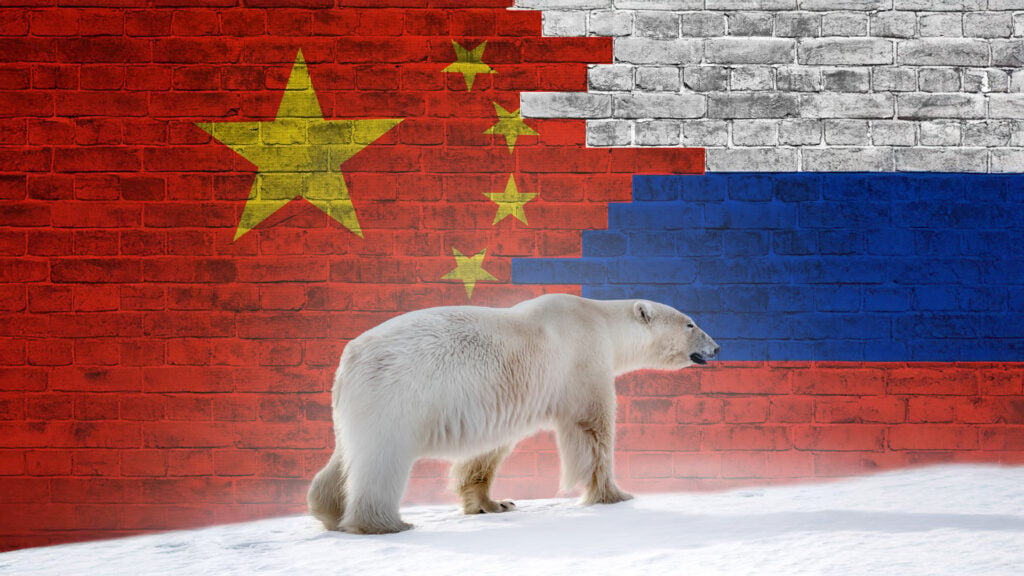
China and Russia finally signed a deal in early September, said Alexei Miller, President Vladimir Putin’s longtime lieutenant and CEO of Russian state gas company Gazprom. The two countries reached the agreement during Putin’s visit to Beijing, where he and some 20 other heads of state witnessed China’s military parade to commemorate the end of World War II in the Pacific Theater.
The deal to which Miller referred was the flagship project “Power of Siberia 2” gas pipeline that will transport 50 billion cubic meters of gas to China annually. It will help fill a significant void for Russian gas pipeline export, left by the 150 billion-cubic-meters per year of pipeline gas previously exported to Europe. Members of the European Union plan to phase out all Russian oil and gas imports by 2027.
The Russian media reported that Gazprom signed a legally-binding memorandum of construction with China. The agreement is for 30 years, though the start date was not specified. The pipeline is estimated to cost $14 billion to construct. It will start from the Yamal Peninsula in northern Russia, stretching through Mongolia to reach China. The total length of the pipeline could be around 4,000 kilometers, including 2,600 kilometers through Russia.
“Talks will now focus on financing the pipeline’s construction and the commercial terms of supply,” said Miller.
The gas price to China will be “objectively lower” than the price to Europe because the gas fields are closer and transport shorter, he also said.
The Power of Siberia 1 had its first production in 2019 and has a capacity of 38 billion cubic meters per year. However, it did not operate with full transport capacity until the end of 2024, partly due to COVID-19. Its final leg reached Shanghai in November 2024. Until Power of Siberia 2 is finished, Russia will supply China with pipeline gas from its offshore gas fields in Sakhalin via an eastern pipeline (Power of Siberia 3) currently under construction. The initial capacity is set to be 10 billion cubic meters per year to start in 2027.
China and Russia have agreed to increase the annual capacity for both pipelines — from 38 billion cubic meters to 44 billion cubic meters for Power of Siberia 1 and from 10 billion cubic meters to 12 billion cubic meters for the Sakhalin pipeline.
The Chinese government and media have not mentioned any specifics about this important deal. Why do the Chinese seem to be so reluctant to commit to this pipeline? What might they be thinking?
The Chinese Side
China has a complex history with Russia. The Qing dynasty was forced to sign a treaty with Russia during the 19th century that conceded a large chunk of land, including the Sakhalin area, to Russia. China’s political disagreement with Russia in the 1960s led to a border war in 1969. Many Chinese citizens have deep-seated suspicions of the intentions of the “polar bear.” U.S. President Richard Nixon and National Security Advisor Henry Kissinger took a historical decision to normalize the United States’ relationship with China in 1972, when China also replaced Taiwan as one of the five permanent members of the U.N. Security Council.
Now, the West accuses China of siding too closely with Russia in the ongoing Russia-Ukraine war. The Trump administration has threatened to put secondary sanctions on China for importing too much Russian oil while Europe and the West are trying to become more independent.
China claims that it is not taking sides, that it had previously signed a strategic partnership agreement with Ukraine and that it is trying to encourage peaceful resolution to the conflict. Compared to his predecessors, President Xi Jinping appears to be less concerned about how the rest of the world views his partnership with Putin. Some believe that China wants to strengthen its partnership with Russia to fend off the increasing political, economic and military pressure from the United States and its allies, especially if China wants to use force to reunite with Taiwan.
In this modern-day “Romance of the Three Kingdoms,” China might want to maintain strategic vagueness about its political ties with Russia, especially while China is engaging in difficult trade negotiations with the United States. Some say that President Trump is trying to do a “reverse Kissinger,” meaning to be closer to Russia to suppress the rise of the Middle Kingdom. Signing a firm agreement to construct the Power of Siberia 2 would be a key milestone in the evolution of the China-Russia relationship.
Despite recent domestic gas production focus and growth, China still could only supply less than 60 percent of its gas needs. For the foreseeable future, China’s gas import dependency will stay around 40 percent. China currently depends upon imports for 70 percent of its oil demand and 40 percent on its gas demand. China is producing more oil and gas in recent years in response to President Xi’s call “to hold the energy rice bowl in our own hands,” and it has greatly increased its domestic investment in exploration and development.
According to the Annual World Energy Statistics Review published by the Energy Institute, China was also the world’s largest gas importer in 2024 and consumed 434 billion cubic meters of gas last year. Its domestic production was 248 billion cubic meters, and the country imported 177 billion cubic meters, representing a 41 percent “foreign import dependency.” Gas imports from Russia were 38 billion cubic meters: 27 billion cubic meters from pipeline,11 billion cubic meters from LNG. Gas imports from Russia represented 9 percent of domestic consumption and 22 percent of total gas imports to China.
Maintaining supply diversity is a key strategy for Chinese energy security. China might have several key factors to consider before committing to the Power of Siberia 2 pipeline.
Economic Considerations
There are three key commercial elements for the pipeline gas deal: gas price, the level of take-or-pay for gas volume and the question of who will pay to construct the Power of Siberia 2 pipeline.
Russia pipeline gas imports represent some of the cheapest imported gas to China, especially compared to liquefied natural gas. From a purely economic point of view, China would benefit from importing more Russia pipeline gas. Knowing that China is just about the only big gas market that could absorb a large amount of Russian gas, Chinese negotiators are reportedly driving a hard bargain to force import gas price from Power of Siberia 2 to be close to Russian domestic gas price level, estimated at roughly $120/1,000 cubic meters, or ($3.5/million British thermal units). That would be substantially lower than the import gas price for Power of Siberia 1, which is reportedly indexed to oil prices. Russia is unlikely to accept the gas price at its domestic gas price level to justify the construction of the expensive pipeline and long-distance transportation.
Russia is in the middle of a costly war with Ukraine. It would benefit from China helping to finance some of the cost for pipeline construction, including the segments in Russia and Mongolia. For Power of Siberia 1, each country reportedly paid for the portion of the pipeline within its borders. China showed willingness to help finance the Power of Siberia 2, in exchange for concessions from Russia on the gas price and take-or-pay level. Typically, the take-or-pay level needs to be around 80 percent to commit to a final investment decision. China is reportedly aiming for a level around 50 percent.
Energy Supply Considerations
China is projected to have to rely on foreign oil and gas imports for the next decade or two, but by 2050, experts predict renewable energy will represent more than half of its primary energy usage.
The Chinese companies project that by 2060, China could be become 90–95-percent self-sufficient for its own energy. Signing a 30-year long-term contract to import more Russian gas until roughly 2060 would be contrary to this renewable energy development.
Will the Power of Siberia 2 gas pipeline will actually be built?