


An integrated geophysical study was undertaken to characterize a deepwater reservoir cluster in the Krishna-Godavari Basin offshore the east coast of India. The seismic data underwent advanced reprocessing and in-house conditioning to optimize it for amplitude variation offset analysis. Using offset well data, rock physics and AVO techniques identified classical anomalies associated with hydrocarbon-bearing sands in a Pliocene-Miocene slope fan complex. AVO cross-plots showed gas sand deviations from wet sand/shale trends, though reliability decreased when anomalies aligned with background trends. Fluid substitution and elastic property analysis further validated prospective zones. To enhance reservoir characterization, simultaneous angle-dependent inversion of four partial stacks yielded P-Impedance, VP/VS, and density volumes, offering improved insights into reservoir geometry, fluid content and lithology – ultimately reducing exploration risk and guiding future drilling.
Introduction and Methodology
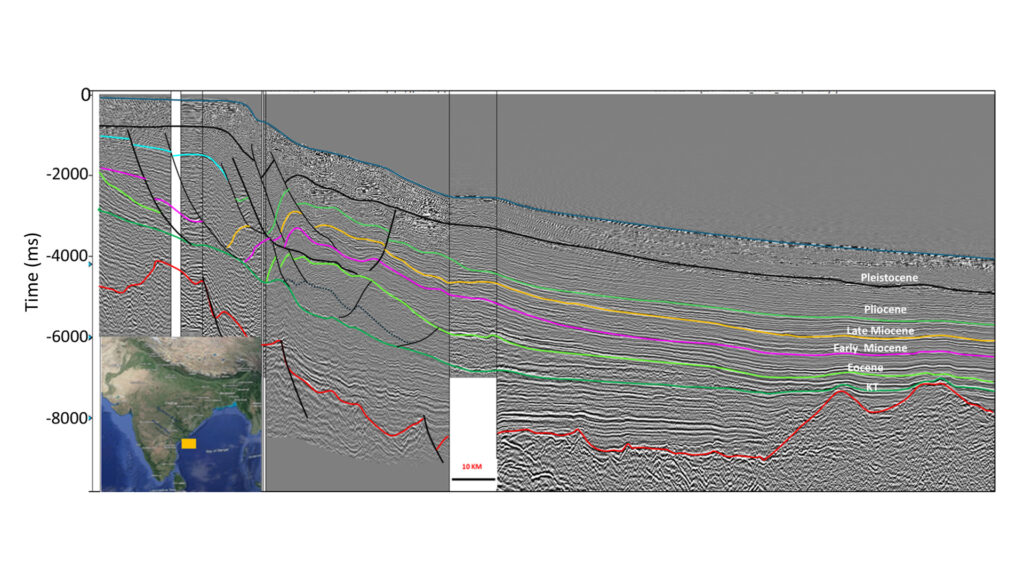
The Krishna-Godavari Basin is a prolific hydrocarbon province formed during continental breakup from Antarctica. Pliocene sands were deposited via slope channels and fan systems, with seismic and drilling confirming their distribution. Exploration targets high-amplitude seismic anomalies linked to structural traps like anticlines and fault closures. Rapid Miocene sedimentation led to growth faults and rollover anticlines, enhancing hydrocarbon trapping (figure 1). In deep water, seismic anomalies help identify gas sands, though reliability might decline in AVO cross plots. This study integrates seismic conditioning, rock physics and AVO analysis to improve reservoir characterization and quantify lithology and hydrocarbon content.
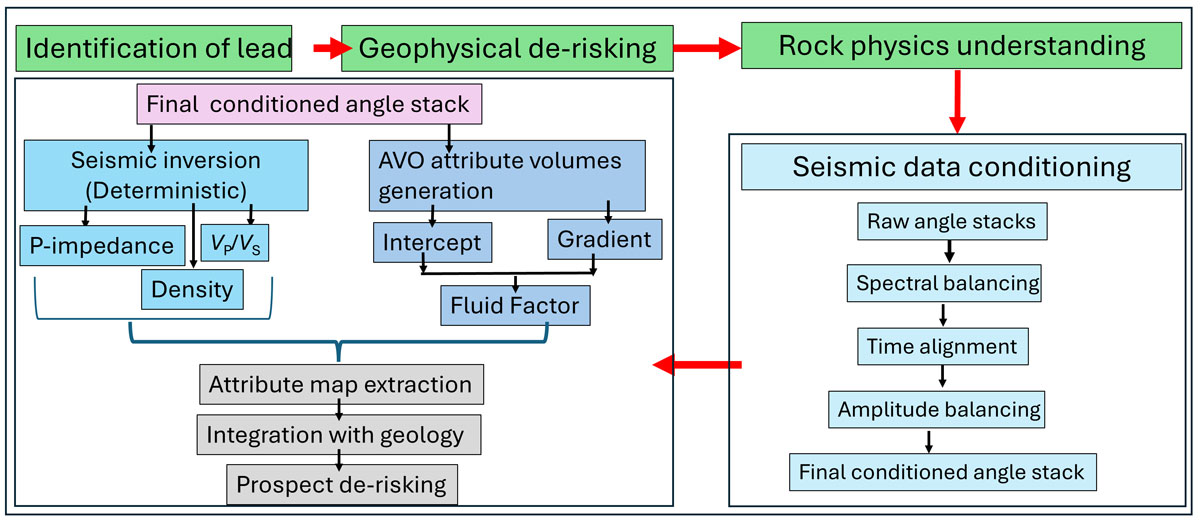
The current study employs a four-stage methodology involving rock physics modeling, seismic data conditioning, AVO analysis and seismic inversion. The workflow adopted is tabulated in figure 2.
Rock Physics Modeling
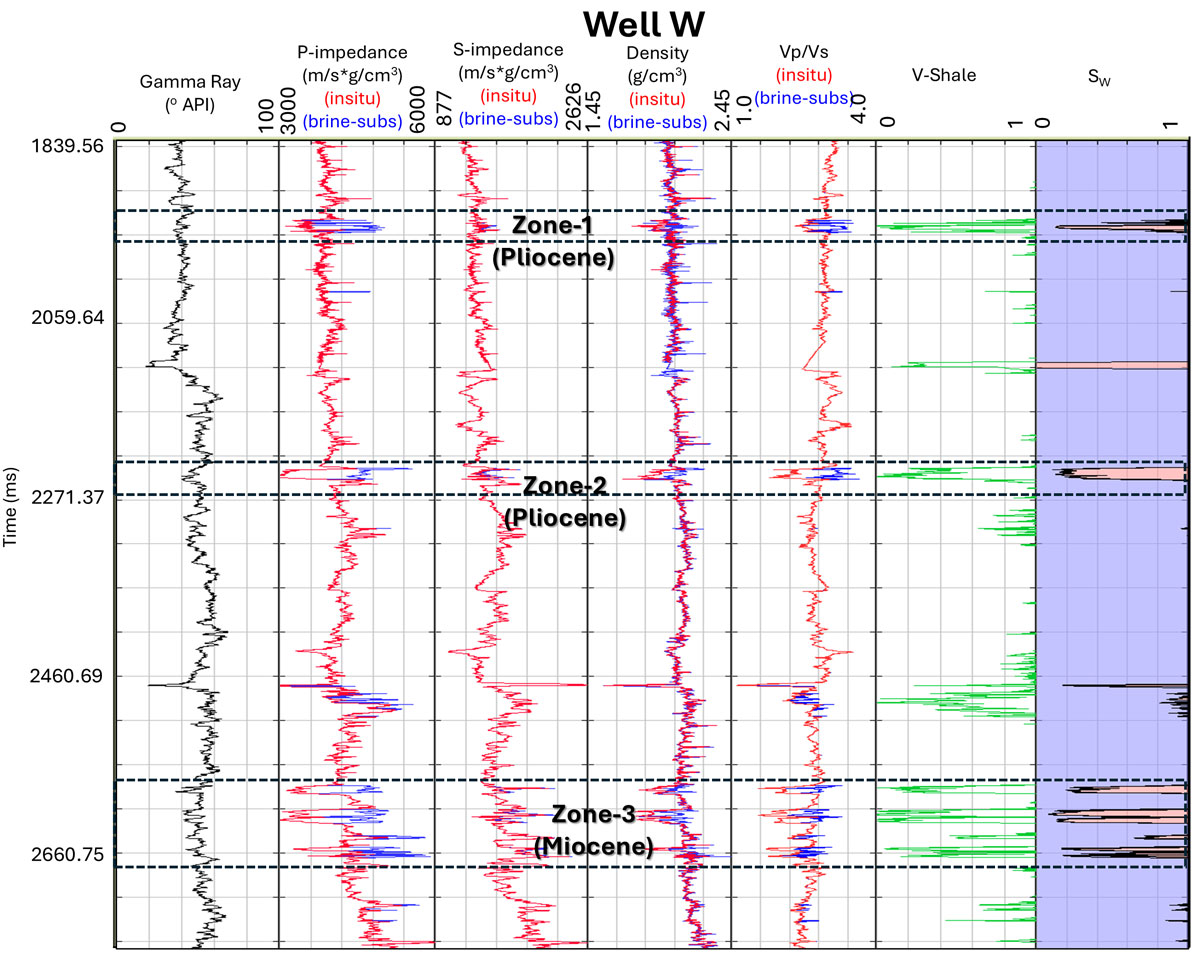
The study area includes offset well W, which intersects hydrocarbon-bearing reservoirs in both Pliocene and Miocene intervals. Detailed analysis of lithology, petrophysical properties and fluid indicators was performed to characterize the reservoirs. Elastic log data from well W revealed a marked drop in P-impedance and VP/VS ratios at the top of the gas sands, indicating a clear gas response (figure 3).
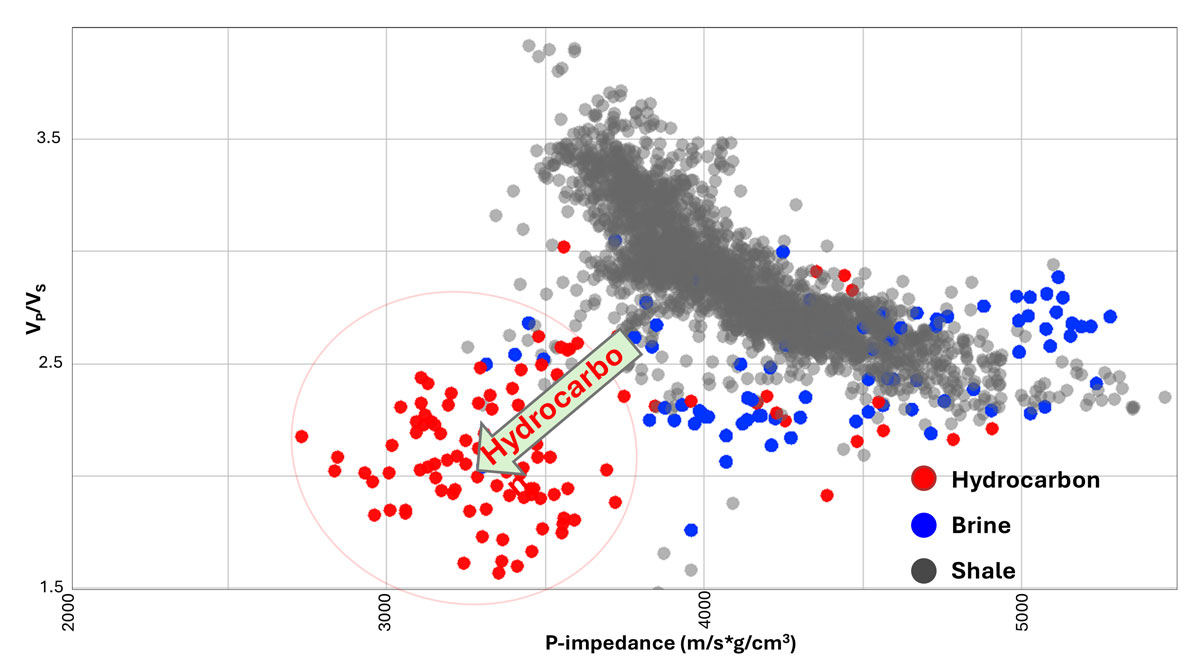
Rock physics templates were built using elastic properties from well logs. Due to thin brine sand layers, fluid substitution modeling via Biot-Gassmann theory was applied to simulate different saturation scenarios. This clarified AVO response contrasts among gas sands, brine sands, and shales. Cross-plots of P-impedance versus VP/VS, color-coded by lithology, revealed that gas sands form a distinct cluster due to lower density and compressional velocity, deviating from background trends. In contrast, brine sands overlapped with shales, enabling effective discrimination of hydrocarbon-bearing zones from non-reservoir intervals and improving seismic interpretation accuracy (figure 4).
AVO analysis at well W was performed to assess seismic responses of gas-bearing and brine-substituted reservoirs across Pliocene and Miocene intervals. Gas sands showed distinct AVO anomalies – Class III in Pliocene and Class II in Miocene – indicating strong offset-dependent amplitude variations diagnostic of hydrocarbons. Brine sands exhibited subdued AVO behavior, aligning with background trends. These contrasts improved hydrocarbon identification and reservoir interpretation. Following successful rock physics and AVO modeling at log scale, seismic data conditioning was undertaken to extend lithology and fluid discrimination to seismic scale. Rigorous quality control ensured the dataset was suitable for advanced AVO analysis and reservoir characterization.
Conditioning of Seismic Data
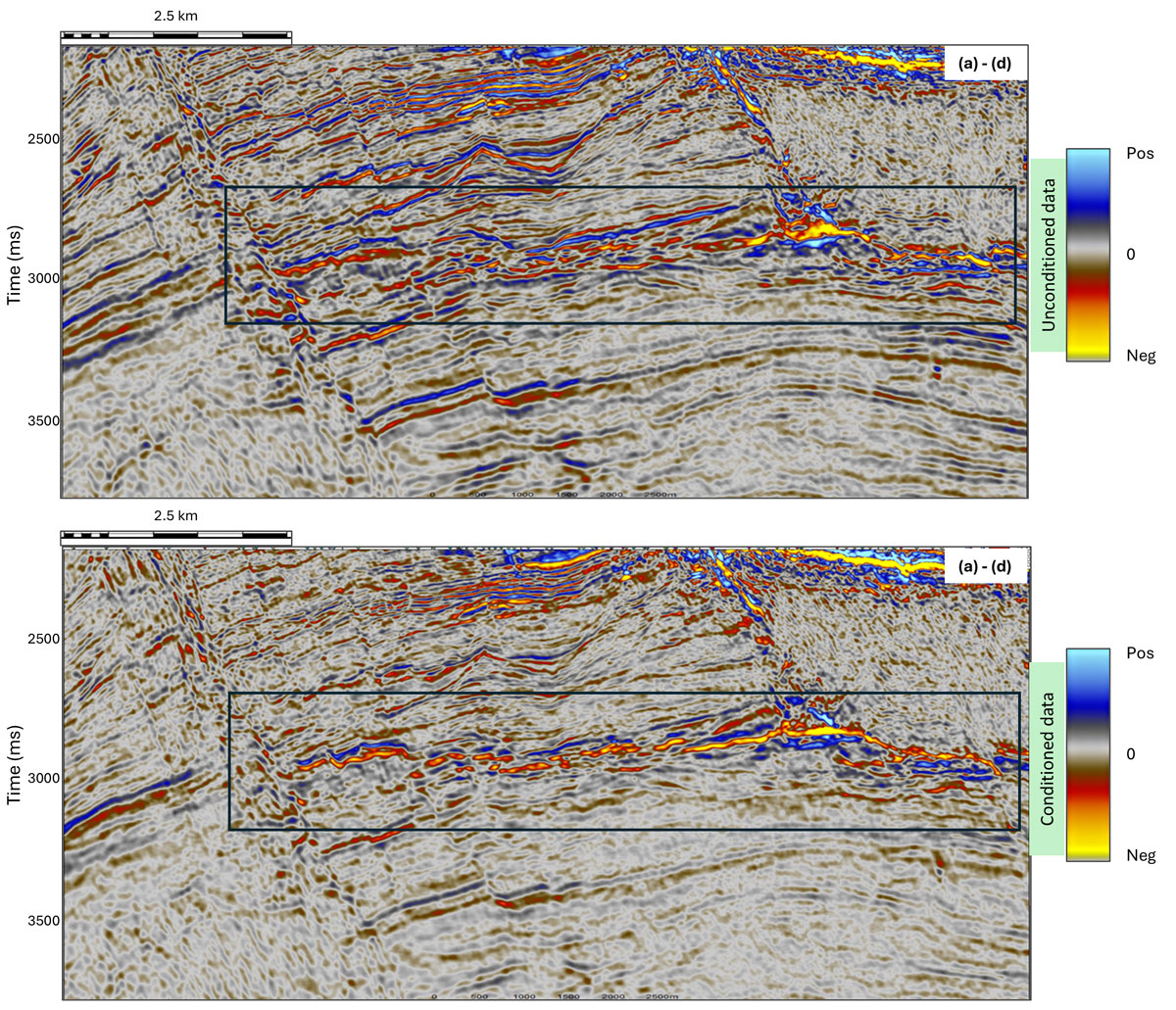
The legacy seismic dataset was reprocessed using pre-stack depth migration with an advanced workflow, followed by in-house conditioning to optimize it for AVO analysis and reservoir characterization. Key steps included spectral balancing to equalize frequency content, time alignment to ensure consistent event positioning across angle stacks, and amplitude normalization to correct offset-related variations. This carefully sequenced workflow preserved data integrity for quantitative interpretation. Comparative analysis showed that conditioned data significantly improved AVO response clarity, reducing background amplitude loss seen in unconditioned stacks and enhancing the detection of subtle stratigraphic features and hydrocarbon indicators.
The conditioning workflow successfully corrected offset-dependent amplitude decay while preserving true amplitude variations. This significantly improved the dataset’s reliability for AVO analysis, fluid discrimination and lithology prediction.
A comparison of different volumes between near and ultra-far angle stacks reveals significant improvements after seismic conditioning. The unconditioned data contains numerous artifacts and persistent background amplitudes, which obscure true subsurface anomalies. In contrast, the conditioned dataset effectively suppresses background noise, allowing genuine amplitude anomalies to stand out more clearly. This enhancement improves the visibility of hydrocarbon indicators and supports more accurate AVO analysis by isolating meaningful seismic responses from clutter (figure 5), thereby refining reservoir interpretation and reducing the risk of misidentification.
AVO Analysis
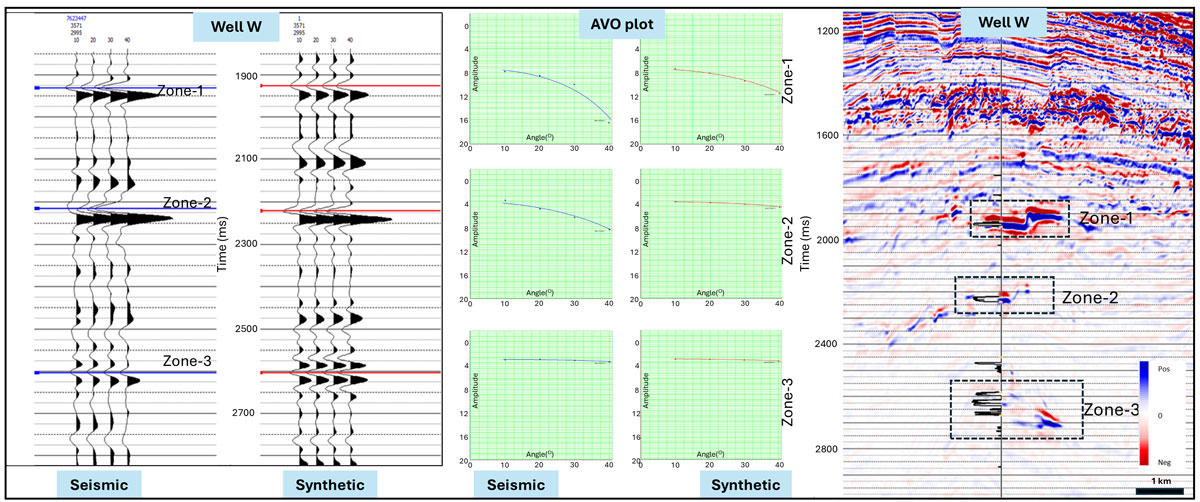
Seismic gather calibration using synthetic gathers from well W was performed to better interpret amplitude anomalies and improve reservoir characterization. The conditioned seismic data showed AVO responses closely matching the synthetic model, with consistent gradient behavior across offsets (figure 6). This alignment confirms that conditioning preserved true amplitude variations and enhanced data fidelity. The strong correlation between real and synthetic AVO responses validates the seismic dataset’s reliability and highlights coherent lithological and fluid signatures. Such consistency is crucial for confident seismic interpretation and accurate prediction of reservoir properties beyond well control.
Integrating the conditioned seismic data and offset well information, a fluid factor volume was generated for the identified reservoir cluster. The fluid factor attribute was calibrated to well data and used to delineate hydrocarbon-bearing sands.
Seismic Inversion
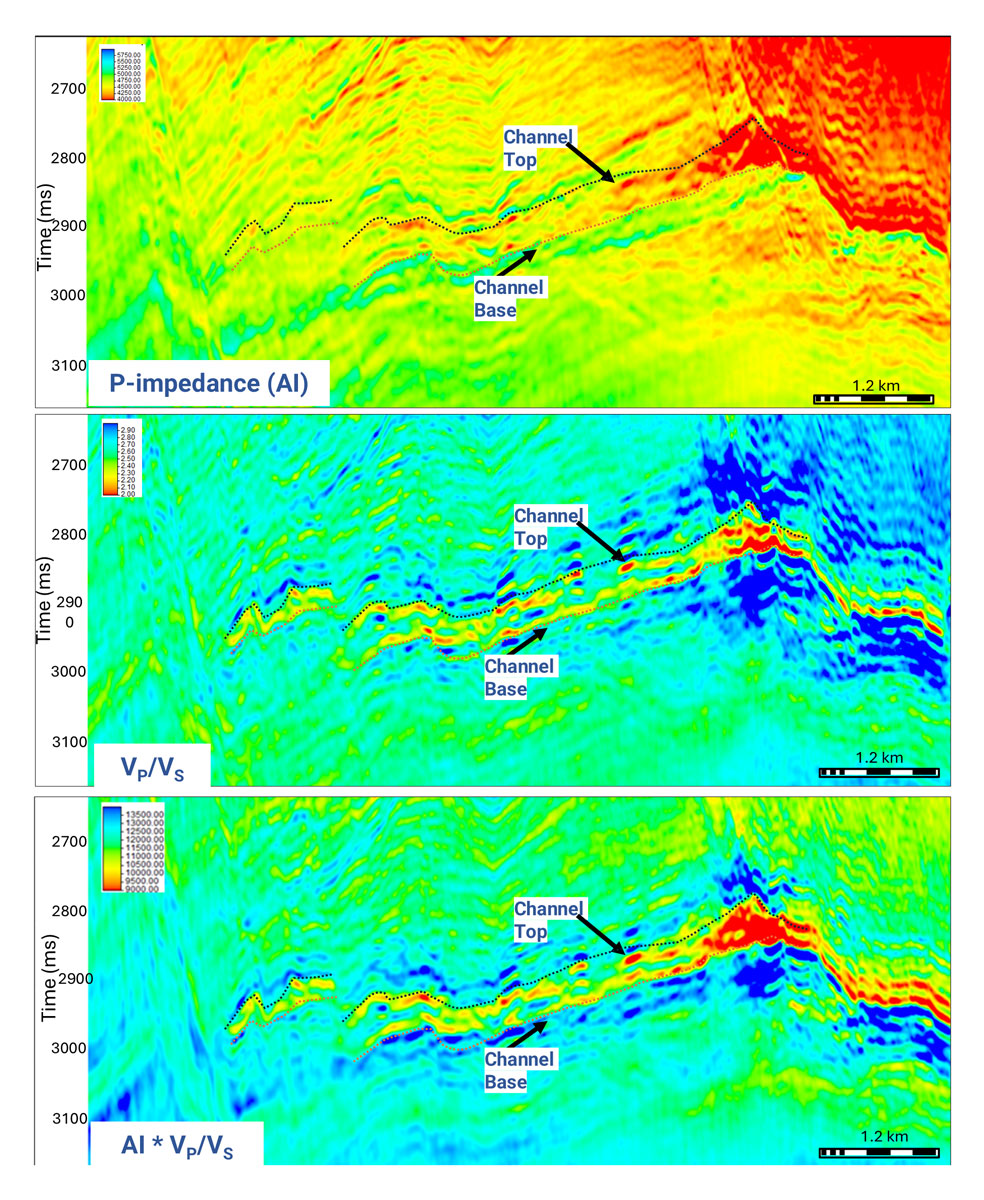
Building upon the AVO analysis and the generation of the fluid factor volume, seismic inversion was undertaken to further characterize the reservoir. A simultaneous angle-dependent inversion approach was employed to transform the conditioned seismic data into elastic property volumes that are diagnostic of the target reservoirs. Four partial angle stacks – from 5 to 15 degrees, 15 to 25 degrees, 25 to 35 degrees and 35 to 45 degrees – were extracted from the PSDM-conditioned dataset were utilized in the inversion process.
Pay sands showed low P-Impedance and VP/VS ratios, indicating hydrocarbon presence. A composite attribute (AI × VP/VS) was derived to enhance gas sand visibility and suppress background lithology, improving reservoir delineation and supporting more accurate subsurface interpretation. (figure 7).
These inverted volumes were subsequently analyzed for geo-body extraction and detailed reservoir characterization, providing valuable insights into the spatial distribution and properties of the reservoir units. This workflow not only enhanced the interpretability of seismic data but also strengthened the predictive capability for reservoir properties away from well control.
Conclusions
This study demonstrates the effectiveness of integrating rock physics analysis, seismic conditioning, AVO analysis and seismic inversion. The rock physics cross plots revealed clear discrimination of hydrocarbons sands against background shale and brine reservoirs. The cluster characterized by low P-Impedance and low VP/VS ratio in the cross plot revealed hydrocarbon anomalies. The conditioned seismic dataset enabled in balancing all angle stacks and generating a reliable AVO response, which, when correlated with offset well W, provided valuable insights into lithological and fluid-related variations.
The fluid factor volume, derived from the conditioned data, proved instrumental in highlighting prospective hydrocarbon zones, thereby supporting risk reduction in exploration and guiding future drilling decisions. To further refine reservoir understanding, simultaneous angle-dependent seismic inversion was performed using four partial angle stacks. This process yielded volumes of P-impedance, VP/VS and density, which facilitated improved delineation of reservoir morphology and supported geo-body extraction.
The integrated workflow – from seismic conditioning and AVO analysis to inversion and attribute calibration – has not only sharpened geological understanding of the target zones but also established a high-confidence interpretive framework. This foundation enables more strategic exploration decisions today and paves the way for predictive reservoir modeling, optimized drilling, and future development planning with reduced subsurface risk.
Disclaimer: The interpretations and results presented in this study are based on technical analysis of available seismic and well data and are intended solely for academic and research purposes. All data have been anonymized to the extent possible. The findings should not be construed as reserves or resource certification and carry inherent uncertainties associated with geophysical interpretation.