
On a dusty lease near Talala in Rogers County back in 1931, an engineer named Bert Collins was about to change Oklahoma’s oil industry forever. Drawing on techniques pioneered in Pennsylvania’s Bradford Field, Collins injected water into a Carter Oil Company reservoir – and the results exceeded everyone’s expectations. That pioneering experiment launched what would become one of the state’s most enduring and profitable recovery technologies, transforming the way operators think about extracting value from mature fields.
Nearly a century later, waterflooding has evolved from those rudimentary experiments into sophisticated, digitally managed operations that combine artificial intelligence, smart water chemistry and real-time reservoir monitoring. The fundamental principle remains elegantly simple: inject water into a reservoir to displace residual oil toward producing wells, maintaining pressure and mobilizing trapped hydrocarbons. What has changed dramatically is the precision with which operators can execute these programs and the financial returns they can generate.
Today, according to the Oklahoma Energy Resources Board, Oklahoma’s oil and gas industry contributes $60.3 billion to the state’s GDP, representing 23 percent of all statewide economic activity and supporting more than 250,000 jobs. As conventional reserves decline and approximately 70 percent of global oil production now comes from mature fields, waterflooding and enhanced oil recovery technologies have become essential strategies for sustaining this economic engine. Private equity firms are taking notice, with capital flowing back into the sector after years of restraint.
From Talala to Tulsa: Oklahoma’s EOR Legacy
The success at Talala quickly transformed Nowata County into the waterflooding hub for the entire region. By the 1930s and ‘40s, operators had established fundamental principles that remain relevant today, including the famous 10-to-1 water-to-oil injection ratio that continues to guide injection strategies nearly a century later. These early pioneers laid the groundwork for what would become a $50-60 billion global EOR market.
Oklahoma’s fields became testing grounds for increasingly sophisticated techniques. The Greater Seminole Field, discovered in 1926 and encompassing 39 separate reservoirs across several counties, reached peak production of 527,400 barrels on July 30, 1927. Early completion techniques often resulted in formation damage and low recovery rates, meaning that much oil was left behind. Operators turned to waterflooding, successfully extending the field’s productive life for decades.
In Lincoln County, the West Carney Field demonstrated the effectiveness of dewatering – producing water to reduce reservoir pressure and push oil into fractures and wellbores. The results were dramatic: ultimate recoverable reserves increased from a modest 38,000 barrels and 500 million cubic feet of gas to an impressive 2.2 million barrels and 16 billion cubic feet. Success stories like these caught the attention of investors looking for proven, lower-risk opportunities in an otherwise volatile sector.
The Healdton Field in Carter County, discovered in 1913, provides another compelling case study. Spanning 8,160 acres with eight waterflood units, 800 production wells and 56 injection wells, the field produces 2,200 barrels of oil per day. Polymer flooding techniques recovered more than an additional 170,000 barrels, with ultimate recovery projected at 2.3 million barrels. Projects like these consistently deliver internal rates of return in the 18 to 25 percent range with payback periods of fewer than six years – metrics that private equity firms find increasingly attractive in today’s market.
The Science Behind Smart Water
While traditional waterflooding has proven its worth over decades, recent innovations have substantially improved recovery rates. The most significant breakthrough involves “smart water” or low salinity waterflooding: reducing the overall salinity of injected water (often to less than 5,000 parts per million) and modifying its ionic composition to alter reservoir wettability. Laboratory and field studies demonstrate that smart water can increase oil recovery by 5 to 30 percent of original oil in place beyond conventional waterflooding.
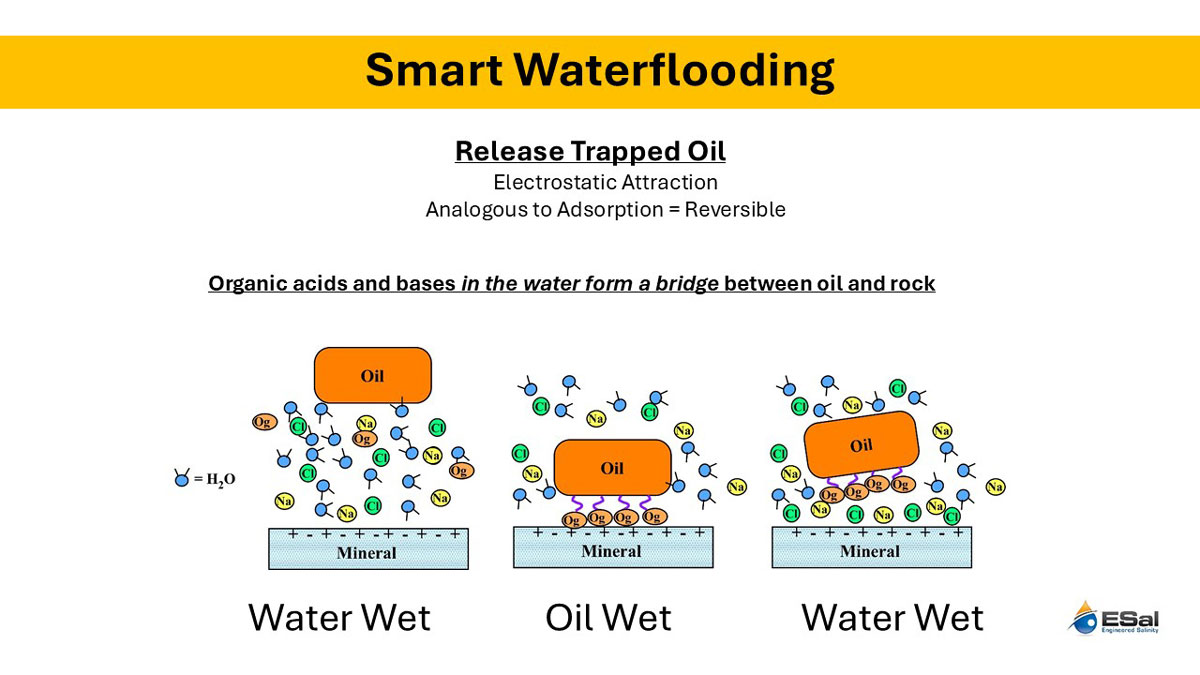
The mechanisms driving these improvements operate at multiple scales. At the molecular level, specific ions – particularly divalent cations like calcium and magnesium, combined with sulfate anions – interact with rock surfaces and crude oil components in ways that change how oil and water behave in the reservoir. Research shows that proper tuning of these “potential determining ions” can shift reservoir wettability from oil-wet to water-wet or mixed-wet conditions, dramatically improving oil displacement efficiency.
Four primary mechanisms work synergistically to enhance recovery. First, wettability alteration occurs when carefully balanced ionic concentrations modify the rock surface properties, reducing the adhesion between oil and rock. Second, electrical double layer expansion increases electrostatic repulsion between oil droplets and rock surfaces when salinity is reduced. Third, multi-ion exchange destabilizes the bonds holding polar crude oil compounds to reservoir rock. Finally, specific ionic interactions can increase local pH, promoting natural surfactant formation through saponification while reducing oil-water interfacial tension.
Field tests consistently show that when smart water is properly designed for specific reservoir conditions – accounting for formation mineralogy, crude oil composition and existing formation brine chemistry – it delivers measurable production increases at costs substantially below other EOR methods.
Digital Transformation of an Old Technology
Today’s waterflood operations bear little resemblance to those 1930s experiments. Modern operators deploy AI-powered digital reservoir management systems that would have seemed like science fiction to Bert Collins. Connected sensors continuously monitor injection and production rates across entire field networks. Machine learning algorithms predict water breakthrough patterns and optimize injection strategies in near-real time. Automated control systems adjust operations dynamically based on performance data, reducing costs while improving recovery.
Leading service companies like Schlumberger and Halliburton have developed comprehensive digital platforms for waterflood management promise to deliver 15 to 30 percent improvements in sweep efficiency while cutting operational costs by 20 to 40 percent.
The integration of Internet of Things technology has fundamentally changed field operations. Remote monitoring reduces the need for personnel in hazardous locations. Predictive maintenance algorithms prevent equipment failures before they occur. Digital twin technology allows operators to virtually test operational changes before implementing them in actual reservoirs. Companies are building high-resolution 3-D models incorporating decades of production data, creating digital representations of their assets that improve with every barrel produced.
This digital transformation extends beyond individual fields. As major operators like ExxonMobil, Chevron and ConocoPhillips divest mature domestic assets to focus on higher-growth opportunities abroad, they’re creating acquisition opportunities for smaller operators and private equity-backed companies that specialize in mature field optimization.
The Investment Case
Several converging factors are drawing capital back to mature field development and waterflood projects. First, the risk profile is fundamentally different from exploration or unconventional development. Oklahoma’s mature fields offer extensive production history, comprehensive geological data including thousands of well logs and core samples, existing infrastructure, and established regulatory pathways. Decades of oil production have created an unparalleled database that significantly reduces uncertainty in reservoir characterization, production forecasting, and project design.
Consider a hypothetical 160 to 320-acre waterflood project targeting the Cromwell Sand in Seminole County at depths of 3,200 to 3,600 feet with 15 to 25 feet of net pay. With 800,000 to 1.2 million barrels of oil in place, the project would require $1.2 million to 1.8 million in capital to drill or convert injection wells, install water-handling facilities and implement monitoring systems. Expected incremental recovery of 80,000 to 150,000 barrels would deliver an IRR of 18 to 25 percent with payback in 4 to 6 years at moderate oil prices. These risk-adjusted returns compare favorably to higher-risk unconventional plays while offering more predictable cash flows.
With approximately 70 percent of global oil production coming from mature fields requiring EOR, demand for these technologies continues growing even as easy-to-access reserves dwindle. Further, waterflood projects increasingly incorporate future carbon capture and sequestration potential. Reservoirs suitable for waterflooding often make excellent candidates for subsequent CO₂ injection, both for tertiary recovery and permanent carbon storage. With Section 45Q tax credits offering up to $85 per metric ton for CO₂ permanently sequestered in saline formations or $60 per ton used for EOR, the carbon capture upside can add $100 million to $500 million in value to large projects. Oklahoma recognized this opportunity early, becoming one of the first states to inject anthropogenic CO₂ underground in 1982 and one of the only states to explicitly recognize the potential to reuse stored CO₂ for industrial and commercial applications.
The Reality Check: Technical and Economic Challenges
Despite nearly a century of commercial success and growing investor interest, waterflooding remains a complex, capital-intensive undertaking with no guarantee of success. Not all reservoirs make suitable candidates. Projects require permeability greater than 10 millidarcies (ideally more than 50), porosity exceeding 12 percent and oil saturation above 35 percent after primary production. Reservoir thickness must exceed 10 feet, and the crude oil cannot be too heavy or viscous for water to effectively displace it. Even when geological conditions align favorably, economic thresholds must be met: break-even costs below $35 to $40 per barrel, minimum net present values of $1.5 million to $3 million, and payback periods of fewer than six years.
Reservoir heterogeneity ranks among the most challenging technical obstacles. Variable rock properties, porosity and permeability cause injected water to flow preferentially through high-permeability “thief zones,” bypassing substantial volumes of oil trapped in tighter formations. In severely heterogeneous reservoirs, operators might recover only a fraction of the incremental oil they initially projected. Advanced conformance control techniques – including selective gel treatments and “pulsing” injection strategies demonstrated at fields like Sho-Vel-Tum – can mitigate these problems but add significant cost and complexity.
Early water breakthrough creates a cascade of operational problems. When injected water reaches producing wells prematurely, water handling and disposal costs escalate rapidly. Typical mature waterfloods produce 10 to 20 barrels of water for every barrel of oil, with some projects exceeding 50:1 ratios. This produced water requires extensive treatment before disposal or reuse.
Formation damage from fines migration presents another persistent challenge. Water injection can mobilize fine particles within the reservoir, causing reduced permeability near injection wells, plugging of flow paths and declining injectivity that requires higher injection pressures or costly well workovers. Research indicates that while controlled fines migration can improve sweep efficiency away from the wellbore, excessive fines detachment near wells causes severe operational problems.
The economic hurdles can be equally daunting in large projects. To tackle an extensive field, waterflood projects can demand substantial upfront capital. These costs strain financial resources, particularly for smaller independent operators during periods of low oil prices. The long-term nature of waterflood projects – typically lasting 10 to 30 years or more – means operators face extended commodity price risk. Projects designed at $70 per barrel oil prices might become uneconomic if prices fall to $40 per barrel for extended periods.
The chemical EOR methods that promise higher recovery – surfactant flooding, alkaline-surfactant-polymer injection – face their own challenges. High concentrations and costs of surfactants, combined with potential adsorption losses on rock surfaces, limited widespread commercial adoption. Polymer degradation at high temperatures or salinities can render the technique ineffective. Laboratory success doesn’t always translate to field-scale results.
The Path Forward: Balancing Opportunity and Risk
Nearly a century after Bert Collins’ pioneering work near Talala, Oklahoma waterflooding stands at an inflection point. The technology has proven itself commercially across thousands of projects worldwide. Modern techniques – smart water chemistry, polymer injection, AI-powered digital monitoring – continue improving recovery rates and project economics. The global EOR market’s projected growth to $60 billion to $111 billion by 2033 signals sustained demand. And Oklahoma’s unique combination of geological knowledge, existing infrastructure, experienced workforce and supportive regulatory environment positions the state advantageously.
Effective projects demand rigorous reservoir screening using comprehensive geological data, disciplined project management throughout the multi-decade project life, realistic performance expectations grounded in actual field results tempering optimistic laboratory studies, commitment to environmental stewardship and community relations, integration of modern digital technologies to optimize operations and long-term strategic perspective rather than short-term financial engineering.
The technical challenges are real and well documented. Reservoir heterogeneity, early water breakthrough, formation damage, water sourcing and disposal, induced seismicity concerns and regulatory compliance all require careful attention. Projects that ignore these factors or attempt to cut corners on engineering rarely succeed. Not every mature field makes a suitable candidate and even well-designed projects sometimes disappoint.
Yet the opportunity remains compelling for well-capitalized operators with appropriate technical expertise. Oklahoma fields with more than 500-million-barrel-recovery potential represent substantial targets for modern EOR techniques. The combination of lower risk than exploration, attractive risk-adjusted returns in the 18 to 25-percent IRR range, growing global demand for mature field optimization, technology advances continuing to improve economics, carbon capture upside adding significant optionality, and proven commercial track record spanning nearly a century creates an investment thesis that resonates with private equity firms and strategic investors alike.
As major integrated companies divest mature domestic assets to pursue higher-growth opportunities internationally, they’re creating acquisition opportunities for specialists who understand the science and economics of secondary recovery. Private equity firms are deploying capital into carefully selected projects. Independent operators are applying digital technologies to optimize existing operations. Service companies are developing new tools and techniques to improve recovery rates and reduce costs.
The future of Oklahoma waterflooding may not generate the excitement of a major new discovery or the rapid growth of an unconventional play. But in an industry increasingly focused on capital discipline, shareholder returns and maximizing value from existing assets, the steady, predictable cash flows from well-managed waterflood projects hold undeniable appeal. From Bert Collins’ 1931 experiment to today’s AI-powered operations, Oklahoma has demonstrated that patient capital, sound engineering and continuous innovation can extract extraordinary value from reservoirs that others might write off as depleted. That legacy continues as a new generation of investors discovers what Oklahoma operators have known for nearly a century: there’s still plenty of oil left to recover.