
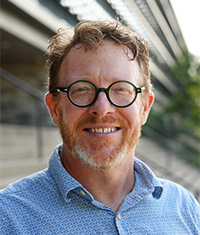
Clay Morton, this year’s AAPG Foundation’s
Teacher of the Year, was not a good student.
But don’t take our word for that. Here’s what he said about his
time at Fayetteville High School:
“As I look back on those days, I am disappointed in my
performance,” Morton wrote in his treatise, “Philosophy of
Teaching.” “I didn’t apply myself, and I was a lackluster student.”
There are reasons why he and millions – billions? – of others
have the same experience, he said. Lack of maturity, irrelevant
material, uninspiring classes, etc., etc., etc.
But also, this: “I don’t have any recollections of anyone
within the (high school) system emphasizing the importance of
education.”
Unexpectedly, that last one proved to be a good lesson
to remember. Because after a bad start to his college career,
followed by a “gap year” that stretched into three, Morton
decided to once again give education a try.
“The education classes I was taking were just slightly less
interesting than watching paint dry,” he said of his early days at
the University of Arkansas, “but the geology class I was taking was
fascinating!”
Being outdoors and close to nature had a lot to do with that,
but so did the fact that his professor, one Walter Manger, “had an enthusiasm that was contagious.
“Not only did Dr. Manger instill in me
a passion for geology,” Morton said, “he
showed me how wonderfully influential a
great teacher can be.”
‘Infectious Enthusiasm’
We’ll have more – much more – on Walter
Manger in a moment. But to finish the point,
Morton’s appreciation for both geology and
education, thanks to Manger as his teacher
and mentor, gave him a new purpose in life.
“He pushed me to do my best,” Morton
said, “(and) his encouragement and
relentless support made me feel as though
there was someone that always had my
best interests at heart.
“His constant guidance helped me to set
myself up for success after graduation,” he
added.
“Those were magical times … we
learned deeply, worked hard, and we had a
lot of fun,” he said.
“It is no doubt true that I caught the
infectious enthusiasm for earth sciences
from Dr. Manger, and I believe that
enthusiasm is contagious enough that
it is caught by a fair number of my own
students.”
After graduating from the University
of Arkansas with a master’s in geology,
Morton was a professional geologist
working a shale play in the Arkoma
Basin. But after five years – and with the
inspiration of Dr. Manger on his heart
– Morton decided to change careers,
switching to education.
Interestingly – or perhaps, perfectly –
Morton is right back at Fayetteville High,
where he has taught for the last 13 of his
19 years as a teacher, currently teaching
AP environmental science. He also has
taught chemistry, environmental science,
physics and concurrent-enrollment geology,
which he created – the first of its kind in
northwest Arkansas.
“Twelve years ago, I inherited 17 AP
environmental science students from a
colleague, and over the years the course
has grown to 118 currently enrolled
students,” he said, adding that concurrent
geology is also in the works for next year.
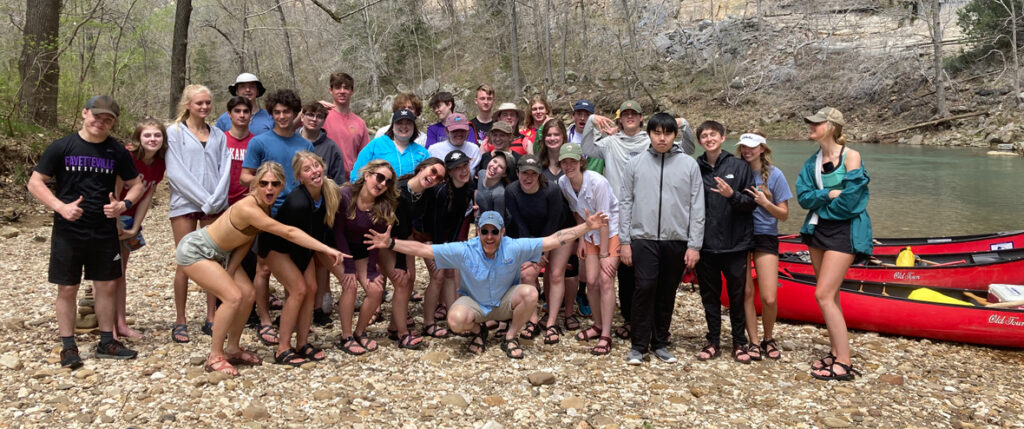
He ”demands” that his students engage
with the environment and the community
– his classes include expert speakers,
ambitious field trips, independent book
clubs and discussions and “a substantial
outside-of-class commitment.”
The daily structure of his classes?
Conversational.
“Constant questions to the students,
with group discussion,” he said. “The design
is to engage each student daily, and to get
them talking, thinking and engaging with
both the content, and with each other.
“Constant themes that overlie every
unit,” he said, “are the importance of
good communication, the value of critical
thinking and problem solving, and the value
of a high-quality education.”
“His teaching style is unique and
compelling,” FHS counselor Lesli Zeagler
said of Morton’s approach. “He consistently
brings his students into the physical world
of geology, environmental ecosystems,
botany, natural resources, conservation,
and the symbiotic relationship between all
of these things by taking them out of the
traditional classroom setting and into the
environment around them.
“His unwavering dedication to fostering
a positive, inclusive and intellectually
stimulating environment,” Zeagler said,
“has made a profound impact on both
students and colleagues alike.”
The Timeless Connection
Which brings us back to Dr. Walter Manger.
“Simply put, I want to be the kind of
teacher for them that Dr. Manger was for
me,” Morton said.
“I strive to develop a strong relationship
with each student, constantly remind
them of the importance of a high-quality
education, constantly encourage them to
do their best, and to help them out in any
way I can,” he said, “both while they are
currently my student, and forever after.”
And here’s where the story goes beyond
Fayetteville, beyond the AAPG Foundation,
beyond even geology.
As told recently by CBS News reporter
Steve Hartman, Morton learned a few years
ago that Manger had been diagnosed with
Alzheimer’s disease – and “the thought of all
that genius and gentleness going to waste”
was more than Morton could bear.
“So,” Hartman said, “(Morton) set out to save as much of his brilliance as possible.”
Morton decided to meet Manger
monthly at Fayetteville High – Manger’s
wife, Peggy, provides the transportation
– where they go over his “treasure trove
of geological knowledge.”
Manger doesn’t remember where the
room is and doesn’t remember what the
teacher and student discussed the last
time they were together – but when he
sees his old geology slides and samples,
Manger comes alive, explaining the rocks
and samples and materials perfectly.
And Morton takes notes. Because, of
course he does. Education doesn’t end at
the bell. Neither do relationships.
As Hartman reported, “Almost
everything I learned about teaching was
from you,” Morton tells Manger.
Manger might not remember those
words. But that’s no problem for Morton.
“It’s nice to be able to tell it to him
over and over again.