There is plenty to see within the city of Medellín, Colombia. The former home of infamous drug trafficker Pablo Escobar and the country’s second largest city is filled with history, culture, standout food and coffee and so much more. It’s even a great example of how infrastructure changes can promote safety and overall wealth: The metro system, including its cable cars, connected the outer parts of the city, located on mountainsides, with the inner portions of the city, providing jobs and educational opportunities that were once unreachable. Once one of the most dangerous cities in the world, it is now safe to visit and enjoy.
The city is located in Colombia’s northwest, in the southwestern part of the state of Antioquia. According to educational website Geotechnica Facil, “Geographically, (Medellín) is located in the Aburrá Valley, on the Central (region of the Andes) Mountain Range. The geology of Medellín is characterized by a Paleozoic metamorphic basement, ultrabasic igneous rocks, volcanic-sedimentary sequences, intrusive granitic bodies and slope and alluvial deposits.”
I’d recommend starting your stay with a walking tour of the city – a great way to briefly see some of the main tourist attractions and learn about the region’s history. Many tours will touch on the Colombian civil war in the 1960s, the violent reign of Pablo Escobar and the Medellín cartel during the 1980s and 1990s, the influence of FARC and other guerilla groups, as well as the more positive recovery and rebuilding efforts since.
Once you’ve gotten a sense of the events from which the region has recovered, wander through the mural-filled streets of Comuna 13, the neighborhood that was once home to Pablo Escobar and is now a street art, café and tourism haven. Walk up and down the hills and find the perfect souvenir.
Most of the year, you can also catch a soccer game at Medellín’s stadium and experience the cultural phenomenon that is Latin American fútbol. Throughout the city, you can enjoy traditional Bandeja Paisa (a platter filled with white rice, red beans, beef, chorizo sausage, fried plantains, pork belly, a fried egg, an arepa and avocado).
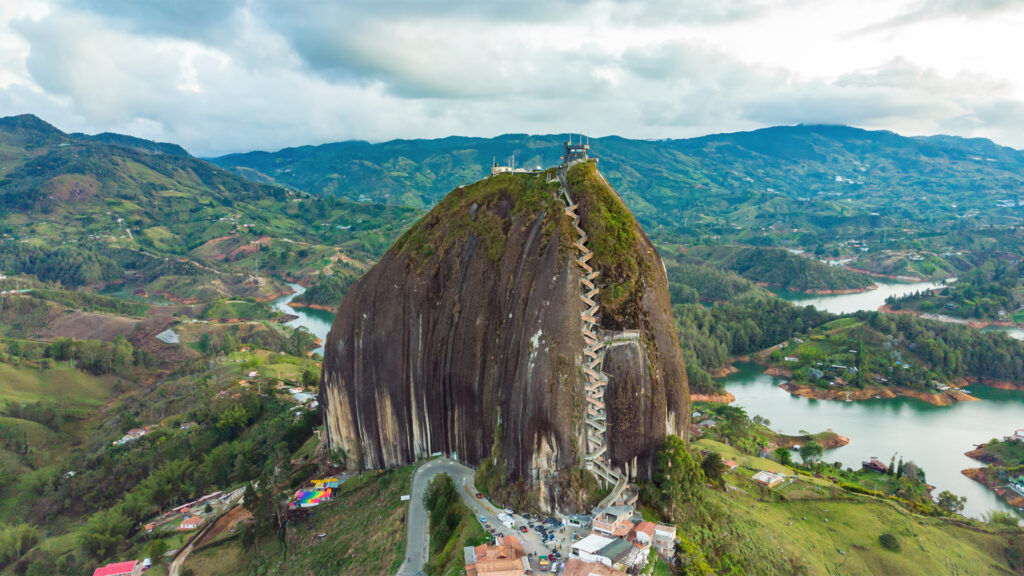
When you’re ready to venture out a bit farther, or just ready to get your geological travel fix, take a day trip to the neighboring town of Guatapé to see El Peñón de Guatapé, also known as La Piedra de Peñól.
El Peñón de Guatapé is a 720-foot-tall granite rock with a signature cleft running diagonally down its face. It formed due to volcanic activity and erosion. Earthquakes and other seismic events might have contributed, according to some sources. It was once a sacred place for the indigenous populations living in the area, the Tahamí.
Trip Tips
How to get there: I’d recommend staying in Medellín’s El Poblado neighborhood. It is considered among the safest and most tourist-friendly neighborhoods in Medellín. It’s also near to plenty of public transit options and provides easy rideshare pickup options. From El Poblado, you can book a day tour, take a taxi, or Uber to Guatapé. The drive is roughly two hours.
Coffee stop: Before you head out, grab a cup of local coffee! The region is among the best in the world for the staple caffeinated pick-me-up. I’d recommend Pergamino in the El Poblado or Laurales neighborhoods. The Laurales location is near the university (through which you can take an enjoyable stroll) and features a peaceful and ambiance and outdoor courtyard where you can sip your early morning cup of joe.
While in Colombia, I’d also recommend trying Cascara, a tea made from dried and fermented coffee cherries. In my opinion, it’s somewhere between black tea and kombucha in flavor, and the versions I have tried in the United States do not even come close to doing justice to the cups I had in Colombia. If you wish to dive even deeper into coffee farming near Medellín, I’d recommend taking a separate day tour to D’Arrieros Coffee Farm about 40 minutes from the city. The farmers there will walk you through the coffee-growing process from bean to brew, and you can even ride a mule through a nearby village to get a better sense of the smaller towns outside Medellín’s bustling streets.
Viewing the rock: El Peñó de Guatapé has 740 steps that zig zag up one of its sides, allowing visitors to scale the formation and witness panoramic views of the surrounding town and greater area. The steps are numbered, so you can track your progress as you ascend to a viewing platform. If climbing that many stairs is not for you, book a boat tour to see the rock from the nearby El Peñól Guatapé Reservoir. You won’t get to see the views from up high, but you will get to enjoy the serenity of being on the water. If you want even more adventure than simply hiking up the stairs to the top of the rock, there are tours that offer rock climbing and rappelling options.