
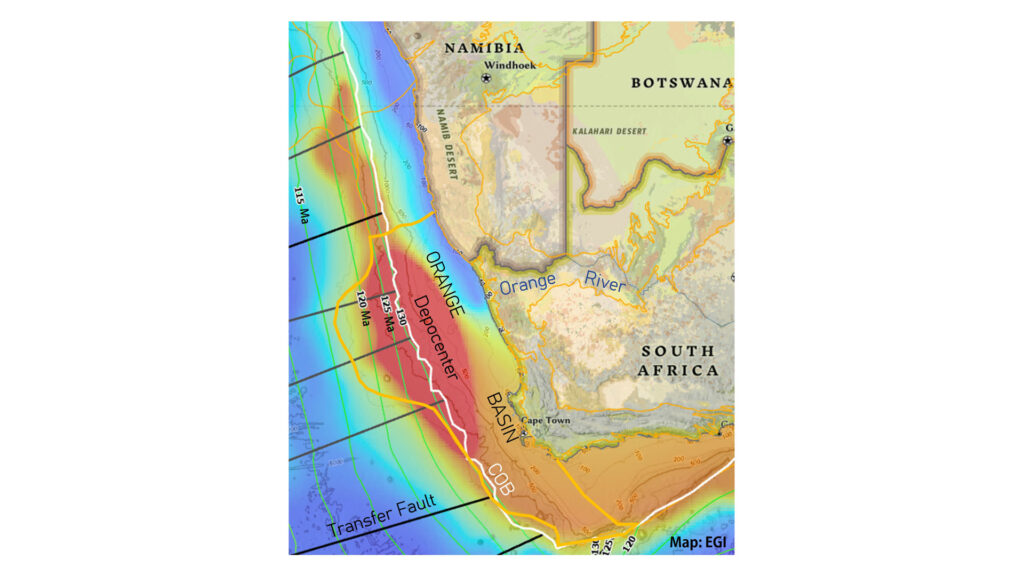
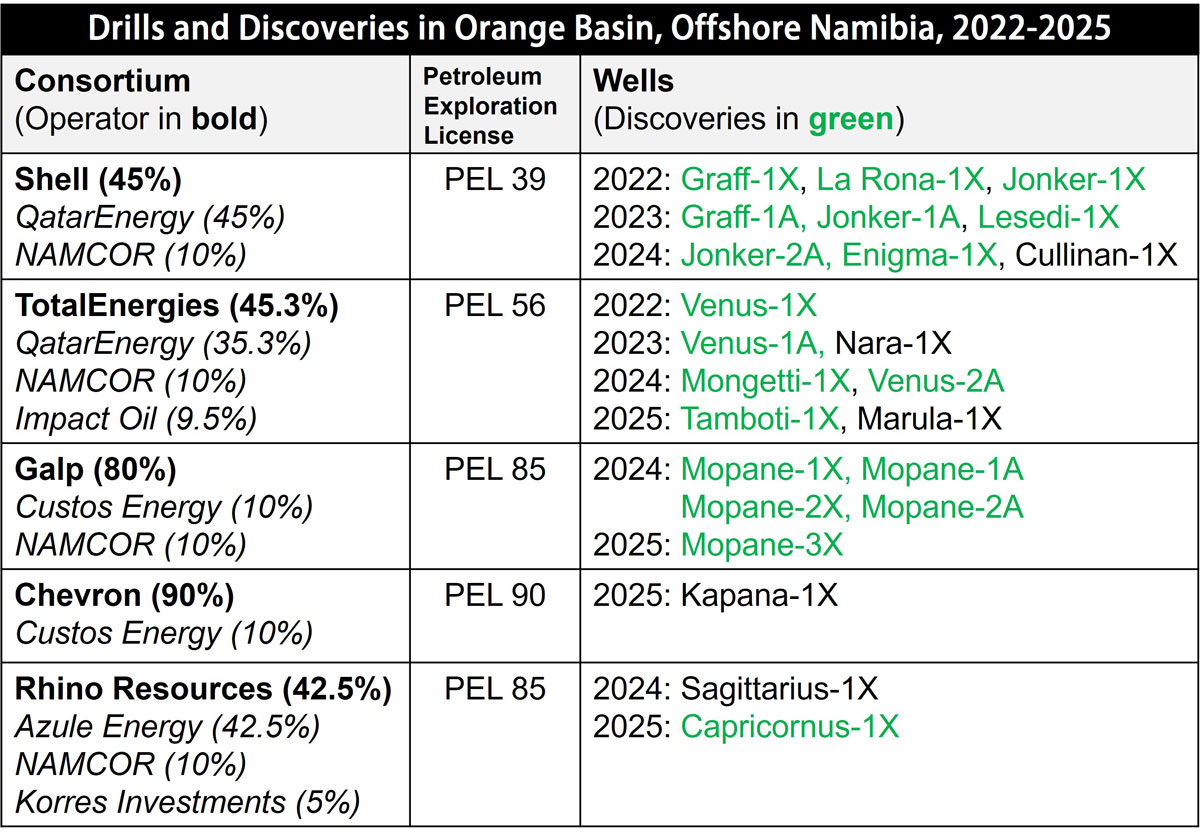
In 2022, as the petroleum industry along with the world was coming out of the COVID-19 pandemic, Orange Basin offshore Namibia became a hotspot for petroleum exploration, thanks to two ultradeep water discoveries: Graff by Shell and Venus by TotalEnergies. Much has happened since then. Let’s take a look.
Orange Basin – named after Orange River on the Namibia-South Africa border – is a major sedimentary basin on the South Atlantic margin straddling between Namibia and South Africa and delimited by two transfer faults: Lüderitz to the north and Agulhas in the south.
Flashback
Prior to 2022, only a few discoveries had been made in Orange Basin. In 1974, Chevron discovered Kudu gas field in Barremian-age eolian sands with proven reserves of 1.3 trillion cubic feet, but the field has remained unproductive because of a lack of infrastructures and major local market in Namibia. Discoveries of A-J oil field in 1988 and Ibhubesi gas field in 1991 put South Africa on the petroleum map. In 2012 Petrobras drilled Kabeljou-1 and in 2013 HRT drilled Moosehead-1 in the Namibian Orange Basin, but both were dry. These two Brazilian companies had hoped to find sub-salt plays analogous to Brazil’s Santos and Campos basins.
Rift to Drift Geology
Orange Basin originated in latest Jurassic (about 150 million years ago) when Western Gondwana began splitting along what today is the South Atlantic margin. The process started off as a continental rift with half grabens filled with clastic and lacustrine sediments. These syn-rift sediments are buried deep under the continental shelf of Namibia and South Africa. During the period 123-132 million years ago, flood basalts, most likely related to the Tristan mantle plume, invaded the basin and marked the transition from continental rift to ocean-floor spreading. Etendeka volcanics onshore Namibia are remnants of this volcanism. The basalt flows, probably also interspersed with sediments, form sea-dipping reflectors imaged on seismic sections at the base of Orange Basin beyond the continental rift basins.
By the end of the Barremian (121 million years ago) thick marine shale filled the basin. From the Aptian to the Maastrichtian (66-121 million years ago), Orange Basin as a passive continental margin was filled with deltaic, shallow marine and deepwater sediments with several stratigraphic sequences separated by eustatic changes. As the Cenozoic began thermal sagging of the crust beneath Orange Basin ended and a stable continental shelf was established. The Maastrichtian shelf and slope became accommodating space for Cenozoic sediments. Growth faults at the shelf edge and toe-thrusts in the distal deep basin dismembered Upper Cretaceous and Tertiary sediments.
Petroleum Plays
Drilling of (even dry) wells in Orange Basin has provided key information on the availability of organic rich (3-14 percent total organic carbon), thermally mature (in oil to wet gas/condensate windows) source rock formations with mainly kerogen type II – particularly at Barremian, Albian, and Turonian stratigraphic horizons.
Reservoir rocks are mainly marine sandstones of Early Cretaceous age (Kudu, Ibhubesi, Venus and Capricornus fields) and Late Cretaceous age (Graff, Jonker, La Rona, Lesedi, Enigma, Mangetti, Tamboti and Mopane fields). Syn-rift Hauterivian-age sediments also have good potential for lacustrine source and reservoir rocks as evident from A-J1 oil well in South Africa. However, these rift basins are restricted and smaller than the widely-spread passive margin plays atop them.
Both updip landward migration via carrier beds and vertical migration via faults have accumulated oil and gas in a combination of stratigraphic and structural traps. Basement structures and facies changes in the basin fill have controlled trap locations.
Challenges and Opportunities
In January 2025, when Shell wrote off about $400 million in exploration costs in its acreage in Namibian Orange Basin, it came as a shock to the industry. Shell had drilled six exploration and three appraisal wells and had made significant discoveries in Orange Basin. Reservoir quality, particularly low permeability and high gas-to-oil ratio were cited for Shell’s concerns about commercial production in its fields.
The low permeability of reservoir rocks is due to pore clogging by clay or chlorite or secondary calcite cementation. High gas contents will require optimized production strategies and long-term reservoir management to avoid gas bubble-out at the expense of oil production. Low reservoir permeability and/or high gas content have also been cited for most of the wells drilled in Orange Basin.
Two events in 2026 will be important for the future in Namibian Orange Basin. First, TotalEnergies has postponed its final investment decision to develop Venus to 2026. If the company decides to go ahead, Venus will come onstream by 2030. Second, Oslo-based BW Energy is planning to develop Kudu gas field in 2026. If this materializes, it will help build critical infrastructures in Namibia for natural gas field development.
The maximum width and depth of Orange Basin is fashioned by the Orange river delta and further exploration is expected to focus on this depocenter. Namibian discoveries have attracted international attention to Orange Basin and there are still a few undrilled prospects (for example, Ushivi in PEL 56 and Olympe in PEL 91) in Namibia. However, most of Orange Basin is located offshore South Africa. Currently, TotalEnergies and Eco Atlantic (Azinam) are well positioned in South African Orange Basin.
For 24 wells drilled in the Namibian Orange Basin since 2022, success rate of 75-percent is impressive. Nevertheless, drilling in water depths of 2,000 meters into reservoirs 3,000 meters or deeper below the sea floor is a costly venture and the exploration will require derisking geological factors and suitable economic propositions.