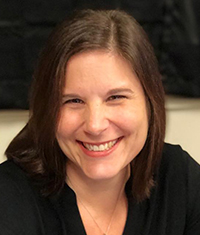
You could call it destiny – Sabrina Ewald’s
family history, after all, is dominated
by those who either worked in the oil
industry or were teachers.
“My father worked at an oil refinery, my
uncle had a career in oil exploration and
extraction, and even my grandmother worked
on an offshore oil platform,” she said. “My
mother was a teacher, and I had many family
members who were teachers at all levels of
academia.”
Add in frequent family trips spent hiking
in the Ozarks and Rocky Mountain National
Park – plus her own love of collecting rocks
and minerals.
“These experiences shaped my plan for
the future, and I always had two ideas of what
I wanted to do with my life – geologist or
teacher,” she said.
Guess what won out?
Trick question. The immediate answer is
“both”: Ewald has been a high school science
teacher for her entire career – and for the past
16 years for the Frisco (Texas) Independent
School District, bringing science and,
specifically, geology and energy education to
high school students in Clinton and Denton
counties, covering Frisco, McKinney, Plano and
Little Elm, Texas.
But the winner in the bigger picture is not
just her, and not even just her students. “What”
is winning is best described as perhaps the
entire contemporary initiative to bring via the
ripple effect a deeper and more complete
understanding of energy to the entire world.
Ewald’s teaching method and purpose is
designed specifically to help students “have a
better understanding of why fossil fuels are so
imperative and so important to the economies
all over the world” – and to help them be
informed and energy-aware when, as adults,
they make decisions.
For her passionate, comprehensive and
experience-driven efforts – and for being
exceptionally creative in a difficult year of
pandemic-forced virtual learning – Sabrina
Ewald is this year’s AAPG Foundation Teacher
of the Year.
“I am beyond humbled and honored to be
selected for doing what I love most, teaching
Earth science and helping students make
real-world connections by engaging in handson
learning,” Ewald said when notified of the
award. “I am fortunate to teach about what I
am most passionate”
“It is a blessing to be recognized for my
work in the classroom in helping students to
see the value and importance of geology,” she
added.
Preparing for Tomorrow’s Challenges
Having the perfect family background to
help her prepare for a career that includes
teaching and geology is a tip of the hat to her
parents. The excellence that she brings to the
job, however, is all hers.
Several factors are considered for awarding
any teaching honor, but TOTY recipients are
typically recognized for at least two important
factors: what they teach, and how they teach
it.
Ewald’s Energy Unit Portfolio, then, is an
online piece of geoscience education art – a
creative yet practical and engaging learning
experience that lets students learn at their
own pace, including opportunities to make
conclusions and personal observations about
the material they just studied.
Her goal: For all students to ultimately
create the best energy plan for the city of
Frisco, Texas (home for many of the students),
based on what they learn in the units about
the energy industry – considering personal
needs, society’s needs, economic realities and
environmental concerns as factors in their
decisions.
To help them prepare their
recommendations Ewald provides curriculum
that is both entertaining as well as educational,
dealing with:
- Mining (How much land is needed to
sustain your lifestyle? Other than food, can
you name one thing in the room that isn’t
connected to mining?) - Energy Resources and Production
(How much energy is needed for you to take a
shower?) - Fossil Fuels and Production (What
country is producing what? What country is
consuming what?) - Oil Production Methods (Comparisons
galore – like, how much energy is needed
to operate an electric car versus an internal
combustible engine car? And … frac’ing?) - Nuclear Energy (What are the pros and
cons?) - Renewable Energy (What? There might
be environmental impacts here, too?)
It proved to be not just educational, but an
eye-opener for all.
Before taking the course, “they didn’t have
a whole lot of solid information or knowledge
about any of this,” Ewald said, despite being
residents of a region associated with oil
production.
“I would say 90 percent of them (students)
admitted that their opinion changed
dramatically about fossil fuels,” Ewald said,
especially in considering “the balance of
moving forward (toward renewables) … it’s
going to be a slow transition, and one that
they still support, but they have a better
understanding of why fossil fuels are so
imperative and so important to the economies
all over the world.”
The Teacher Gets Taught
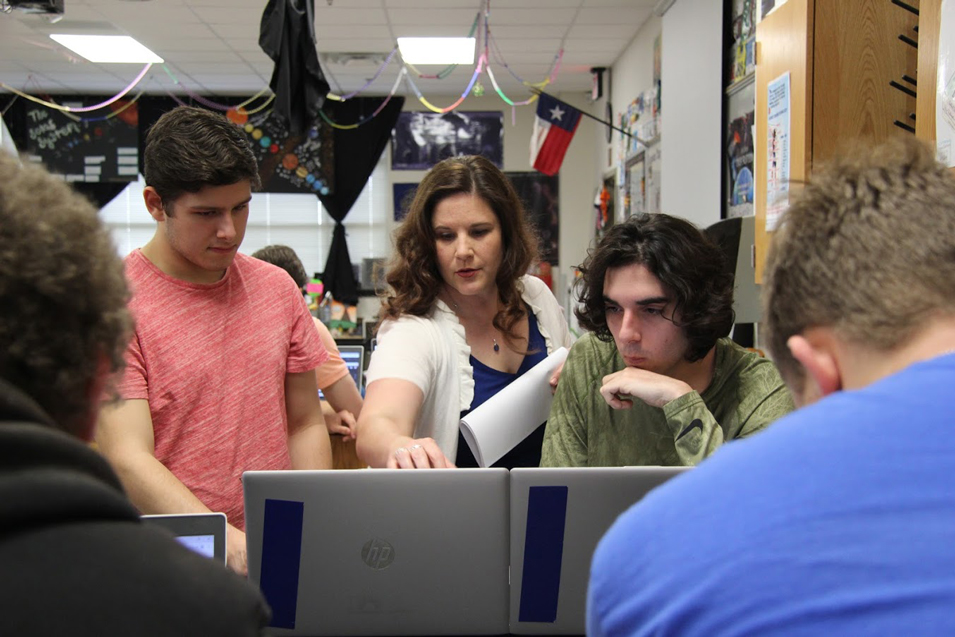
Ewald’s approach to geoscience education
for her entire career has been “hands-on
engagement,” trusting that students both
comprehend and also retain information faster
and longer when they are exposed to that
learning experience.
Then came the 2020 pandemic.
“When virtual learning became our reality,”
she recalled, “the challenge pushed me into
new and scary territory. I re-evaluated my
teaching practices to find innovative ways
to design activities that would still allow
students to be in charge of their learning and
be engaging.”
It wasn’t easy.
“It has taken every ounce of my experience
in the classroom to adapt to our new reality
in education,” she said of the challenge,
but added “I am passionate about the
subjects I teach, and that is what drives me
to continuously improve and push myself
out of my comfort zone so I can evolve my
classroom practices.”
First, she spent hours learning how to
implement new online tools and programs.
Second, she spent hours more converting her
lessons to the new virtual platforms.
“With these new skills and programs, I was
able to convert many of my activities in our
natural resources and energy production unit
to virtual activities,” she said.
Next, she found resources that were
current, creative and content-driven.
Participating in a variety of teacher
field experiences helped, including mining
workshops and the Geology Camp for
Teachers with Texas A&M. (“I developed a
deeper understanding of geology, more so
than from some of my courses in college,” she
said.)
Also, last July she participated in a fiveday
workshop with the University of Texas’
Petroleum Technology and Science Institute –
an in-depth look at petroleum engineering, the
global energy market and current technologies
used in oil production and energy extraction.
It proved to be relevant information for
today’s high school students whose insight
into energy is largely gleaned from political
sources.
“The advanced technologies work to
minimize environmental damage and the
instructors addressed the integrating of
renewables with existing fossil fuel use,” she
said. “Once again, I was able to enhance my
knowledge and comprehension of fossil
fuels, and I have been using these resources
to create new virtual, learner-centered
assignments.
“All of these efforts reflect back on my
philosophical approach to teaching,” she said:
“Being the best teacher I can for my students
and giving them a caring and engaging
educational experience by delivering studentcentered
inquiry and investigations.”