


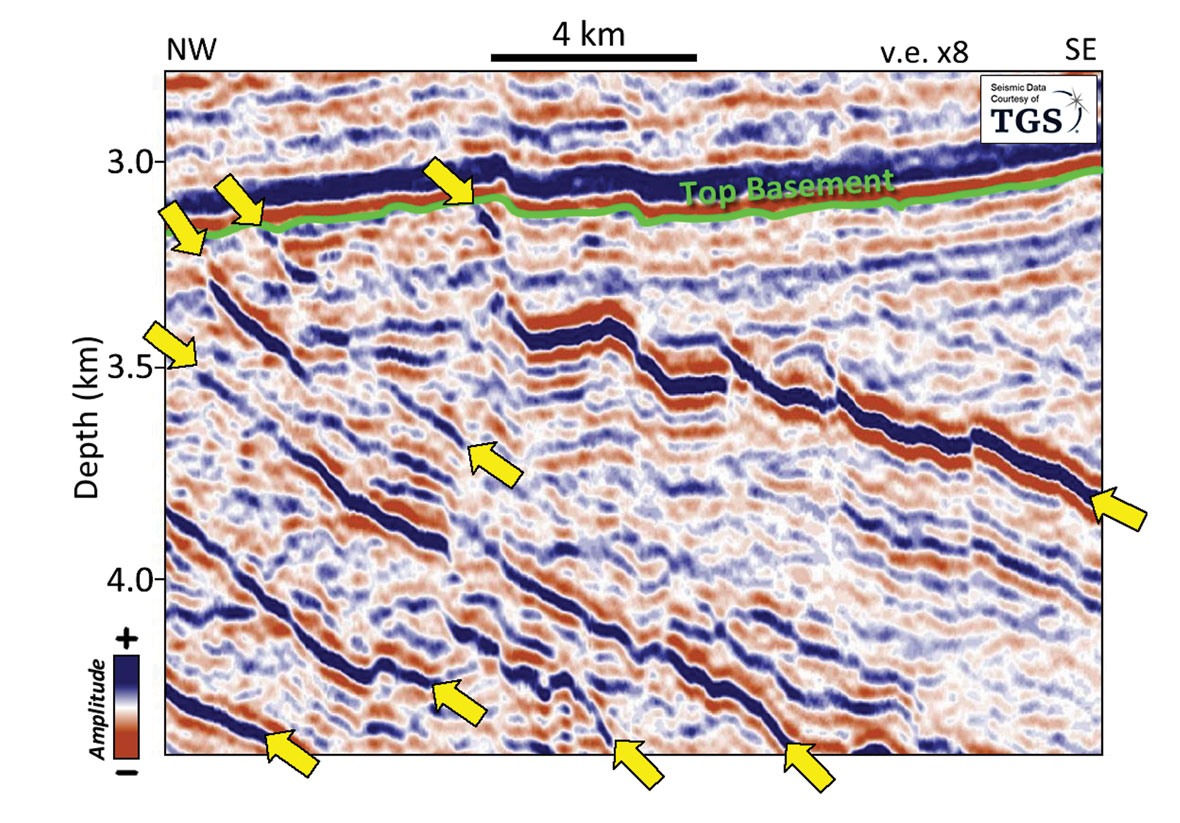
In Oklahoma, seismic reflection data from different areas show distinct, systematic patterns of reflectors within depth intervals dominated by the crystalline basement (figure 1). A few studies have highlighted the presence of these reflectors and have interpreted them as low-angle detachment faults or intra-basement igneous sills (horizontal-inclined sheet intrusions). These reflectors define broad, undulating surfaces that commonly terminate below the Top-Precambrian erosional surface and do not extend into the overlying sedimentary sequences. Thus, they have been interpreted to be associated with Precambrian and Cambrian tectonic events.
It is necessary to better understand the origin and composition of these characteristic layers in the Oklahoma basement, as it will fill a major gap in the understanding of its tectonic and thermal history. It is well known that the thermal history of a basin has important implications for the thermal maturity of its hydrocarbon source rocks. Additionally, due to the lack of surface outcrops of known hydrocarbon-hosting rock units in central and northern Oklahoma, oil and gas explorationists in the region have relied extensively on well logs and seismic reflection data to provide subsurface data on prospective targets. Therefore, a detailed knowledge of the geologic complexity of the subsurface is also crucial in order to avoid seismic interpretation pitfalls, as well as understanding how every aspect of the geology impacts the petroleum system. Furthermore, a better insight into the styles of intra-basement deformation in the area can provide knowledge of the potential basement-driven sedimentary deformation and their implications for sedimentary zones of interest.
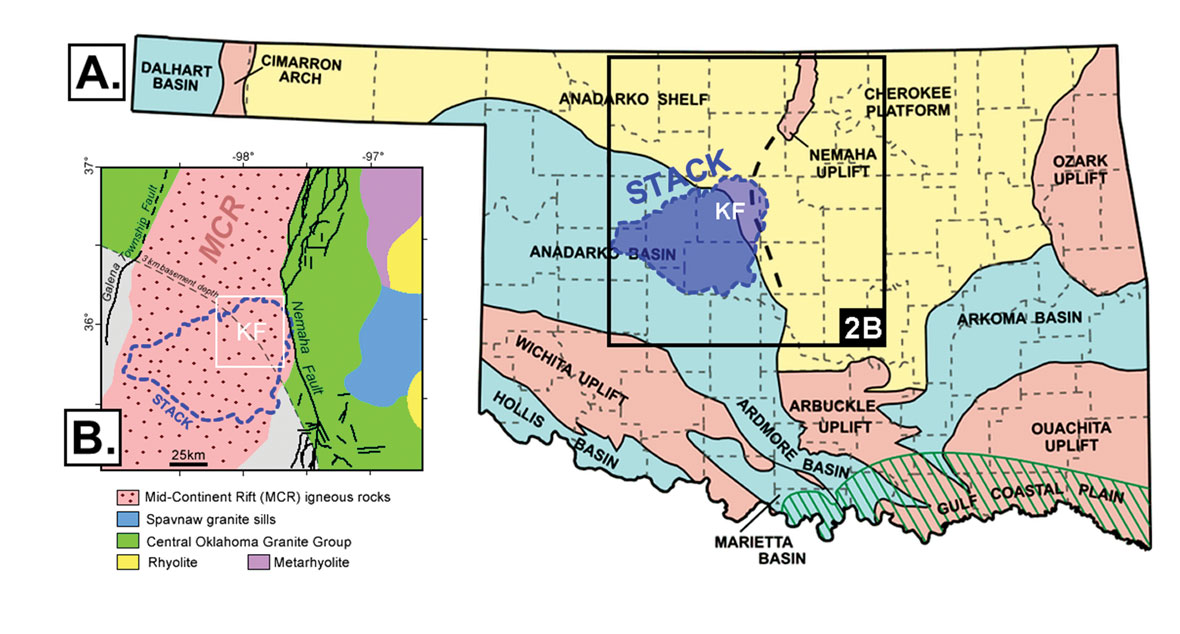
The “STACK” (Sooner Trend-Anadarko-Canadian-Kingfisher) play of central Oklahoma (figure 2) is currently one of the most active areas of unconventional oil and gas exploration in the state. It is a prolific trend of multiple prospective horizons defining a world-class horizontal-drilling hot spot that encompasses both unconventional and conventional formations in central Oklahoma. The economic significance of the STACK area, therefore, necessitates a better understanding of the underlying crystalline basement. Published geologic maps of the crystalline basement (from basement well penetrations, gravity and aeromagnetic data – figure 2b) show that the northern and central Oklahoma basement is dominated by igneous rocks of both extrusive and intrusive origins with ages ranging 1.1 – 1.4 billion years. The basement geologic map shows that the STACK area is underlain by igneous rocks related to the Midcontinent Rift (1.1 billion years old).
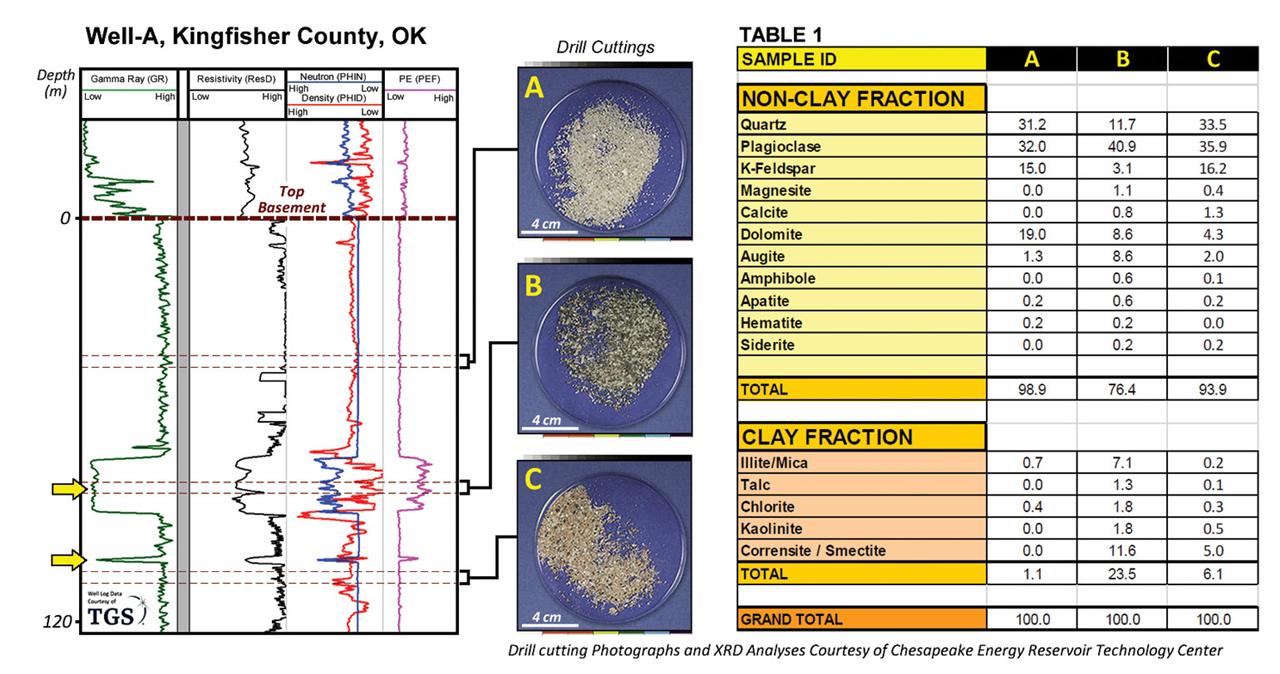
Here, we present drill cuttings and wireline log signatures from Well-A (figure 3), a basement well penetration in Kingfisher County, Okla. located within the STACK area. Our analyses of the Well-A data provide direct physical ground-truthing and new insight into the composition of the intra-basement reflectors of north-central Oklahoma.
Composition of the Basement Beneath the STACK Area
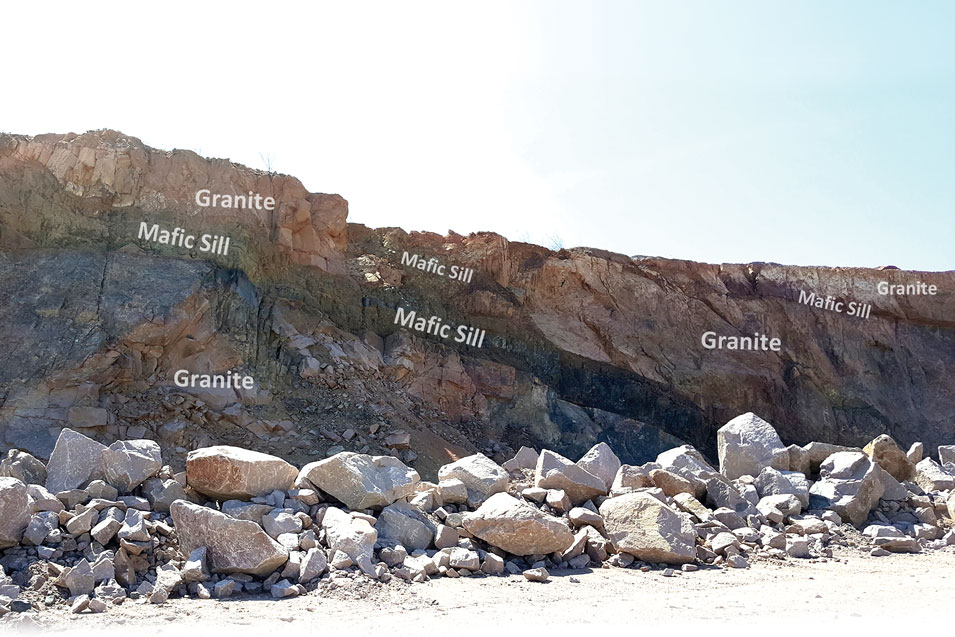
Wireline logs (Gamma Ray, Resistivity, Neutron/Density and Photoelectric Index) for the basement interval in Well-A (figure 3) show an overall high gamma ray and resistivity but low P.E. baselines for the entire 120 meter-long basement interval. However, within this extent, there exists two abrupt 17 meter and 1.5 meter-thick intervals (yellow arrows in figure 3) characterized by very low gamma ray and resistivity values, high P.E. values and extremely low density log values but increased neutron log values. These two zones of abrupt excursions of the wireline logs (unknown intra-basement layer) suggest a distinct lithologic layering in the crystalline basement of the STACK area. We go further to examine the actual drill cuttings from the three intervals in the basement: one above (sample A), one within (sample B), and another below (sample C) the unknown intra-basement layer. The photographs in figure 3 show the drill cuttings obtained from the three intervals, and table 1 shows results of XRD analyses of the cuttings. These results indicate that overall, the crystalline basement is dominated by a host rock that is rich in orthoclase feldspar and quartz (samples A and C), whereas the unknown intra-basement layer (sample B) is dominated by plagioclase feldspar, amphibole, mica, smectite and augite minerals. Based on these mineral assemblages, we interpret that beneath the STACK area, the crystalline basement is granite (samples A and C) and the intra-basement layering is composed of diabase/gabbro rocks (sample B). These results suggest that the intra-basement layering observed in seismic reflection data (figure 1) is composed of mafic igneous intrusions (sills/inclined sheets) most-likely diabase/gabbro. Thus, the north-central Oklahoma basement is analogous to the exposed Precambrian basement rocks in south-central Oklahoma (figure 4) in which the dominant granite basement is pervasively intruded by sills and inclined sheets of diabase composition.
Summary
Well data, including litho-logs and wireline logs, when integrated with seismic reflection data provide incredible insight into the structure of the buried crystalline basement that underlie sedimentary basins. A better understanding of the structure and thermo-tectonic history of the basement undoubtedly improves the knowledge of the evolution of the sedimentary sequences above. Here, our results from basement well penetrations in the oil and gas -rich STACK trend of the Anadarko Basin, Oklahoma, provide direct physical ground-truthing of the long contested intra-basement reflectors in north-central Oklahoma.