

Amplitude variation with offset or angle (AVO or AVA) has been widely used for discriminating hydrocarbons from brine-saturated rocks. Such analyses are based on Zoeppritz equations that describe the partitioning of energy at a rock interface into reflected and refracted energy components. These equations are complicated and, to get an intuitive understanding of their capabilities and limitations, various investigators and researchers have provided approximations by adopting some simplifying assumptions.
One of the earliest linear approximations to the Zoeppritz equations was provided by Shuey for angles of incidence (θ) up to 30 degrees and is given as R(θ) = A + Bsin2θ, wherein the first term A, is called the zero-offset reflectivity or intercept stack and is a function of only P-wave velocity and density.
The second term B referred to as the gradient stack, has a dependence on P-wave velocity, S-wave velocity and density, and thus has an appreciable influence on the seismic amplitude as a function of offset or angle. The changes noticed in the gradient stack could be indicative of the fluid content or lithology.
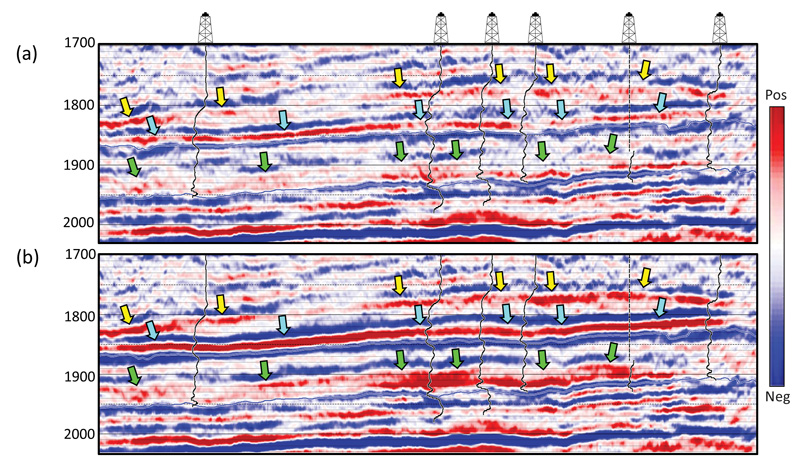
Figure 2: An arbitrary line passing through different wells extracted from the AVO gradient volume generated when (a) seismic velocity, (b) well-driven velocity was used in the analysis. The seismic data are from central Alberta, Canada. Data courtesy of TGS, Canada.
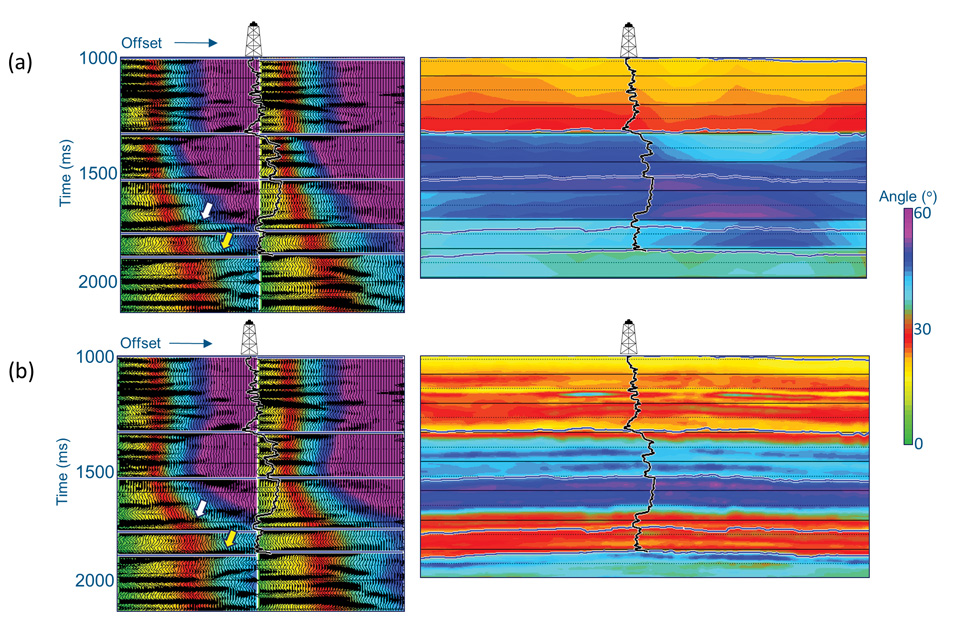
In actual practice, Normal Moveout (NMO)-corrected prestack seismic data are conditioned for enhancing the signal-to-noise ratio and thereafter put through amplitude-variation-with angle (AVA) analysis. As all mathematical formulation for AVA analysis is carried out in the angle of incidence domain, a significant step in the AVA workflow is to transform conditioned NMO-corrected seismic offset gathers to angle gathers. There are two options for doing this. One is to make use of the seismic velocity field obtained from processing the seismic data, and the other is the well-driven velocity field generated using the sonic log curves. Generally, seismic stacking velocities exhibit an increasing velocity trend, which is quite evident when overlaid on the offset gathers for quality control purposes, as shown in figure 1a. Even when they do show variation at strong impedance-contrast geologic markers, the vertical and lateral variations may not be smooth. Segments of sections from the seismic as well as well-driven interval field are also shown in figure 1a and b, with a sonic log curve (filtered to seismic bandwidth) overlaid on them. Notice the variation in velocity on the seismic interval velocity section, both laterally and vertically is not smooth, even though no significant geologic changes are expected. The well-driven velocity field looks more reasonable in terms of interval consistency and correlation, and so appears to be more authentic. Such a more realistic interval velocity field, when used in the AVA analysis, exhibits significant differences in the gradient attribute. Besides, the angle range computation may be different in the two cases as indicated with the two white block arrows in figure 1a and b.
Seismic Velocity Field versus Well-driven Velocity Field Computations
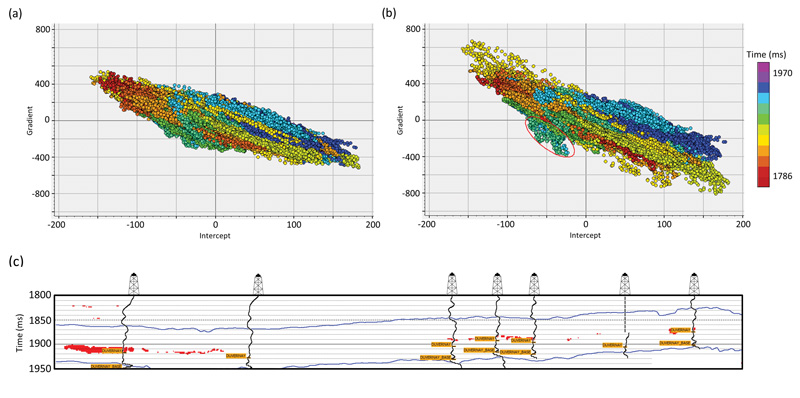
Figure 3: (a) Crossplot of AVO intercept versus gradient over the zone of interest when (a) seismic velocity, (b) well-driven velocity was used in the analysis. (c) When anomalous points on the crossplot are enclosed in a red polygon in (b) and back projected on the seismic section, they highlight the Duvernay zone, which is the source rock. Data courtesy of TGS, Canada.
As stated above, intercept and gradient attributes can be computed using Shuey’s approximation to Zoeppritz equations. As the intercept attribute is a function of just the impedance contrast at zero offset, no appreciable differences are seen on the intercept sections. However, as the gradient attribute is a function of the P-wave velocity, S-wave velocity and density, which in turn are a function of the various rock-fluid properties, significant differences may be seen between the gradient attribute computed using the seismic velocity field and the well-driven velocity field. In figure 2a and b we exhibit such a comparison, for data from central Alberta, Canada.
The interpretation of the intercept and gradient attributes is usually carried out by judiciously selecting the data covering the zone of interest from the two attributes and displaying them in crossplot space. While the background lithologies plot along a linear trend along a diagonal, the hydrocarbon bearing facies form a cluster separated from the background trend. Such interpretation follows the premise that data that are statistically anomalous are geologically interesting.
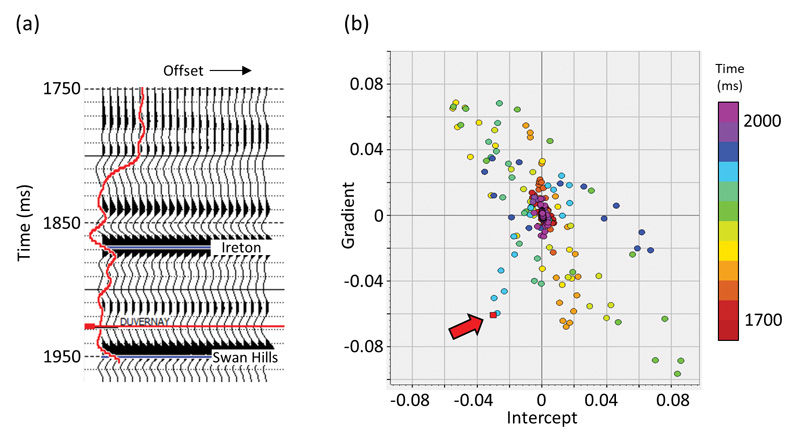
Figure 4: (a) AVO modeled elastic gather for a well that traverses the Duvernay formation of interest, (b) crossplot of intercept versus gradient attributes for the modeled gather. Notice, the outlier points (indicated with the red block arrow) resemble the points enclosed in the red ellipse in Figure 3b.
In figure 3 we show a comparison of crossplots between the intercept and gradient attributes, when the seismic velocity field (figure 3a) and when the well-driven velocity field are used (figure 3b). The data cluster points are colored with time. Notice that the cluster points in figure 3a fall more or less along a single trend that we understand would be the background lithology trend. In figure 3b however, in addition to the background trend, we also see some deviation of cluster points that can be picked up for further interpretation. As an attempt to do this, we enclose a set of cluster points within a red polygon and back project them on an arbitrary vertical section as shown in figure 3c. We notice these points highlight the zone that is suspected to be the Duvernay source rock.
For confirming that it is actually so, we generated the intercept and gradient attributes on a modeled AVO elastic gather for one well, and crossplotted them as shown in figure 4. There is a striking resemblance in the points enclosed in the red ellipse in figure 3b and the outlier points coming from the Duvernay zone in the crossplot of the intercept and gradient attributes of the modeled gather in figure 4b. This lends strong support to our interpretation.
Conclusion
The use of an accurate velocity field in AVA analysis can yield amplitude variations on the gradient attribute that are easily interpretable. In the example cited, the interpretation in intercept versus gradient crossplot space showed cluster points corresponding to the Duvernay source rock and thus is interesting.
Acknowledgement: The well data used in this work was obtained from the TGS Well Log Data Library.