
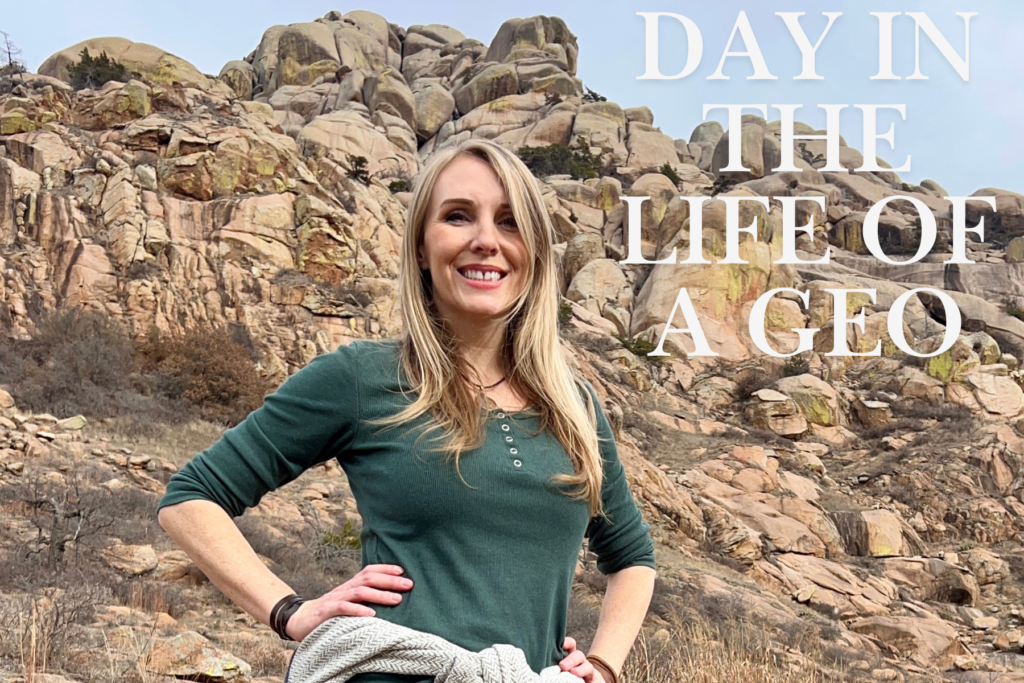
The array of specialties and careers within geoscience is broad, ranging from petroleum geoscience to work in mines, academia, geothermal, renewables, and many more areas of the energy landscape. Thus, the workday of one geoscientist can look vastly different from another.
As part of its Day in the Life of a Geoscientist series on Instagram, AAPG has interviewed several geoscience professionals to show students, young professionals, and the broader geoscience community what a day in the life within various specialties of geoscience might look like.
We recently spoke to Molly Turko, a structural geologist at Devon Energy. The reel featuring a peek into one of her workdays will be going live soon on AAPG’s Instagram. Follow @aapgeologists to make sure you don’t miss it!
Here’s what Turko had to say about her career and upcoming Day in the Life video.
How did you choose to become a geoscientist and what is your specialty?
“I discovered geology while attending community college. I tried several different classes, but it was the earth science courses that really drew me in and inspired me to pursue the field. I earned my associate’s degree in geology before transferring to the University of Tulsa, where I completed my bachelor’s and master’s degrees.
There, Dr. Bryan Tapp, a structural geology professor, really inspired me. His passion for structural geology was contagious, and he had a way of presenting what can be a very challenging subject as a puzzle that needed to be solved. I’ve always loved puzzles, and I enjoyed the mathematical side of geology, so structural geology felt like a natural fit for me.
Growing up primarily in Oklahoma, I was naturally drawn to the oil and gas industry. I enjoyed learning about the different types of subsurface data and how they could be used in exploration. What I love most is the chase of trying to find hydrocarbons: developing ideas and theories about where they might be and eventually having the opportunity to test those ideas. There is also so much innovation in this industry, which keeps things exciting.
After graduating, I interviewed with several oil and gas companies and eventually landed a position with Chesapeake Energy in Oklahoma City. That was the start of my career in the industry.
I also realized that I really missed being in an academic environment and had a passion for teaching. While working, I decided to return to school part-time at the University of Oklahoma, where I had the opportunity to study under world-renowned structural geologist Dr. Shankar Mitra. I earned my PhD in structural geology, allowing me to further develop an area of geology that had become both a passion and a career specialty.”
Describe the day you chose for “Day in the Life,” and how it is representative of your role as a geoscientist.
“If I’m being honest, most of my days as a geologist, even as a structural geologist in the oil and gas industry, are spent behind a computer. That’s because most of our data comes from the subsurface, including seismic data and well logs. Occasionally, we get to spend time in the lab working with core, but getting out to the field is especially valuable.
To better understand what we’re seeing in the subsurface, we need to study real-world outcrops that serve as analogs. This helps keep our subsurface interpretations realistic and grounded in what we observe in surface geology. Sometimes, that means participating in field trips, and other times it means visiting specific locations to collect structural data to compare with what we’re seeing underground.
For my Day in the Life, I’m getting out in the field to study fault and fracture patterns and thinking about how those observations can help us better understand the subsurface. I also love teaching, so whenever I’m in the field, I’m thinking about how I might incorporate what I’m seeing into a short course or use the location for a future field trip.”
What do you enjoy about being a geoscientist? What excites you about the future of the field?
“One of my favorite things about being a geoscientist is understanding how the Earth works and applying that knowledge to the world around me. I love visiting new places—especially areas with mountains and great rock exposures—and being able to understand how they formed. Looking at the stratigraphy, interpreting depositional environments, and imagining what that area might have looked like millions of years ago is fascinating to me. Even when it takes a little research beforehand, there’s something really rewarding about visiting a new place and understanding its geologic history.
What excites me most about the future of our field is just how important geology will continue to be to humanity. Whether it’s energy, mining, environmental science, or geoengineering, geoscientists will play an important role in addressing some of the biggest challenges facing our planet. Access to safe, reliable energy and natural resources can have an enormous positive impact on society, and geology is at the center of making that possible.”
What is your best advice for students entering the energy landscape?
“My biggest piece of advice is to start building your network now. It’s never too early! Be active on LinkedIn, get involved in local and national professional societies, attend geology luncheons, and take advantage of opportunities to attend conferences large and small. Put yourself out there, meet people, ask questions, give presentations, and build those relationships.
The technical knowledge you gain in school is important, but the relationships you build along the way can be just as valuable throughout your career. Find your people in this wonderful industry!”
What is one book or podcast you recommend all geo students and YPs read? Why?
“While it might be traditional to recommend a technical geology book or podcast, I would encourage students to spend time developing their soft skills and learning how to interact with people.
Vanessa Van Edwards is a great person to follow when it comes to communication, body language, and understanding human behavior. I’d also recommend books that explore different personality types and how those personalities interact, as well as resources that teach you how to navigate difficult people and situations. You’ll definitely encounter a few of those throughout your career! There are also some great resources available for developing presentation and public speaking skills.
At the end of the day, technical knowledge is important, but people skills can make a tremendous difference in how you grow your network, build confidence, and establish your professional brand. Learning how to communicate effectively and connect with others is an investment in your career that will pay off throughout your professional life.”