
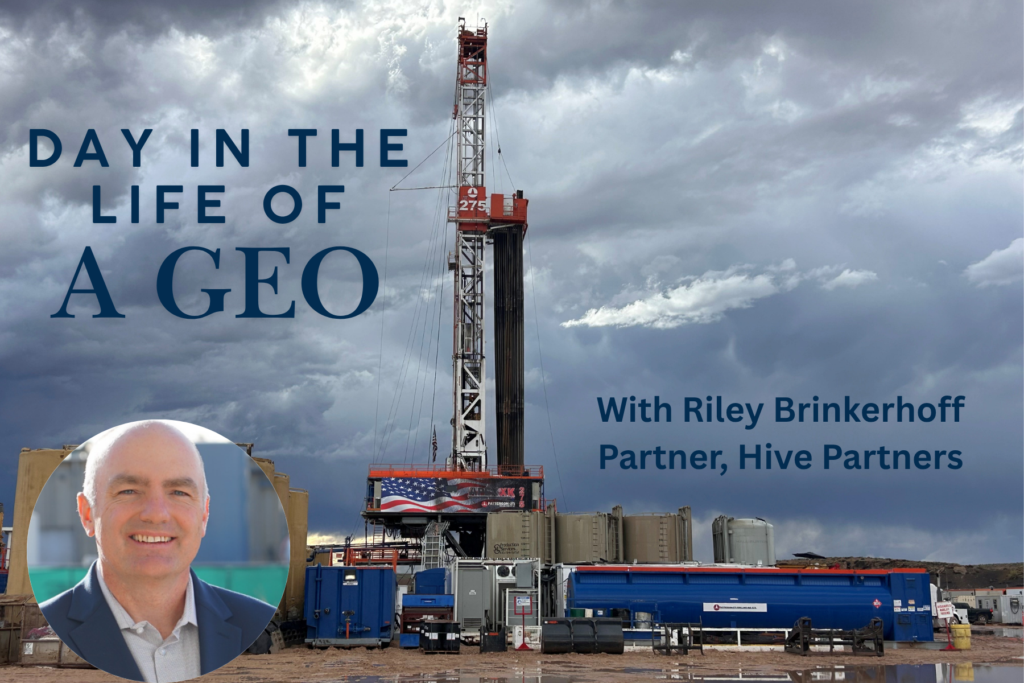
The array of specialties and careers within geoscience is broad, ranging from petroleum geoscience to work in mines, academia, geothermal, renewables, and many more areas of the energy landscape. Thus, the workday of one geoscientist can look vastly different from another.
As part of its Day in the Life of a Geoscientist series on Instagram, AAPG has interviewed several geoscience professionals to show students, young professionals, and the broader geoscience community what a day in the life within various specialties of geoscience might look like.
For Episode 2, we have spoken to Riley Brinkerhoff, a petroleum geoscientist, operator, and partner at Hive Partners. The workday he chose to show features calls with investors, trips to well sites, collecting tar samples, and much more. You can view his reel on Instagram @aapgeologists.
Here’s what Brinkerhoff had to say about his career and Day in the Life video.
How did you choose to become a geologist, and how did you determine your specialty?
“After my first geology class, I knew that I had to major in geology.
Utah, where I grew up and did my studies, has amazing stratigraphy. Stratigraphy and sedimentology classes were always my favorite, especially if they had a field component. I started my career at BP after graduation, then I did an MBA to strengthen my financial skills.”
How is the day you chose for your reel representative of your work life more broadly?
“With three other partners, I started my own oil company about three years ago. I develop exploration ideas and propose them to partners with acreage. We then negotiate drill Certificates of Service, in which we will fund the exploration wells through these partner companies for a cut of the revenue and acreage.
The day I chose for Day in the Life shows a lot of the operational tasks that I oversee as we work through a 26-well program. We are a very lean company, so I am responsible for my own geological and engineering work, as well as making sure that our capital is being spent wisely as we develop these prospects. That means a lot of time in the field, checking on operations.”
What do you enjoy about being a geoscientist, and what excites you about the future of the field?
“Being a geoscientist is fast-paced, exciting, and tremendously impactful. The decisions that I make lead to many millions of dollars of investment and jobs for my fellow Utah residents. I love putting the pieces of a puzzle of a play together, the excitement and stress of drilling my own prospects, and winning or losing based on the quality of my interpretations.
The world needs more energy and minerals, so I am very excited that we will have more need and better tools to keep finding hydrocarbons and ore deposits.”
What is your best advice for students entering the energy landscape?
“Study geology broadly. Take all the classes you can, because you’ll want to have as many interpretive tools in your toolbox as you can. No one knows where the future of energy will take us, but the best-prepared people will have the most opportunities. Also, go out into the field as much as possible: The rocks are the best teachers.”
What is one book or podcast you recommend all geo students and YPs read?
“I read The Prize by Daniel Yergin many years ago, and I still reflect on its lessons about what it takes to economically produce and market oil. It’s a big book, but I don’t know of anyone who has ever gotten bored reading it!”
If you would like a day in YOUR life as a geologist featured on AAPG’s Instagram, website, and student newsletter (Field Notes), email editorial@aapg.org or message us on Instagram @aapgeologists.