
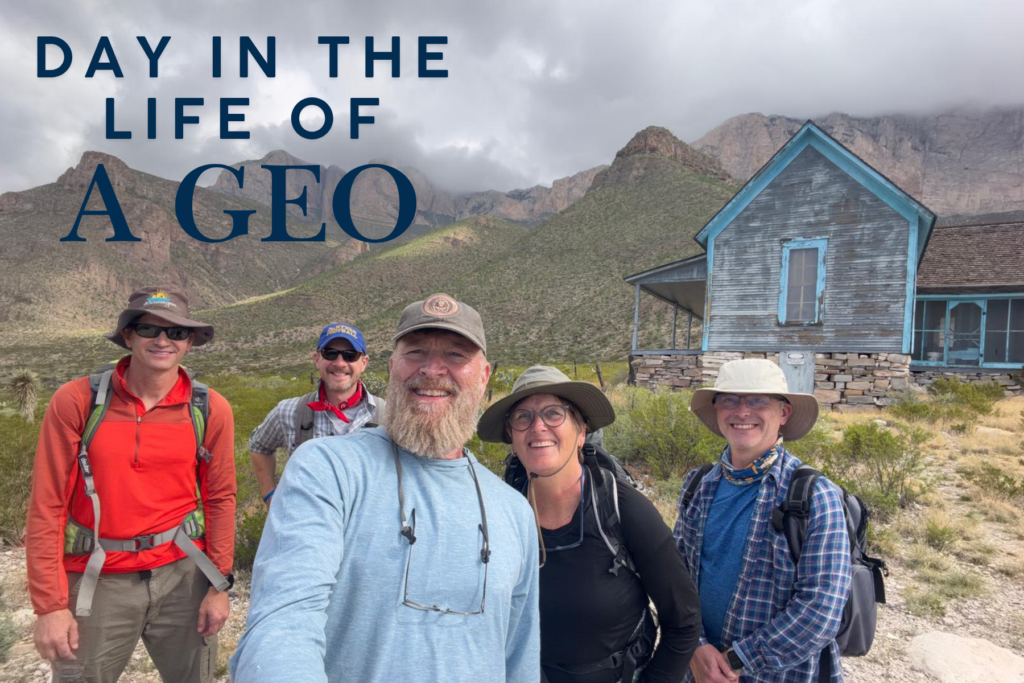
The array of specialties and careers within geoscience is broad, ranging from petroleum geoscience to work in mines, academia, geothermal, renewables, and many more areas of the energy landscape. Thus, the workday of one geoscientist can look vastly different from another.
As part of its Day in the Life of a Geoscientist series on Instagram, AAPG has interviewed several geoscience professionals to show students, young professionals, and the broader geoscience community what a day in the life within various specialties of geoscience might look like.
For Episode 1, we have spoken to Zane Jobe, geoscientist, research professor, and director of the Chevron Center of Research Excellence at the Colorado School of Mines. He specializes in clastic sedimentology, and in particular, deepwater depositional systems. Jobe chose to showcase video clips and photos from several recent days of fieldwork. You can view his full reel on Instagram. To make sure you don’t miss the rest of the series, follow AAPG at @aapgeologists.
Here’s what Jobe had to say about his career and Day in the Life video.
A Day in the Life of Zane Jobe, Research Professor and Director of the Chevron Center of Research Excellence, Colorado School of Mines
How did you choose to become a geologist, and how did you determine your specialty?
“My parents used to joke that I always had rocks in my pockets. The rocks would get in the washer and bang around, so I guess I was always meant to be a geologist. I had a great mentor at The University of Texas at Arlington in John Holbrook, and he got me interested in rivers. Then, I did an internship at Pioneer Natural Resources (bought by ExxonMobil in 2024). in Irving, Texas. I got to work on a little bit of 3D seismic data from offshore Nigeria, and that really made me want to study submarine channels, which look just like rivers, but on the seafloor.”
How is the day you chose for your reel representative of your work life more broadly?
“This day was an outcrop field work day, which I’m lucky to get to do quite a bit of in my role at the Colorado School of Mines. Most people get into geology partially because they like to be outside and in nature and are curious about the world around them. This video shows some of the work we do, but also some of the curiosities that we find while out doing field work, like a nice flower or a nice calcite crystal.”
What do you enjoy about being a geoscientist, and what excites you about the future of the field?
“I enjoy the constant rate of discovery that happens in geosciences. It’s a pretty young field compared to some of the other hard sciences, so there are new advances all the time, many of which are driven by industry. These applied research questions are the most exciting for me to work on, and they directly, and in many cases, immediately, impact the economy, which is pretty rewarding for me. As for the future, we’re going to need all the energy that we can get, and we’re going to need to do it in a sustainable way. Geoscientists will be a key part of that.”
What is your best advice for students entering the energy landscape?
“Maintain curiosity, because that’s really what will drive your interest in a particular specialty. I think it’s also super important to maintain a networking group, and the easiest way to do that is through a society like AAPG or a local society. The membership is super cheap or often free, and the meetings are a great place to learn and to meet people.”
What is one book or podcast you recommend that all geo students and young professionals read?
“I read so much technical material at work that when I’m at home, I read sci-fi and fantasy. I can say that the Expanse series by James S.A. Corey is the best material I’ve read in a very long time.”
Want to read more student advice and see more Day in the Life reels and interviews? Sign up to receive Field Notes, AAPG’s free newsletter for students and young professionals, here. OR want to showcase your Day in the Life as a geoscientist? Email editorial@aapg.org