
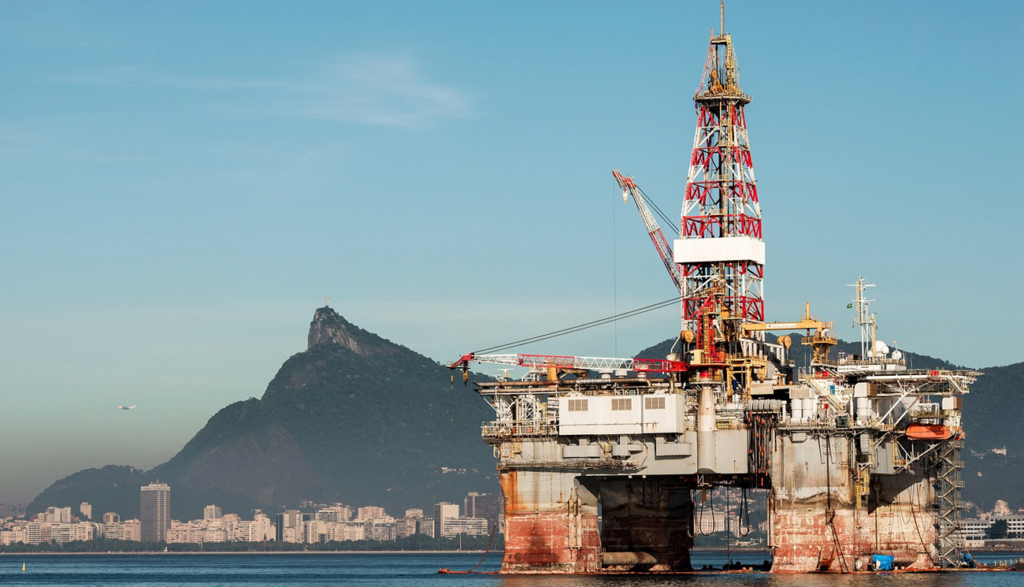
Brazil is by far South America’s biggest oil producer. Home to the world’s seventh-largest population and a booming economy, Brazil has made energy security a key national priority. The country produced 3.9 million barrels of oil per day in 2025, and its production is still climbing.
Brazil has an energy mix of more than 54 percent renewable energy, while fossil fuels constitute only 46 percent, including 34 percent oil, 8 percent gas, and 4 percent coal. In other words, Brazil has already achieved the “ideal” energy mix that the rest of the world is striving to achieve by 2050.
However, without new discoveries, the country’s production is predicted to peak by the 2030s. National oil company Petrobras is pursuing multiple growth opportunities, in partnership with many large IOCs, other NOCs, and smaller local companies.
The company is starting with its biggest strength: deepwater. During a recent AAPG webinar, Sylvia Anjos, Petrobras’ director for exploration and production, shared that in the second half of 2026, Petrobras will have 4.9 million barrels of oil equivalent per day in operated production, primarily from deepwater fields. This is by far the largest operated deepwater production, surpassing super majors such as ExxonMobil, Shell, and Chevron.
“Geology led us into deepwater,” said Anjos during the webinar, referencing the inception of Brazil’s deepwater ventures in the early 1980s, when it could not find enough oil in its onshore and shallow-water basins. Since then, Brazil has been part of the “golden triangle” of deepwater, alongside the Gulf of Mexico (America) and West Africa.
Of these global deepwater leaders, Brazil is the only country in which its national oil company is leading production, not a supermajor. Most national oil companies, with a couple of rare exceptions such as Petronas from Malaysia and CNOOC from China, tend to invest as non-operating partners to join deepwater fields led by other IOCs and/or Petrobras.
A Global Deepwater Draw
Almost every major international oil company is invested in Brazil’s deepwater sector, except for Italy-based ENI. European leaders Shell, TotalEnergies, and Equinor have the largest production in Brazil among the IOCs. According to Ruaraidh Montgomery, head of energy trends and analysis at leading consultancy Welligence, Shell led all foreign investors with an estimated 470,000 barrels of oil per day of production in Brazil in 2026.
Fellow European supermajor BP made a major oil discovery in Bumerangue in the Santos Basin last year. It is actively appraising the field and hopes to establish a significant production base in Brazil during the next decade.
American supermajor Exxon’s production in Brazil is around 30,000 barrels per day and will grow to roughly 70,000 barrels per day by 2035. Chevron, the world’s second-largest IOC, also has secured ample exploration acreage in frontier deepwater basins in Brazil.
Chinese NOCs, including CNOOC, CNPC, and Sinopec, are all equity investors in Brazil’s deepwater activities. For the past two decades, CNPC and CNOOC have often partnered on projects in Brazil, while Sinopec has been involved in a joint venture with Spanish company Repsol.
With its equity holdings in the giant complex of the Buzios and Mero fields, CNOOC has established a production base of 140,000 barrels of oil per day in Brazil. Its production is projected to grow to around 180,000 barrels per day by 2035, according to data shared by Welligence during the recent AAPG webinar.
CNPC’s share of oil production will grow from 100,000 barrels per day to 110,000 barrels per day by 2035. Sinopec has a production base that is about half that of CNPC in Brazil through its joint venture with Repsol.
Leading Local Companies
Brazil’s legislation encourages investments in the oil and gas sector through different acreage tenders run by the Agencia Nacional do Petróleo (ANP). As a result, several noteworthy local private companies have emerged in Brazil.
Prio is the biggest private company by value, and it specializes in reviving mature basins. According to Welligence’s estimate, Prio’s assets are valued at around $14 billion. From its founding in 2015 to 2022, Prio acquired oil fields including the Polvo, Tubarao, Martelo, Wahoo, Albacora Leste, and Frade. It reached 100,000 barrels of oil of production per day by 2023. Recently, Prio won two exploration blocks in the Campos Basin as the operator and 100-percent equity holder during Brazil’s pre-salt subsea bid round.
Other private companies such as Brava Energia, Origen Energia, and PetroRecocavo have grown their asset bases beyond the billion-dollar mark. These smaller private companies tend to focus on onshore and marginal fields, as evidenced by the recently completed 6th permanent offer bid round outside of the pre-salt polygon.
What’s Next for Petrobras?
Petrobras has a reserve life of 12.5 years, similar to other leading NOCs. To keep a healthy funnel of development and production, especially beyond 2035, Petrobras needs to continue to make new exploration discoveries.
According to Anjos, Petrobras will drill about 40 new exploration wells between 2026 and 2030 and will invest $7.1 billion in exploration. These wells will include wildcats in frontier basins near Brazil’s equatorial, south, and southeast margins, ranging from the Foz do Amazonas Basin in the north to the Pelotas Basin in the south.
In August 2026, Petrobras made breakthrough oil discoveries in the Morpho Well near the northern border with French Guiana. A second discovery followed at the start of October. These discoveries confirmed the presence of a working hydrocarbon system in the area. Petrobras is planning to drill three more exploration and appraisal wells in the Foz do Amazonas basin, hoping to establish a new oil-producing base.
Another of Petrobras’ growth strategies is international exploration, especially in the South Atlantic basins along western Africa. Petrobras has exploration acreage in South Africa, Namibia, Sao Tome and Principe, and Ivory Coast, where it recently acquired eight exploration blocks as the operator and 80 percent equity holder.
Petrobras bid aggressively during the recent pre-salt bid round and committed about $600 million to secure exploration acreage, outbidding international heavyweights TotalEnergies and QatarEnergy. Time will tell how these and other new investments will develop for Petrobras.