
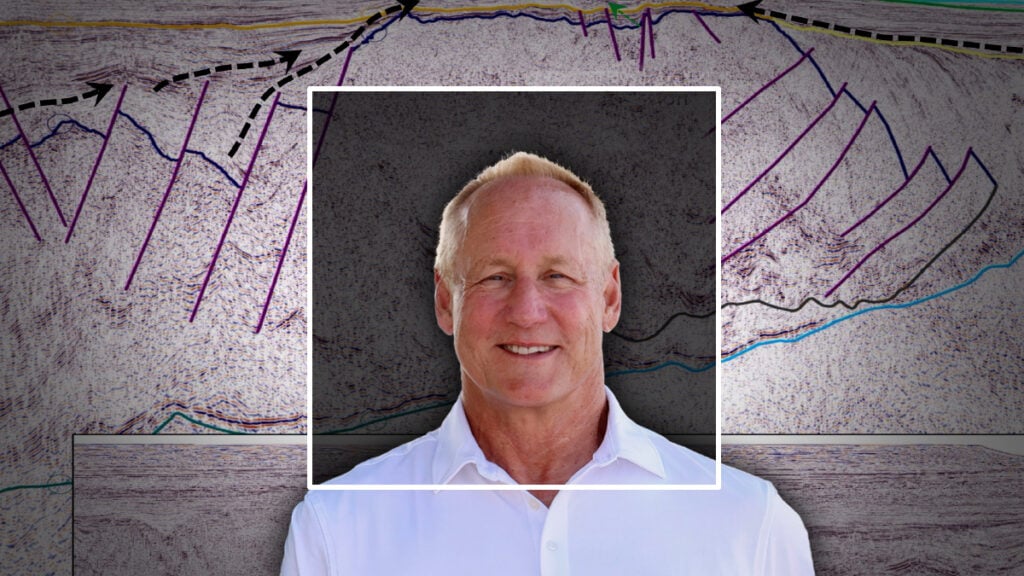
During my year as president of AAPG, I spoke with many industry leaders, university faculty, researchers, and students. Those conversations started me asking what the future of geoscience will look like and how we will prepare the next generation of scientists to deliver the energy the world needs.
Throughout my career, technology has transformed the way we handle and analyse data, yet the fundamental geologic and scientific principles remain largely intact. With continued advances in computing power, artificial intelligence, and access to new data, I believe the energy industry needs to reevaluate what skills are essential and what new skills will drive the next generation of innovation. These tools will make interpretation faster and cheaper. They will not tell us whether we are asking the right question.
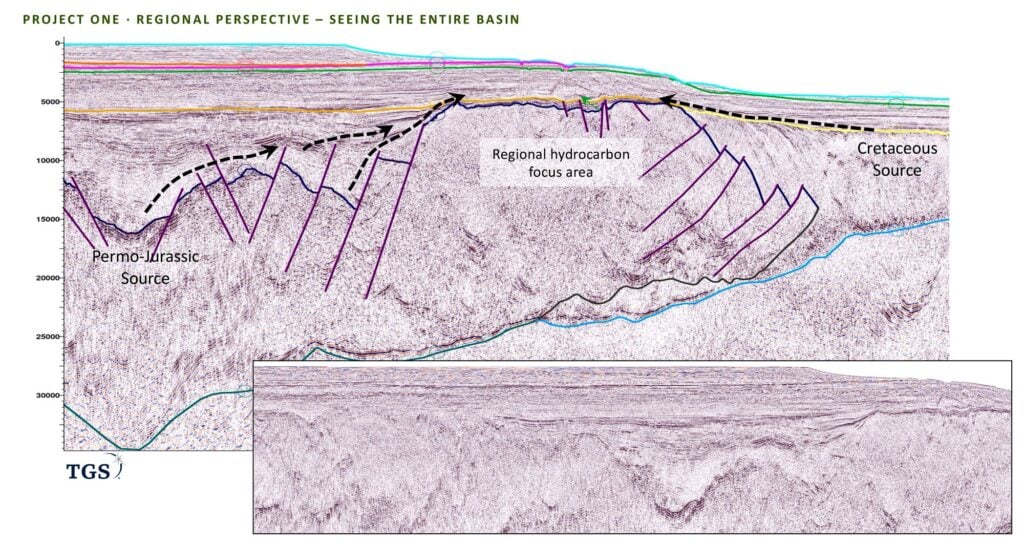
That matters commercially. Exploration decisions worth hundreds of millions of dollars rest on interpretation. I recently heard an exploration VP say, “We aren’t exploring for oil and gas, we explore for money.” The costliest input in a frontier exploration well may not be the well cost but the assumptions and interpretation behind it. (See figure 1.)
The Qualities That Count
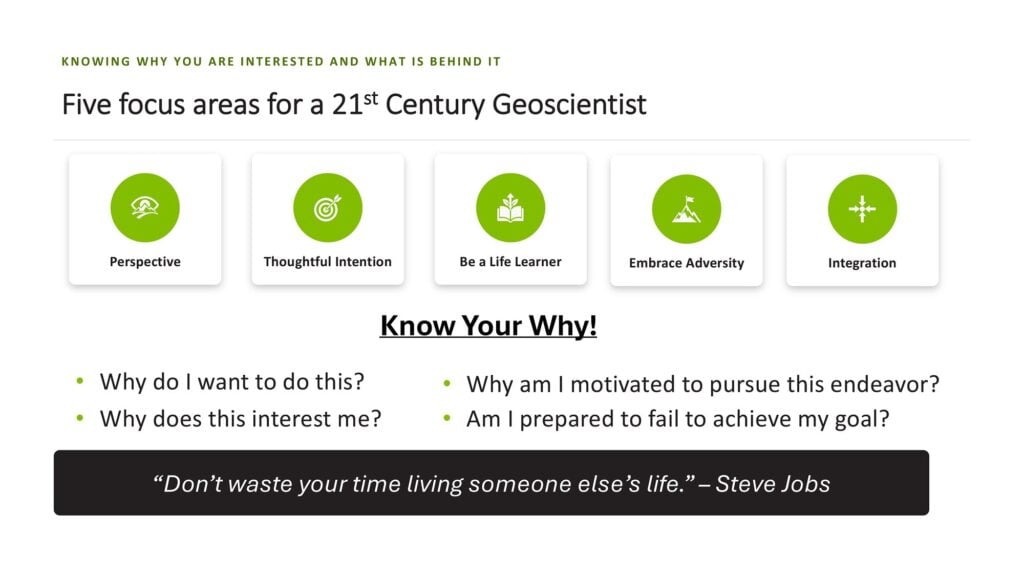
Five themes emerged from those conversations: perspective, thoughtful intention, being a lifelong learner, embracing adversity and integration. I do not have all the answers, and I don’t claim these five should be codified as truth. My hope is that they start a community-wide discussion.
Perspective: “If you’re not prepared to be wrong, you’ll never come up with anything original,” Sir Ken Robinson once said. Every geoscientist carries personal and technical bias; it is part of being human. What matters is being aware of our bias and understanding how it affects our interactions with people, our decisions and our interpretation of data.
Too often, a prevailing interpretation and a few strong-willed individuals constrain creative thought within an organization. A postdoctoral researcher told me recently that in several academic settings, she believed creative thinking was lost. Too many students study for grade rather than for an understanding they can apply in different circumstances.
New ideas are the foundation of scientific progress. But as a friend told me after criticism regarding new interpretation of rifting processes, “The first guy on the beach usually gets shot.” The stigma of being wrong stifles creativity. I recognized this in myself: too often I followed other people’s dogma rather than investigating the concepts thoroughly myself.
Perspective also means looking beyond the study area and viewing the entire basin as a system. A larger perspective lets the interpreter compare what they know with what could potentially be present. Understanding the regional context creates context to ask, “Is this the best exploration idea and is it the right location to test it?” (See figure 2.)
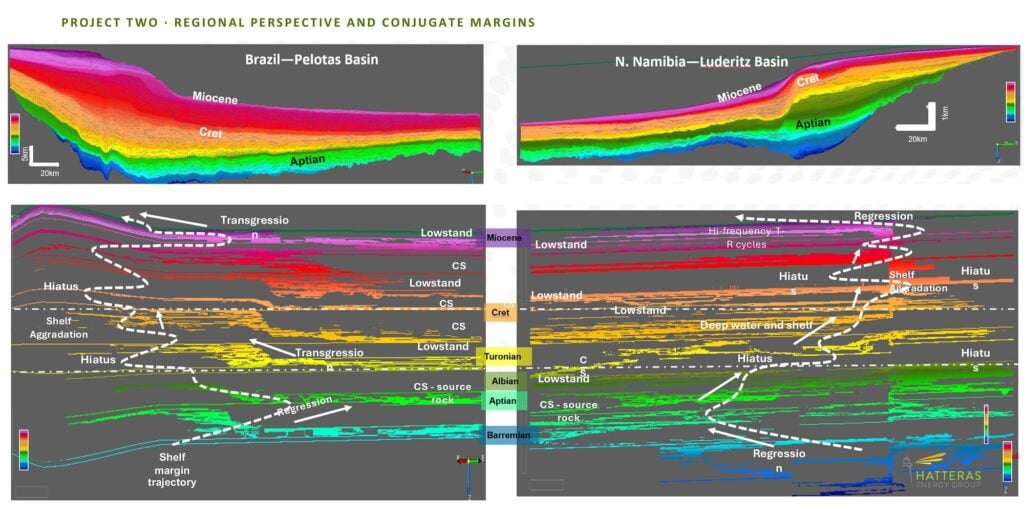
Thoughtful intentionality: It is a learned skill. It requires thought and willful action. Working on a conjugate margin for a project in the South Atlantic, we asked whether we should evaluate the basin fill on both sides, from rifting through to the opening of the ocean. It had never been attempted, and it required us to modify interpretation software.
We knew the result was not “the answer,” but it gave us a new way to understand depositional systems across conjugate margins. Rifted margins were initially viewed as symmetrical; we now understand that often they are not. From the Late Cretaceous to the present, the Uruguayan and Namibian margins have had very different depositional histories. Namibia’s discoveries are primarily in the Aptian-Albian section, where deepwater reservoir systems overlie the Aptian source rock. In Uruguay, the Turonian and younger section has highly aggradational shelf margins and limited basin floor deposits. The first deepwater well to be drilled off Uruguay since 2016 is now being prepared, and those differences could have real implications for reservoir continuity, deliverability and connectivity. (See figure 3.)
Lifelong learning: My first oil industry job as a second-year university student was as a geotech. The work involved mylar sheets overlain on base maps and posting data with Rapidograph pens on light tables. My supervisor requested two copies of the mapped data. When I delivered them, he said: “You take a copy. I’m going to make a map, and you’re going to make a map. You need to learn how to contour a map.”
His advice at the time became a framework for my career: “Brian, you cannot be just a geologist. You need to know geophysics, petroleum engineering, petrophysics and commercial analysis. You don’t have to be an expert in all these areas, but you will need a working knowledge of the concepts.” Leaning in when the work doesn’t seem relevant to your discipline can pay abundant dividends later. I have been fortunate to have several mentors and teachers throughout my career. It is important to seek these people out and spend time with them, watching how they work.
Embracing adversity: Ask anyone who has worked in a geoscience-related industry, and they will most likely tell you their career path has been circuitous. Anyone who has worked in mining or oil and gas can tell you about layoffs, market collapses and technological innovations that redefined workflows, hiring, and required skills. People who have built successful careers will tell you that adversity taught them their most important lessons. Grit matters, as does knowing your “why,” as Simon Sinek puts it. Successful people don’t give up; they find a way to pivot. Technology will keep changing hiring patterns and the skills the industry needs. Self-reflection, awareness and thoughtful intention provide a framework for thriving through those changes.
Integration: In Range: Why Generalists Triumph in a Specialized World, David Epstein argues that integration is fundamental to solving complex problems. Subject matter experts often view a problem through the lens of their own expertise. That is essential in many respects, but it can create blind spots that seem obvious to people trained in other disciplines.
In geoscience, this is particularly important. The Earth’s systems are highly anisotropic, and our questions often have more variables than equations. Reducing a complex problem to a few first-order controls is a fundamental skill. I learned it by watching experienced colleagues we often referred to them as “cobblers”: people who could weave disparate data into a cogent analysis grounded in scientific reasoning. It’s a skill can be learned, but requires creativity and a willingness to be wrong and curiosity to ask people how they came to a different understanding.
At my college graduation, my father said, “I never took you for a technical guy.” He was right. I struggled as an undergraduate. It wasn’t until I faced a choice about graduate school that I found my why. I have never looked back and I still try to emulate all the cobblers I have known and worked around.
The Future is Human
The tools available to the next generation will be extraordinary. But the geoscientists who matter most this century will not be the ones with the most data. They will be the ones with perspective, intention, breadth, resilience and the ability to integrate, and the courage to question what everyone else accepts. If we train them for that, I hope every 21st-century geoscientist will have a career as rewarding as mine.