
Companies looking to commercially store CO₂ along the Gulf Coast face a limited amount of subsurface real estate, especially in conventional oil and gas reservoirs. There are a finite number of depleted or non-producing fields, and that is before one considers the location of aquifers, faults, and legacy wells.
But what if traditional seals, such as shale and mudstone, are not needed? Not only would that exponentially increase the capacity for carbon storage, it would transform the business of carbon sequestration altogether – just as unconventional resources did for oil and gas.
“Most people come to the carbon capture and sequestration field from the petroleum industry, myself included, and even those who don’t, they still look at petroleum as an analog and draw heavily upon it,” said Alex Bump, a geologist and research associate professor with the University of Texas’s Bureau of Economic Geology. “In petroleum, we look for accumulations with large volumes of mobile hydrocarbons that we can extract efficiently. And the geology that supports that is a large, clean reservoir, a trap, and a sharp contact with an overlying seal. The blind spot is thinking we need the same for CO₂.”
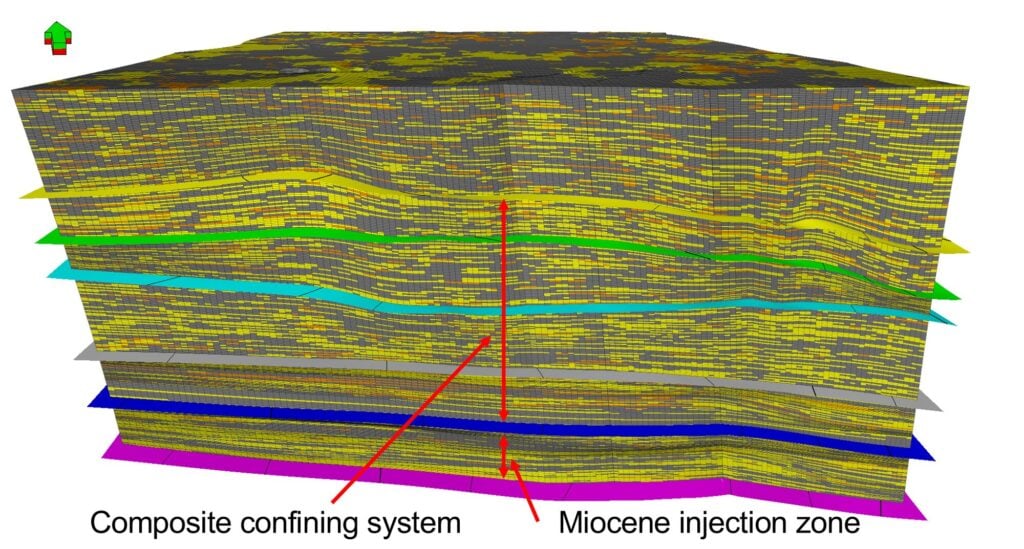
For the last four years, Bump and other BEG researchers have been conducting promising studies in the secure storage of CO₂ – not in reservoirs with classic petroleum seals – but in reservoirs with composite confining systems. These are multi-layered geological formations, abundant along the Texas and Louisiana coasts, composed of many thin, discontinuous barriers that are believed to function as well as large, continuous caprocks for carbon storage. Their research is sponsored by the Gulf Coast Carbon Center, an industry-funded research group run by the BEG.
Rigorous risk and uncertainty models have tested a myriad of injection and storage scenarios, and they remain effectively unbreakable to date.
Building, and Breaking, the Model
Texas and Louisiana are home to many producing oil and gas fields, refineries and chemical plants – all of which emit CO₂. When Bump was initially asked to perform subsurface capacity assessments for potential CO₂ injection projects from these sources, he was not concerned about the region’s storage capacity. Rather, it was the lack of a regional marine shale seal that made him question long-term containment.
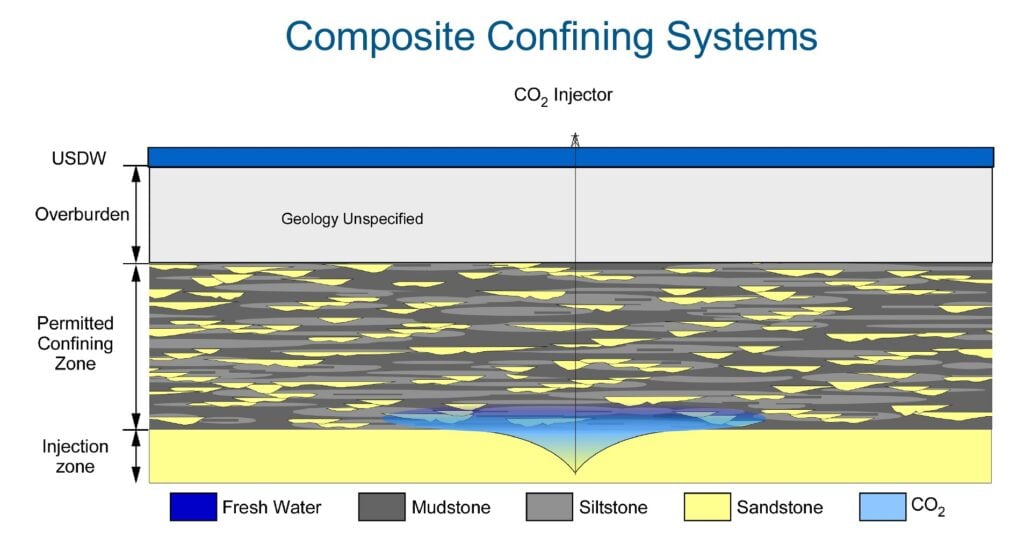
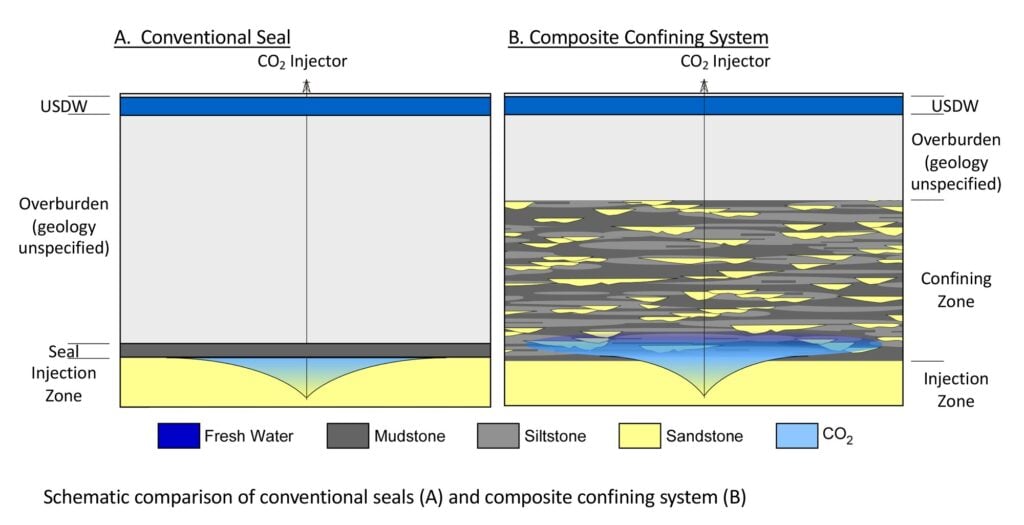
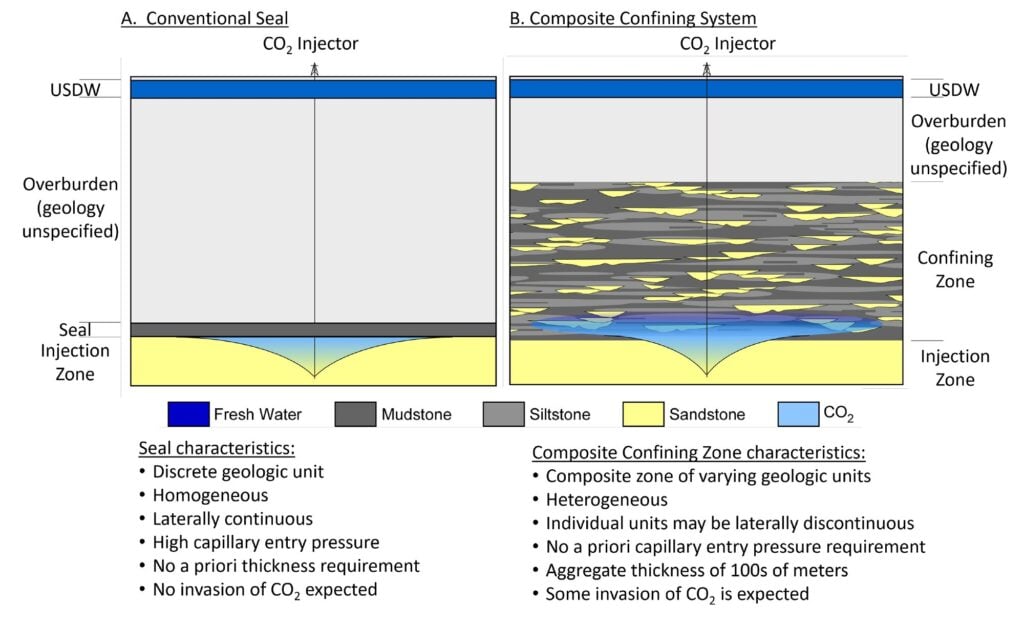
But then he had an idea: The Oligo-Miocene deltaic and fluvio-deltaic strata of the Gulf Coast contain a rich, heterogenous stratigraphy with thousands of feet of interbedded sands, shales and silts. Perhaps further examination of these confining zones, specifically in terms of the ratio of vertical permeability to horizontal permeability, would yield favorable results.
After performing numerical modeling and sand tank experiments, Bump ran across a 1985 paper by Steven Begg and Peter King titled, “Modeling the Effects of Shales on Reservoir Performance: Calculation of Effective Vertical Permeability.” The publication offered a way to quantify effective vertical permeability as a function of discontinuous barriers. It was intended for reservoirs, but Bump could apply the same concept to a confining system.
Yet, figuring out how to test the idea and key variables was a “real process of exploration,” he said.
In the past, carbon injection and storage have targeted heterogeneous reservoirs and shown that discontinuous barriers could limit vertical migration. However, Bump was not aware of research that had formally de-risked the practice to meet the standards required for investment, permitting and approval. He wanted to assess the uncertainty of the confining zone between the points of injection and legally protected subsurface aquifers.
Bump asked David Hoffman, a research collaborator and geologic modeler at the BEG, to help build a robust, realistic, base-case static model. Using data from more than 200 wells and 3-D seismic imaging, Hoffman built a reservoir model from electrofacies, log-derived petrophysics and seismically guided depositional environments. He generated statistical descriptions of sand-belt geometry, mudstone barrier length, predicted lithofacies, and petrophysical properties to define a “most likely” case.
The same statistics also defined P10 extremes, which assumed – based on the well data – that the confining system had no greater than a 10-percent chance of real storage capacity. Hoffman used these extremes to construct uncertainty cases, forcing the geology between the wells to the P10 values. In other words, the models contained P10 realizations of barrier length, barrier frequency, flow unit thickness, and flow unit permeability. (In this case, “barriers” were defined as mudstones, although sand tank experiments suggest that anything with lower permeability than the underlying flow unit would function as a barrier capable of diverting vertical flow into horizontal flow.)
Taking this ultra-conservative approach, the model remained “pessimistic” on vertical confinement.
Hoffman and Bump tried to break a wide range of static model realizations through dynamic simulations, which skewed the geological base case and variables in every way imaginable. They questioned their assumptions on petrophysics and well control, for example, altering the models to reflect the least likely of interpretations.
They continuously adjusted the percentage of sand bodies and the distributions of shale in the total volume, and they assumed the most ambiguous well data. They even created a model using all P10 values, a geologic “worst case” scenario.
“None of it made much difference to the flow of CO₂,” Bump said. “The details of the final plume changed, but no model allowed the plume to rise past layer 20 out of 210 in the confining zone.”
Unable to come even close to breaking the model, they made adjustments to the engineering margin of safety by over-injecting CO₂ by orders of magnitude. Yet, the CO₂ never used more than one-third of the confining system’s vertical space. Interestingly, it migrated much more laterally.
“While individual barriers may be poor seals in the conventional sense, their aggregate effect creates a long, tortuous flow path that arrests migrating fluids in dissolution, residual trapping, local capillary trapping and small buoyant traps,” Bump said.
The dynamic model assumed commercial injection rates and volumes into multiple injection wells for 20 years, and the CO₂ plume was modeled for 200 years post-injection. “Even in the most pessimistic and geologically unrealistic cases, the CO₂ plume was almost completely immobilized,” Bump said. “By 200 years post-injection, literally 90 percent was either dissolved or residually trapped.”
“We violated the laws of physics in some cases. We violated all the rules of geologic interpretation. It still worked,” Hoffman said. “The purpose of our research is to show that the risk is extremely low. As more companies explore the possibility of long-term CO₂ sequestration, I think this kind of research is going to be very helpful.”
Applications and Challenges
Feeling confident in the geology’s overall ability to securely contain CO₂, Bump admitted to having several lingering concerns that he is currently working through. One is encountering a structure in the subsurface that resembles a typical petroleum trap, which limits lateral migration and builds column height, allowing CO₂ to breach sub-par barriers.
“I have looked at enough petroleum accumulations on the Gulf Coast now to realize that petroleum is doing the same thing,” he said. “Even then we are trapping in multiple-reservoir intervals tens to hundreds of megatons of CO₂ equivalent. In terms of reservoir volume, 10 (billion cubic feet) of gas is about the same as a megaton of CO₂.”
Second, Bump is unsure how transmissive faults might affect CO₂ containment, although his research into approximately 350 faults on the Gulf Coast has not shown that they would provide quick escape routes.
Third, legacy wells could be an issue in terms of cost, if remediation is required. Bump is using naturally occurring experiments to demonstrate borehole closure and calibrate varying views on risk.
In the meantime, results of Bump’s methodology are expected to serve as a template for future evaluations of CO₂ injection uncertainty and derisking sequestration projects.
As a credit to Bump’s study, an industry partner of the BEG received a draft Class VI permit for CO₂ injection explicitly in composite confining systems from the Texas Railroad Commission this year. Bluebonnet Sequestration Hub, LLC, a large-scale carbon capture and storage project developed by 1PointFive, a subsidiary of Occidental Petroleum, has a planned injection project into four shallow reservoirs, which are collectively top-sealed by an approximately 500-foot-thick upper composite confining zone.
According to the RRC website, the draft permit covers six injection wells with planned storage of 1.3 million metric tons of CO₂ per year over a 20-year operational lifespan. The CO₂ will come from nearby industrial power plants, refineries, chemical plants, and natural gas processing and liquification facilities near Port Arthur, Texas.
Whren the rigorous permitting process is complete, Bump believes the large-scale operation of injecting and storage will serve as important field tests as the industry moves forward. Above-zone monitoring can also provide assurance that the confining system is behaving as predicted.
“This research vastly broadens the area over which you could store carbon on the Gulf Coast. It opens up a huge amount of running room,” Bump said. “A lot of discontinuous barriers, like deltaic ones, can create a really long flow path for vertical migration and essentially attenuate mobile CO₂,” Bump said. “In petroleum, we call it migration loss because it’s irretrievable. But in CO₂, it’s super-secure storage.”