
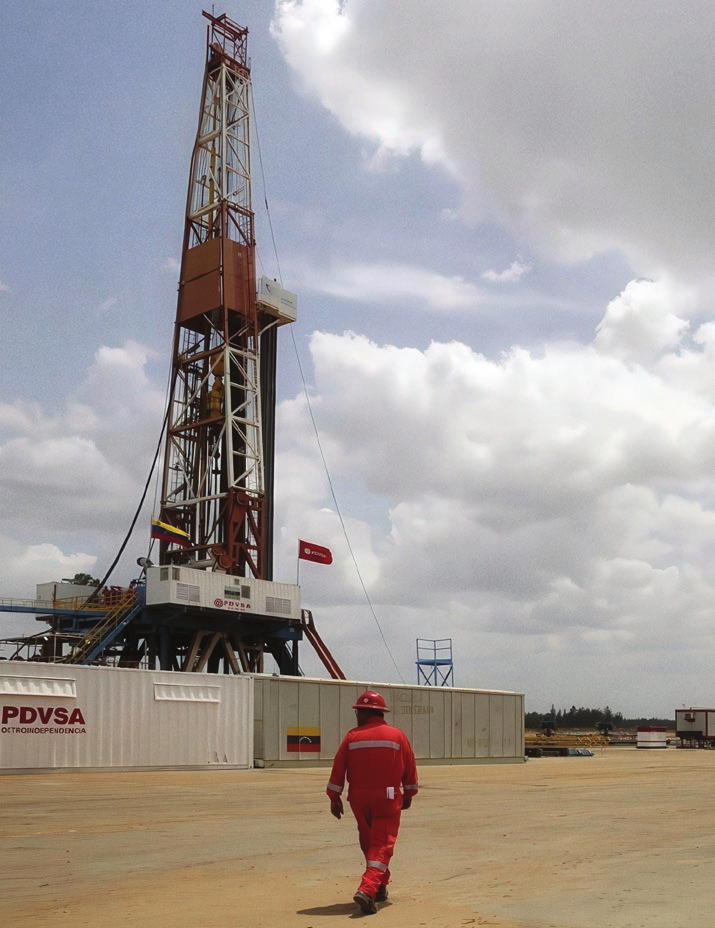
Anyone who’s been following global energy news in recent months has heard many announcements about Venezuela. There are big names making big moves, but what opportunities exist? And is investing in Venezuela worth the risk?
The AAPG Explorer reached out to experts to get their take on the legal, technical and contractual considerations companies should keep in mind when evaluating Venezuela’s oil and gas opportunities.
Leopoldo Olavarría, partner at Fisher Broyles Bravo, advises companies on investments, joint ventures, acquisitions and divestitures in energy and infrastructure projects in the Latin America and Caribbean Region.
He left Venezuela in 2013 to pursue work in Colombia, then Mexico. He is licensed to practice law in all three countries but hopes to go back home when conditions are right.
“Of course I plan to return,” he said. “I have followed my clients where they need me most. My clients now need me to assist with their planned investments in Venezuela.”
Olavarría began traveling to Venezuela following the United States’ military actions on Jan. 3. He monitors what has changed and what has not.
He noted that while business opportunities exist, investors still face challenges.
“Commercial engagement has become more feasible, while improvements in everyday conditions remain uneven and institutional uncertainty persists,” he said.
Olavarría said the most notable changes for the energy sector are closer engagement with the United States, expanded authorizations for certain transactions, and reforms creating additional opportunities for private participation.
“The developments have made investment discussions and project planning more feasible. Their effectiveness will depend on implementation and the durability of the resulting arrangements,” he said.
Conditions on the ground present a more mixed picture.
“Recent reporting describes continued pressure on household purchasing power and persistent interruptions to electricity and other services. In some regions, power shortages have intensified,” he said. “Announced investments therefore should not yet be equated with a broad improvement in living standards or operating reliability,” he added.
He also described a political environment that remains in transition.
“Overall, the commercial outlook has improved more clearly than everyday operating conditions. Companies should assess each location and project individually, particularly its infrastructure, workforce, payment arrangements and legal requirements,” he said.
Advice to Companies
Olavarría counsels his clients to approach Venezuela with both optimism and discipline.
“The country is moving toward a legal framework more open to private investment, creating potentially significant opportunities in oil and gas exploration, production and marketing, as well as mining, electricity generation, and related infrastructure and services,” he said. “Venezuela also has an important pool of experienced professionals, both within the country and across its diaspora, who can contribute the technical expertise and local knowledge these investments require.”
At the same time, Venezuela remains a complex and challenging business environment.
“Each opportunity requires careful assessment of the applicable authorizations, contractual protections, counterparties, financing and operating conditions. I encourage clients to identify risks early, determine which can realistically be mitigated, and structure their commitments accordingly, including through phased investment where appropriate,” he said. “For investors prepared to do that work, Venezuela can offer a compelling opportunity to build successful businesses and contribute to the country’s recovery. Helping clients navigate that process is work I find both intellectually engaging and professionally rewarding.”
Types of Contracts Available
Olavarría explained how Venezuela’s Organic Hydrocarbons Law provides two principal participation routes for investors.
The first is to acquire a minority equity interest in a mixed company, or “empresa mixta,” in which the Venezuelan state retains more than 50-percent ownership. Private shareholders may assume technical and operational management, market all or part of the company’s production and manage bank accounts.
“Minority ownership therefore does not necessarily mean a passive operating role,” he said. “The company’s governing documents and agreements between shareholders should clearly define decision-making, funding obligations and the exercise of these functions.”
The second is a contractual arrangement under which a private company domiciled in Venezuela undertakes upstream activities at its own cost and risk under an agreement with a wholly state-owned company or its subsidiary. Its compensation may consist of a share of production or another permitted form of participation in the project’s benefits.
“The investor’s economic interest arises principally from the contract rather than from ownership of shares in a mixed company. In both structures, ownership of the hydrocarbon deposits remains with the Republic,” he explained.
Choosing the Right Fit
For Olavarría, the appropriate structure depends on the project, the investor’s objectives and the terms available.
“A mixed company may suit an investor seeking equity participation in an established enterprise, provided that governance and operating arrangements are satisfactory. A contractual model may suit an investor seeking to define its operating responsibilities and remuneration directly, while accepting the associated financing and execution risks,” he said.
He advises clients to compare the actual economics and allocation of risk under each alternative.
“Important considerations include operational control, capital commitments, taxes and royalties, marketing and payment rights, existing liabilities, contractual dispute resolution and the treatment of assets when the arrangement ends,” he said, adding that neither model is inherently superior, and companies cannot assume that both will be available for every asset.
“The choice must fit the rights being offered, the required governmental approvals and applicable sanctions authorizations. Non-associated natural gas and other energy activities require separate analysis under their respective legal frameworks,” he said.
Evaluating Risks
Olavarría acknowledged that investing in Venezuela involves political, legal, operational and financial risks.
“Changes in government policy, fiscal terms or sanctions could affect an investor’s ability to operate, receive payment or recover capital,” he said.
The risk extends beyond outright breach or expropriation. Changes in taxation, regulation or the interpretation and administration of contractual terms can also affect investment value, he said.
Olavarría advises clients to be cautious about projects requiring substantial upfront investment and many years before capital recovery.
“These projects are more exposed to changes in policy, costs and market conditions. Their economics should remain acceptable under lower prices, higher costs and slower development than initially expected,” he said.
He also noted how, once substantial capital has been committed to assets that cannot readily be relocated, the negotiating balance can shift toward the government.
“This is often described as the ‘obsolescing bargain’ – the conditions that initially encouraged investment may come under pressure after the investment has been made,” he said.
Olavarría encouraged companies to assess individual opportunities carefully and avoid rushing into signatures.
“I would favor investments whose returns depend on demonstrated operating performance and enforceable commercial arrangements, with limited reliance on further political or regulatory improvements. Where those conditions cannot be established, waiting may be the more prudent investment decision,” he said.
Data-Driven Decisions
But before assessing contracts, regulation and legal frameworks, most oil and gas companies start at the beginning – looking at the rocks and the data.
Robert Sorley, president at Geoex MCG LLC, shared how access to resources and information provides significant change to the investment landscape in Venezuela.
“For the first time in over two decades, the industry has access to offshore Venezuela data refreshed to modern standards, creating an opportunity to reassess the basin with a level of insight that wasn’t previously available,” he said.
Geoex MCG has been engaged in Venezuela for most of the past 10 years. In 2024, the company signed an exclusive agreement with the Ministry of Hydrocarbons and obtained access to data covering the entire offshore. They have spent the past two years working with DUG Technology to apply modern imaging technology to the country’s offshore seismic library.
“Work continues, and plans for a new basin-wide 2-D acquisition program are in development,” Sorley said. “The program is currently open to E&P companies, giving opportunities to provide input on priority areas and survey design before acquisition commences later this year.”
Sorley said a strong technical foundation is critical for exploration teams preparing for contract negotiations.
He encouraged companies to obtain a basin-wide dataset, which allows teams to place a specific block within its wider regional context, rather than reviewing it in isolation. This approach holds particular importance for lesser-known areas like the offshore.
“Venezuela’s offshore sits at a complex tectonic junction, as a result, isolated well or seismic survey data can be misleading when viewed on their own,” he said. “Regional coverage allows teams to see which petroleum system a target is actually associated with, allowing comparison to nearby producing analogues.”
Sorley described how a basin-wide understanding influences a company’s approach to negotiations.
“Exploration teams typically assess opportunities at the basin scale before narrowing their focus to individual blocks, as regional geological trends provide the context needed to validate local interpretations, assess risk and identify the areas with the greatest potential,” he said. “Getting the picture right, before negotiations begin, means fewer hypotheses are tested after a petroleum sharing contract is signed.”
Greenfield Opportunities
Sorley said now is the time for companies to evaluate not only brownfields – fields near existing resources and infrastructure, but also greenfields – unexplored frontier areas.
“Current activity in the country is understandably centered on restoring near-term production,” he said. “However, sustaining that production over the long term will depend on new discoveries coming online, a process that takes years, not months. Companies beginning to evaluate greenfield acreage now, while attention is still concentrated on brownfield production, put themselves ahead of the curve for when the next wave of development begins.”
Sorley said access to data is vital for companies evaluating opportunities in Venezuela.
“For exploration teams, the advantage is clear. They can build a technical understanding of the basin, benchmark opportunities, and identify areas of interest before commercial decisions come into focus. That preparation helps organizations respond quickly and make more informed decisions when opportunities emerge,” he said.
Drawing Conclusions
So, are there opportunities in Venezuela? Yes, many of them. Are there risks? Like in any oil province, there are plenty.
The next 12 months will bring new announcements and opportunities and more reasons for companies to evaluate their role in shaping Venezuela’s energy future.