

Scientists are often presented with disparate pieces of information and asked to synthesize them. They analyze the data, looking for relationships, correlations and causation. Hypotheses are formed and tested and, ultimately, interpretations are formed. Decisions follow and investments are made.As a professional association dedicated to the economic application of applied subsurface geology, AAPG is very comfortable with this progression from scientific discovery to business evaluation.
Recently, I came across two pieces of thought leadership that challenged me to think differently about AAPG’s membership value proposition. Although both were produced by commercial organizations, the insights they offered were directly relevant to the challenges and opportunities facing AAPG.
Evolving Member Priorities
The first article came to my attention while I was researching the factors that drive professional association membership. In 2019, membership management software company Aptify published on its website an article entitled, “The evolution of member benefit priorities throughout the career journey,” summarizing survey findings from its association customers. The survey asked respondents to rank and prioritize benefits they received via membership in their respective societies. All members and membership types were surveyed. What was unique about this survey is that they categorized their findings by career stage.
Two key takeaways stood out to me.
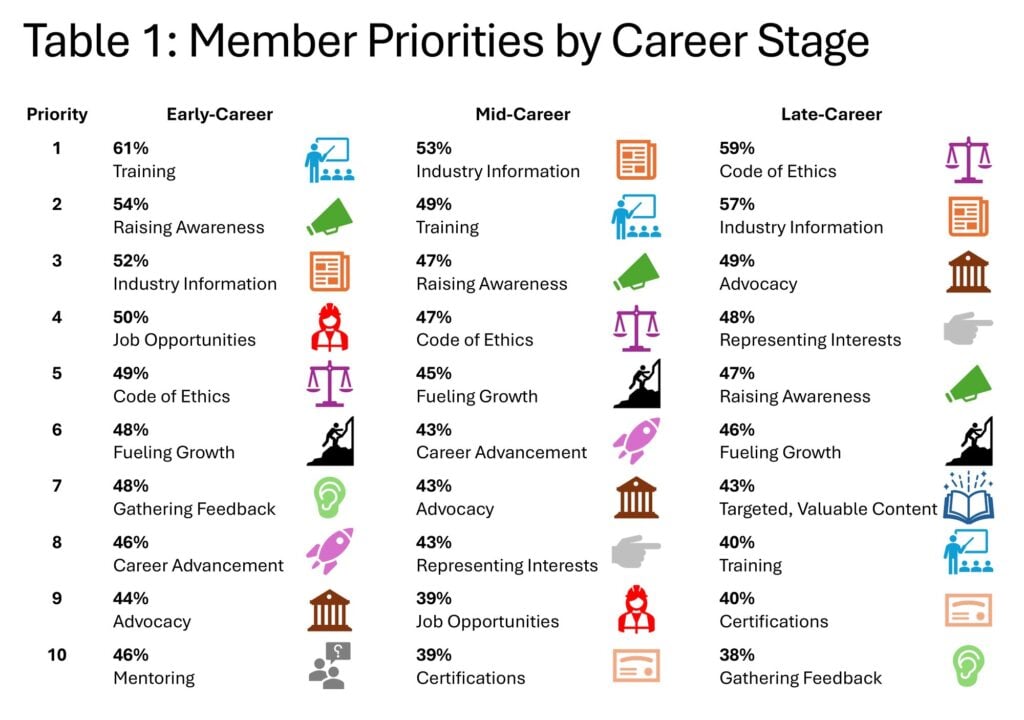
First, the value members place on different association benefits evolves throughout their careers. What members prioritize early in their careers might differ from what they value as mid-career or late-career professionals. Table 1 summarizes the Aptify survey results of prioritized member benefits by career stage.
The color-coded symbols illustrate how the relative priority of each benefit changes across career stages. For example, training (or education) in the light blue color is a highly valued benefit for early career professionals, but it becomes less important to a member throughout their career and falls to a much lower priority for late-career professionals. Whereas profession advocacy (brown), rises in importance throughout a member’s professional career.
For AAPG, these findings led me to two additional conclusions. First, to provide sustained value, AAPG must perform consistently across several dimensions, because the benefits members prioritize will evolve throughout their careers. Second, AAPG currently delivers education primarily through events, workshops and webinars, but we do not offer structured, self-paced digital or face-to-face training. Other professional education providers have expanded into this space, particularly as training has shifted toward digital and on-demand formats since COVID-19. This represents a clear opportunity for AAPG. We have work to do.
Young Professionals
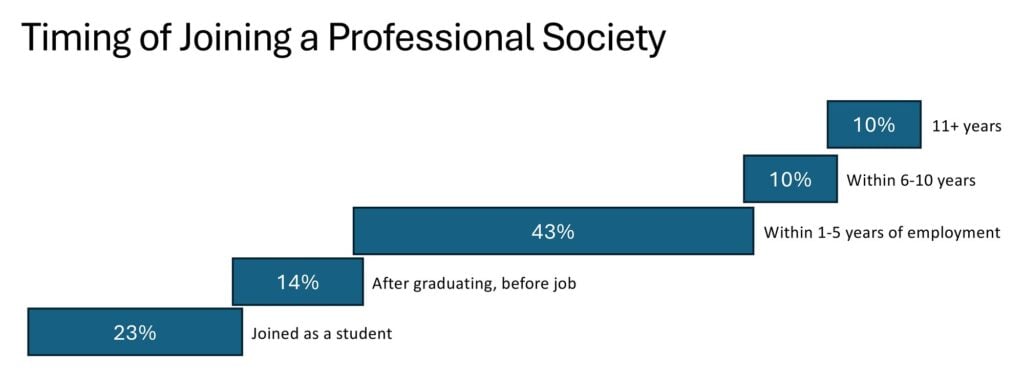
The second key takeaway I captured from the Aptify survey was that the time that most professionals join an association is within their first five years of employment. Roughly 40 percent of members join during this period.
Another approximately 35 percent join as students or during the transition from school to their first professional position.
Historically, AAPG has placed a large portion of its member attraction efforts toward students, but not young professionals. The now-concluded Chevron grant enabled students to join AAPG at no cost, and AAPG benefited greatly from that support. Our members during this past renewal season stepped up to help replace this grant. More than 730 student memberships have been donated by members. Thank you. Even with that generosity, approximately 350 students remain on the sponsorship waitlist. A student membership costs $10.
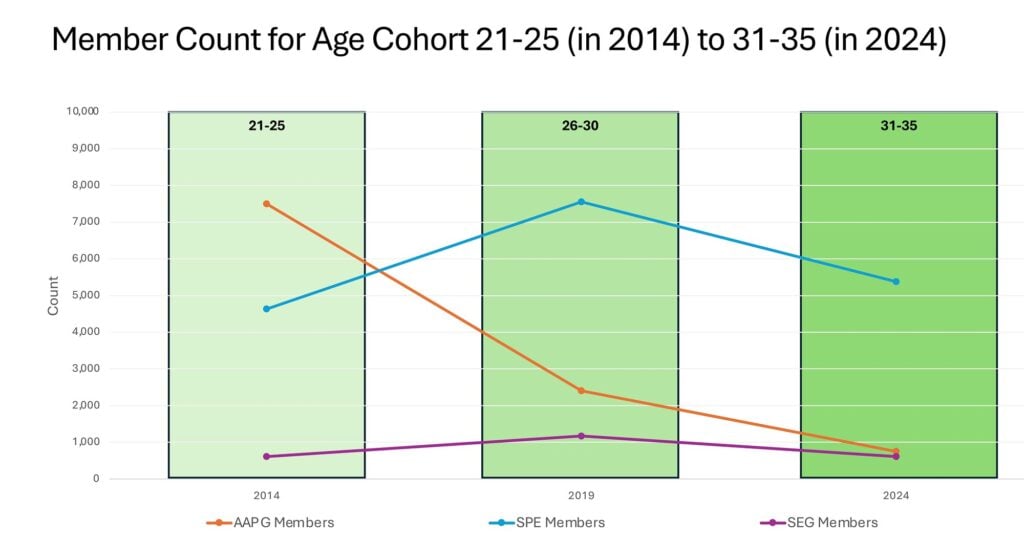
AAPG is renewing its focus on young professionals. Marcella Cilia has been appointed the global lead of young professional chapters, and she is beginning to pull together the data and resources she needs to help us reinvigorate this effort for our membership across both the regions and sections. The challenge the young professionals’ leadership will be looking to address is not only attracting members to AAPG, but also retaining them. In my March 2026 column, I featured the data shown in figure 2.
From 2014 to 2024, we experienced 90-percent attrition in our ranks from those who were students or young professionals (ages 21 to 25) to when they became mid-career professionals (ages 31 to 35). This is not sustainable and, per the Aptify benchmark study, this age window is where we should be seeing the most growth.
Career Transitions
The second article that caught my attention was written by Chris Vaughan of Sequence Consulting. In his article titled “The member who didn’t leave angry. They just left,” published at insights.sequenceconsulting.com, he asserts that most professional associations fail to connect with their members during periods of career transition. This has profound impacts on member retention because, during these transitions, members stop becoming members.
Vaughan provides the following examples in his text to illustrate his thesis:
A young professional joins for a sense of community and ultimately becomes the person people come to for community, only to discover the association has nothing to support them in this new member leadership role. Alternatively, a mid-career professional grows into a senior leadership role, and all the association programming delivered to them still speaks to them as though they are just starting out in the profession. The association has failed them by not recognizing the professional transitions their members are making.
What happens next is the logical outcome; members leave. They just leave and don’t tell the association why. They just stop renewing and the professional society assumes it has a member engagement problem. When, in reality, the association has a relevance problem that no one is tracking.
AAPG is very guilty of this same relevance problem. We do not track a member’s career trajectory well. We typically do not modify our delivery of content to a member based on their current professional needs. We tend to treat our members as a monolithic, scientific profession and focus on advancing the science. We do, however, create opportunities to which members are left to self-navigate, depending on their interests. This includes our special interest groups or divisions.
How can AAPG be aware of our members’ career transitions? We need to find ways to communicate with members to learn of these transitions without being burdensome or invasive. With this knowledge, we could be much more tailored in our approach to engaging a member on a personal level.
Vaughan’s consulting firm took on an engagement with an engineering association not too dissimilar to our organization. What they found is that their association’s members wanted more. Their members wanted the association – with intensity and intentionality – to play a direct role in their career advancement. They wanted help with getting a job, being promoted, making more money, and getting noticed.
This is a very big ask of an association and is a very different membership value proposition than most associations currently offer. Most professional associations focus on advancing their disciplines or sciences without making an explicit connection to a member’s individual career outcomes. I once heard from a former member who said they left AAPG because we did not help them find a job. My initial reaction was to question whether AAPG could or should be responsible for a member’s employment. On reflection, I believe the member might have been asking for something different: “Help me become a stronger professional so I can compete for that job. Help me build the skills, relationships, and visibility needed to advance. Create pathways that connect me with the job market.”
Epiphany
So what did I conclude when I considered these two pieces of thought leadership together?
Quite simply, we need to know our members better. We need to know where they are in their career progression and what they need in their current career moment. We also need to have the foresight to know what they might need in their next career moment and help them make the transition.
Are we a scientific organization? Are we a professional association? Or are we a scientific, professional society? If we answer “yes” to any two of these three questions, the aperture of our member value proposition will need to widen to make sure we are relevant to our members, no matter what stage they are in, in their professional life. I would argue that AAPG is both a scientific organization and a professional association. Our commitment to advancing the science remains fundamental, but science alone might not sustain a lifelong member relationship. Our membership value proposition must also help members learn, connect, lead and advance throughout their professional lives. If we want to remain relevant at every career stage, we must understand not only who our members are, but also who they are becoming.