How do you pick a favorite outcrop?
I don’t know that I can. Over my career, my field work has taken me from the remote reaches of the Gobi Desert in Mongolia, to working outcrops in the shadows of medieval castles in Europe. From the desolate plains, prairies, and deserts of the American West to creeks that are little more than an ambitious drainage ditch in the urban environments of downtown Cleveland and Columbus, Ohio. But, one part of the world always calls me back. Whether it’s due to familiarity, proximity, its world-class exposures, or some combination of all three, I never grow tired of walking the creeks and shorelines of western New York state, measuring, collecting, and analyzing countless meters of Devonian strata.
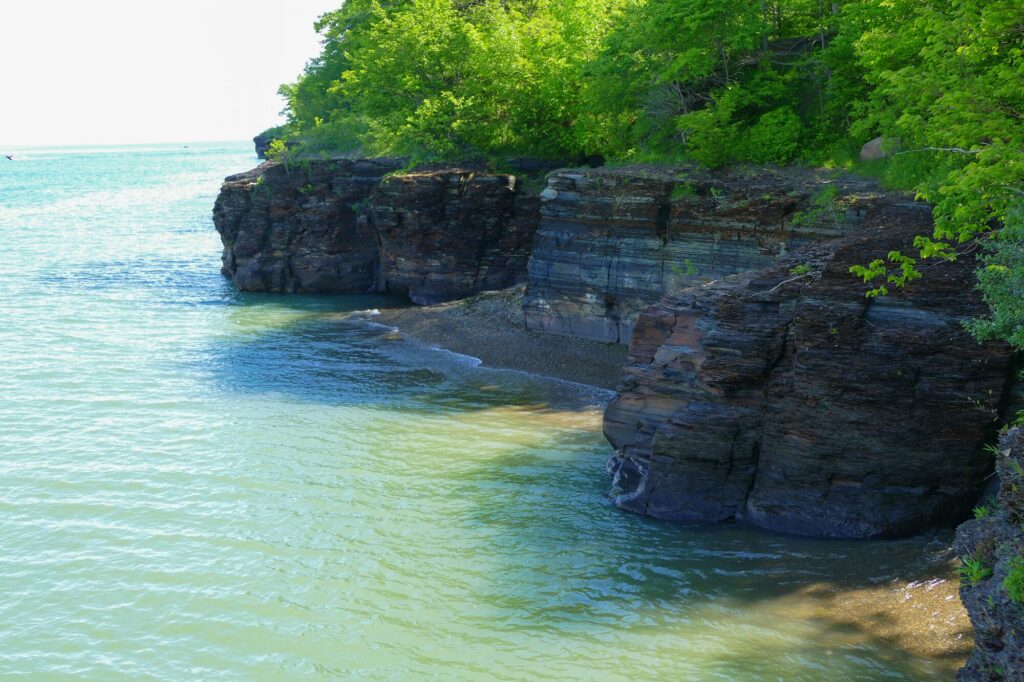
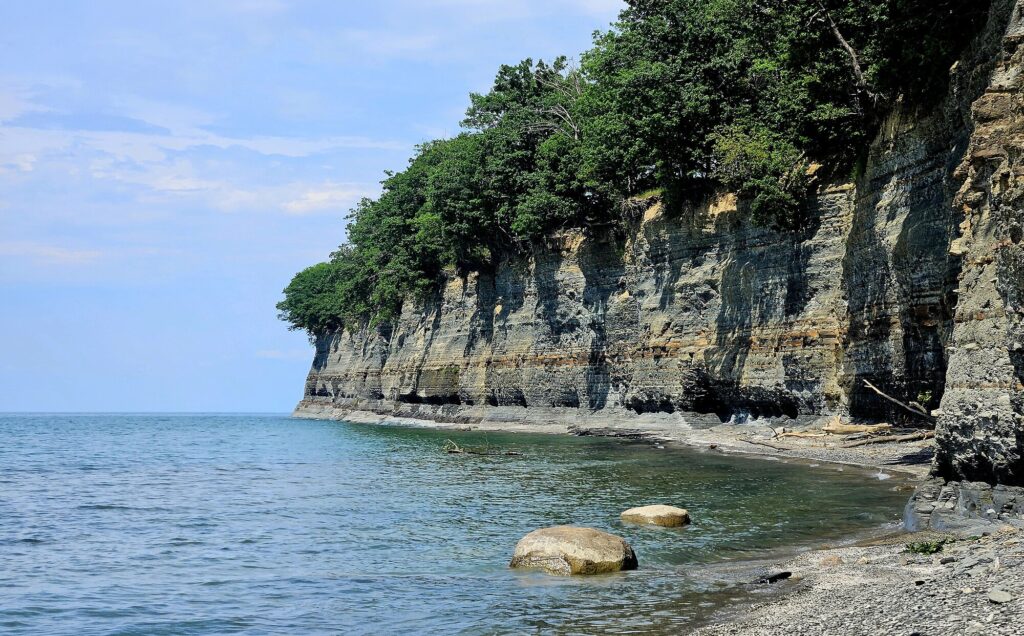
The most recent estimates suggest that 40 percent of New York has Devonian bedrock exposed at the surface or buried just underneath Quaternary soils and glacial deposits. In the western portion of the state, far removed from the effects of the Alleghenian Orogeny, these rocks are relatively undisturbed, dipping at a gentle half degree to the south, with only occasional faults and folds, many induced by ice shove, as glaciers moved through during the last ice age. Indeed, glacial advance and retreat played a large role in the excavation and occurrence of these outcrops. By some estimates, ice sheets in western New York were up to two-miles thick, depressing the crust into the mantle. As these ice sheets retreated, and the mass removed, the crust began to rebound. This isostatic rebound resulted in the rocky, high cliffs along the southern shores of Lake Erie, and the steep walled canyons of the creeks and rivers that feed into the lake as the waters cut down through the rising crust.
This is where I first learned to do geology – where I learned the importance of seeing rocks in the field and getting a three-dimensional perspective, and it is where I continue to satisfy my curiosity about the natural world and learn as much as I can.
Why Settle for Just One Creek?
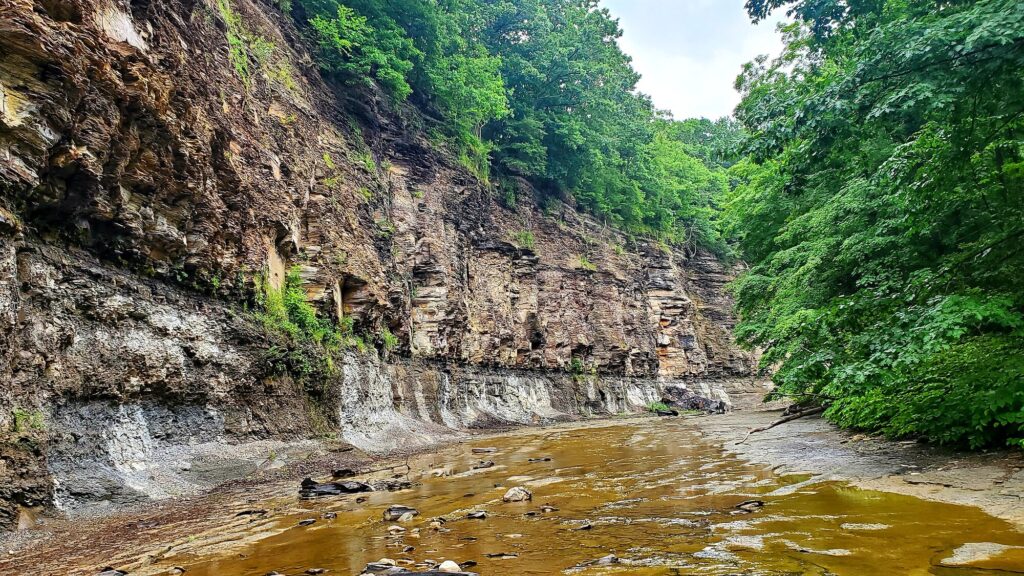
As a student, I learned two approaches to conducting field geology. Much of my time was spent with Gary Lash of the State University of New York at Fredonia. The approach we took was to work on the classic exposures in great detail. Walnut Creek was where one went to work on the Pipe Creek and Hanover Shale. If you wanted to work on the Middle Devonian through Rhinestreet Shale, you went to Eighteenmile Creek. Indeed, if starting at the lakeshore and walking up Eighteenmile Creek, a geologist can walk from the Middle Devonian (Eifelian) Wanakah Shale, all the way up to the high Upper Devonian (Famennian) deposits of the Gowanda Shale before running out of bedrock exposure.
But if you did that, you would notice some differences in the Pipe Creek and Hanover shales on Walnut Creek compared to Eighteenmile Creek. And what would that section look like on Beaver Meadow Creek? What would you find if you walked every creek? That is the approach I learned from Gordon Baird of SUNY Fredonia and Carl Brett at the University of Cincinnati. Why walk one creek when you can walk every creek?
Clues to the Upper Kellwasser Event
Seeing as many exposures as you can opens so many pathways to better understanding the geology you are interested in. On Walnut Creek, I have seen centimeter-thick black shales that look the same, but were deposited under incredibly different conditions. A few miles away on Eighteenmile Creek, the same interval tells a story of rocks deposited in a much more dynamic setting, and here, you can find millimeter-thick horizons that quite possibly answer a question about global ocean circulation patterns. Sometimes the lesson is that simple: the same rock, walked in a different place, is a different rock. And sometimes it’s as simple as how the geometry of a creek or lakeshore changes the quality of an exposure, which allows you to see something you otherwise could have missed.
Over the last five years, I have tried to combine these two approaches to the Upper Kellwasser Event, one of the greatest, and most poorly understood mass extinction events in earth’s history: study as many sections as possible, in as much detail as possible.
Studying the Upper Kellwasser Event has been very rewarding. In many places around the world, it is represented by an organic-rich limestone or mudstone. In the Appalachian Basin, it is a black shale called the Point Gratiot Bed and chasing that signature bed has taught me more about how black shales accumulate and preserve organic matter than any single outcrop ever could on its own. This is knowledge I can carry straight into the black shales of commercial interest. It has also put me shoulder-to-shoulder with geoscientists across a dozen disciplines, in places I never expected to end up, and given me a sharper appreciation for just how lucky I am to live so close to the world-class outcrops of western New York state. Living in Pittsburgh, Pa., it is a short three-hour drive to these outcrops. You will be hard pressed to find better exposures of Devonian foreland basin strata in North America.
The Flame is Eternal, the Opportunity is Timely
With the Eastern Section AAPG Meeting at the end of this month near Pittsburgh (visit esaapg.org for details), I would suggest you make that drive up to Lake Erie, along the lake shore towards Buffalo, N.Y., and find your way to Eternal Flame Falls in Chestnut Ridge Park. Siliceous black shale in the lower portion of the Dunkirk Shale holds up a beautiful waterfall in a small gorge at the end of a well-marked hiking trail. The contact with the underlying Hanover Shale occurs near the base of the waterfall, and the Point Gratiot Bed is wonderfully exposed in the creek banks and waterfall. But the main attraction is the “eternal flame” and as someone who has made a career in the oil and gas industry, I can’t help but get excited every time I see it. Fractures in the shale allow for the vertical migration of natural gas through joint systems from the underlying Rhinestreet Shale up through the strata. This gas exits in a small grotto in the face of the waterfall where it has burned for decades, creating a picturesque scene well worth the drive and hike.
So how do you pick a favorite outcrop? Maybe you don’t, not really. Maybe the honest answer is that a favorite outcrop is just the place where the rock stops being data and starts being the story. A place where extinction events hundreds of millions of years old occur quietly next to a burning flame of natural gas, all of which is there because of glaciers from just a few tens of thousands of years ago. That’s western New York for me. It is where it is always worth checking out one more creek before it gets dark, worth going around that next bend, because in the end, the outcrop rewards the effort it takes to find it.