
In the oil and gas business, the average time from an idea to first production is roughly 15 years. For many investors, that timeline can be a long wait – long enough to look elsewhere.
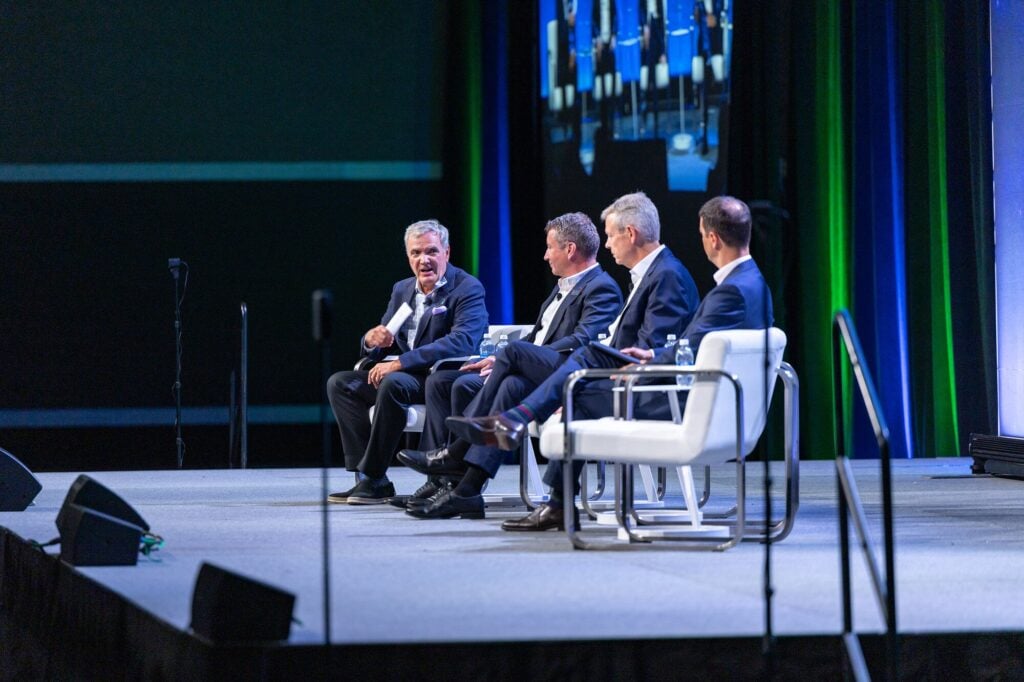
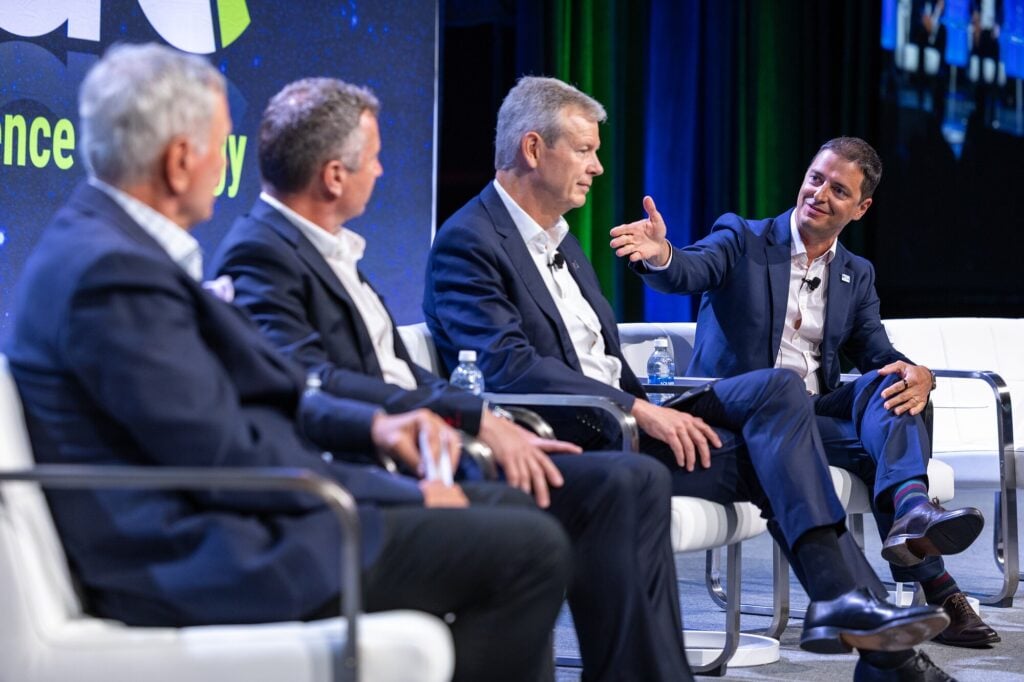
At the annual International Meeting for Applied Geoscience and Energy in Houston in August, a small group of experts shared how this timeline is changing in the opening session panel discussion titled, “Exploration: Shortening the Cycle from Idea to Production.”
Conceptualizing ideas and getting them into realm of discussion is top of the list for John Ardill, vice president and head of global exploration at ExxonMobil.
“It’s very difficult to get your idea moved up and communicated to non-geoscientists,” he said, referring to those who oversee decision-making and budgets.
Yet, once an idea is set into play, it could only take 12 to 18 months to begin drilling, contrasted to the 10 to 15 years one had to wait many years ago, Ardill recalled.
In terms of seismic data acquisition, he pointed to ExxonMobil’s work in Trinidad to emphasize an expedited timeline. It took the operator seven months to move from an idea in the workroom to a fully teamed-out production-sharing contract, followed by boats in the water just six months later, he said of the Ultra Deep 1 block off Trinidad’s east coast.
Decades ago, when a discovery was made, it typically took five to 10 years to have it appraised. Today, the appraisal process takes place alongside development, also shortening the cycle.
While many geoscientists have seen the tools they use change from colored pencils and folded paper well logs to machine learning and artificial intelligence, one constant has remained: “It all starts with the same fundamental idea,” Ardill said. “We often don’t know if it’s a really good one or not. We need data to validate it. It’s all about moving fast today and interplay between the geosciences, the subsurface story around the idea, and then turning that into a very rapid investment.”
In an effort to shorten the cycle, Chevron has taken a different approach to exploration with a new leadership team and a regional theme, said Kevin McLachlan, vice president of exploration. The operator aims for a balance of nearby infrastructure and emerging plays while increasing both quality and efficiency of its operations.
McLachlan pointed to Namibia and Angola as standout examples, which have both seen rapid movement specifically from idea to seismic acquisition. In Namibia, Chevron’s first well was drilled in less than two years, he explained. “It’s looking at every piece of the puzzle to create success in the near term,” he said.
Expediting Ideas
Major oil and gas companies have changed significantly over the last few decades.
“About every five to ten years, there is a major structural shift,” Ardill noted, “and it’s usually bringing people together, optimizing, speeding up workflows, new tools and all of that.”
“The observation I would make for the development to production cycle is that there’s a very, very tight operation between exploration, appraisal and development, where that becomes one team,” Ardill said.
In Guyana, where ExxonMobil is operating six rigs in the Stabroek block, three are running pure exploration and appraisal and another three are running development and production, all of which are overseen by one team.
“There are learnings coming off of every rig line, impacting everything else,” Ardill said. “Geo-steering is going on in Guyana, Houston and India (from its Bengaluru Technology Center) 24 hours a day. So, it’s that hyper-connected model, and that’s the only way we would be able to deliver that pace of production.”
In terms of expediting idea generation, ExxonMobil does most self-origination in house, Ardill said. It looks at data rooms to validate ideas and relies on fundamental studies and retesting.
“Every time someone says, ‘It can’t be done or there’s no oil and gas there,’ we just start asking a few questions. Someone once told me there is no sand or hydrocarbons in East Africa, and that was about six months before the Rovuma Basin (in Mozambique and Tanzania) was discovered (with more than 200 trillion cubic feet of natural gas). I use that example to say … we know a lot less than we think. Just be humble, get to the data, and generate those ideas,” he said.
Service companies are also thinking of ways to expedite exploration and development cycles.
“I think exploration is where the whole life cycle starts,” said Andrea Lovatini, vice president of exploration data and geosolutions for SLB.
While some may believe that exploration is dead, the growing demand for energy coupled with geopolitical challenges make conventional supply routes less obvious and the need for continued exploration essential.
For example, the concept of domain foundation models is very developed in seismic over log space, Lovatini said, and it is beginning to take over the production space as well.
“I think the geoscience community in exploration can play a role in innovating beyond finding resources, for the rest of the project lifecycle,” he added.
A main focus for SLB is acquiring better data from the onset. Surveys are designed from an imaging point of view so that operators can have the right data from the start.
“We are seeing with the images produced today that these types of datasets are much better than what we thought were top-tier seismic datasets, like wide-azimuth, full-azimuth datasets and coil shooting,” Lovatini said. “They reduce time because they reduce uncertainty.”
Furthermore, the adoption of high-performance computing and cloud computing and enabling multiparameter, full-waveform inversion from many sources, including SLB, is allowing images to be produced within days, rather than months, Lovatini said.
Technological Transformation
Artificial intelligence is no doubt helping to speed up timelines in the industry.
“A few years ago, the question was, ‘Are you using AI?’ Ardill said. “The question today is, ‘Can you find a space where you are not using AI?’”
The use of AI in the Permian Basin, ExxonMobil’s largest asset, has helped the operator set new paradigms for how it conducts geoscience and how it builds production capacity. From subsurface data integration, fiberoptic downhole measuring and completion performance, data measurements go right through to the rigs, Ardill explained.
The approximately 40 rigs the operator has in the Permian are managed out of its Houston campus for drilling completions, production operations and emissions management.
“That bench of 40 rigs is collaborative and fully integrated. That data collection is like a Formula One car,” he said. “The learning curves for drilling, completion, cost, every metric, is transformed because of that data approach.”
In addition, the operator has begun using AI to generate prospects and has seen “transformative” progress over the last several years, Ardill said. “I think that will start to really touch or refine and derisk oil and gas,” he said.
Ardill added that it’s not just the large operators making plays like the Permian successful. Small, agile and nimble companies with good ideas, vision and drive laid the seeds for the Permian, and that was followed by larger companies scaling up operations.
“The playing field is open to all here,” he said of the doors being opened by new technology. “If you have the idea, you can probably get it moved forward without having an excellent-sized balance sheet.”
Chevron, as well, is relying heavily on its AI knowledge and bringing that to the deep offshore along with investments in ocean bottom node technology and advanced imaging using full waveform inversion technology, McLachlan said.
“We are rejuvenating our exploration efforts, which, with full expectation, will lead to development of the deep offshore, that being the high focus of our exploration program,” he added. “Some of those areas are super complicated, the Gulf of America is one. Investments in OBN and FWI enhance our ability to bring success, and of course development.”
SLB is investing in AI and automation in the drilling space where it has seen autonomous wells reduce drilling time by up to 40 percent, Lovatini added.
“That’s a huge savings in time and capital,” he said.
Better Data in Frontier Basins
While the United States has led the world in shale and deep offshore basins, the drive for innovation can be seen in smaller sects of the world. In the last several years, SLB has seen the demand for more and better data from frontier basins around the globe, Lovatini said.
In emerging basins, that poses a challenge in terms of capital and balancing value with cost.
“Our effort is how can we take these technologies that are making a difference and use them in different basins?” he said. “Technologies like OBN and advanced imaging can really make a huge impact, and going into the automation of some of the workforces can help reduce the cost element, not just the time.”
SLB is currently experimenting with ways to achieve more affordable survey costs without sacrificing quality.
“It’s a blend of geoscience technologies with intelligence technology,” Lovatini said.
Yet, McLachlan argued that top-tier technology is essential, and so well worth the cost, for companies to thrive, citing Chevron’s large footprint in Angola. Investments in OBN and FWI have been expensive but have led to “impressive outcomes,” he said.
A recent lookback showed the operator that had current data been available at the time of drilling, six of nine dry holes would have been drilled differently or would not have been drilled at all, McLachlan said.
ExxonMobil once held on to unused acreage but now discards it in favor of developing new ideas.
“We are very high on maximizing the ideas, moving them as absolutely as quickly as possible,” Ardill said. If an idea looks promising, the operator will buy as much acreage as possible to explore and develop it.
“It’s all about the pace, capturing the ideas, getting to the first decision as quickly as possible, and if you like it, act on it,” he added. “It’s about seeing the opportunity before others, and being the fastest to the first exploration well.”
Moderator of the session, Bob Fryklund, vice president and chief strategist for the Upstream Energy Group at S&P Global Energy, noted that oil and gas are making a resurgence with investors and comprising nearly 7 percent of the S&P 500 index.
“The main thing that boards, investors, and the gentlemen up here with me think about most of the time is the value of money and how to return that quickly,” he said. “Everybody is involved in this, so it’s an interesting game.”