
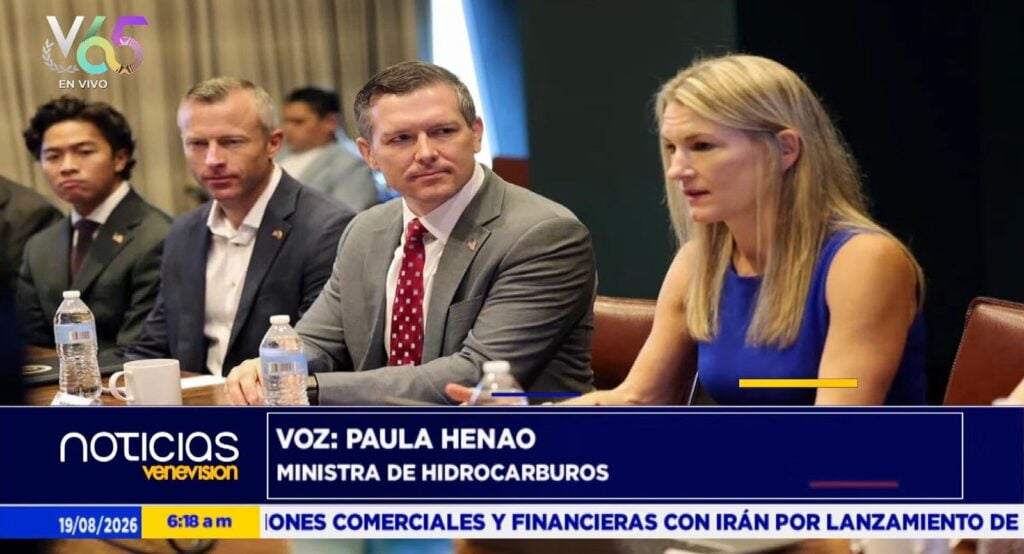
U.S. and Venezuelan officials strengthened bilateral relations and made historic announcements about Venezuela’s energy sector at the International Meeting for Applied Geosciences and Energy, organized by AAPG and the Society of Exploration Geophysicists in Houston in late August.
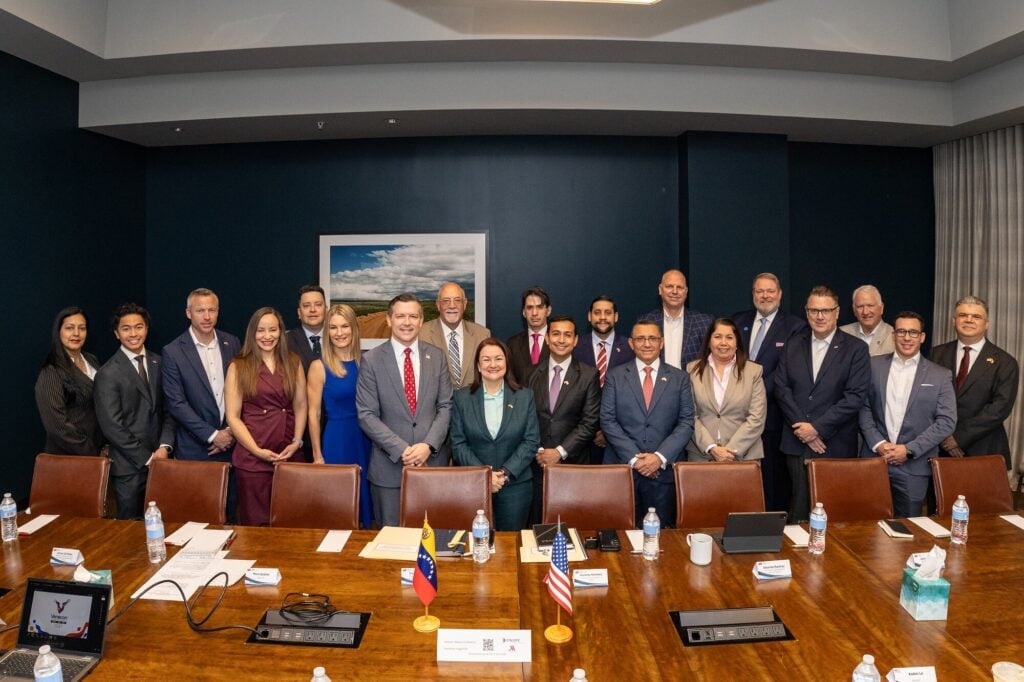
The Venezuelan delegation to IMAGE, led by Minister of Hydrocarbons Paola Henao, included Vice Minister for Geopolitics and Hydrocarbons Eduardo Ramírez, PDVSA Executive Vice President Jovanny Martínez, Chargé d’Affaires to the United States Johan Álvarez, and 16 other representatives from the Ministry of Hydrocarbons, PDVSA and the Venezuelan Embassy to the United States.
The United States Department of Energy also sent a delegation led by Under Secretary Kyle Haustveit.
Haustveit, Henao and Martínez delivered keynote talks at the IMAGE session “Empowering Venezuela: Energy, Investment and Opportunity,” a special forum highlighting Venezuela’s energy resources, investment opportunities, regulatory framework, and reconstruction efforts following the June 24 earthquakes.
The Value of Technical Events
Henao, a petroleum engineer, expressed appreciation for the opportunity to speak at a geoscience conference and said attending IMAGE made her “feel like a kid in a candy store.”
She also recognized the importance of engaging in technical meetings.
“With over a century of experience in petroleum engineering, our nation is reconnecting with top-tier global technical forums, fostering technology transfer and cooperation with the world’s leading societies of geologists and geophysicists,” she said.
Henao’s presentation featured three key themes:
- Resource Potential and Subsurface Characterization: Reaffirming the magnitude and quality of the country’s hydrocarbon reserves
- Legal Framework and Investment: How updates in Venezuelan legislation are providing legal certainty for international-scale projects
- Business Opportunities: Mechanisms for developing sustainable energy partnerships.
“We are showing the world not only the investment opportunity available in Venezuela – given our country’s vast oil and gas reserves – but also how to successfully finalize the contracts that will enable the conversion of those reserves into barrels at the surface,” she said.
The Aug. 18 forum concluded with a technical presentation from Yurbis Gomez, executive director of exploration and integrated reservoir studies for PDVSA, who shared maps showing light crude and free gas opportunities and explained why continued exploration is important in a country with proven oil and gas reserves.
People, Progress and Potential
Haustveit organized his remarks around the people needed to develop the oil and gas industry, the progress made since Jan. 3 and the potential yet to be achieved.
He noted that Venezuela has a proud energy history built by generations of workers, engineers, and innovators, not unlike North Dakota, the oil state where he grew up.
“Venezuela’s energy expertise runs deep, and its engineers helped pioneer the production of heavy oil which have since been deployed across the world,” he said.
Haustveit shared about progress during 2026 and signaled growth to come.
“Venezuela has gone from producing under one million barrels per day in December to nearly 1.3 million today (August 2026) – roughly 30-percent growth,” he said.
He described similar growth in imports in recent months.
U.S. imports of Venezuelan crude have increased by more than 400,000 barrels per day, helping supply Gulf Coast refineries for heavy crude. Additionally, diluent exports to Venezuela have climbed from essentially zero in the second half of 2025 to more than 100,000 barrels per day in August 2026.
But there is more work to be done, he said.
“Venezuela holds more than 300 billion barrels of proven oil reserves – the largest of any country in the world and roughly seven times the U.S. Yet Venezuela currently produces only about one-tenth of what the United States produces,” he said.
He invited companies to join the effort to build a stronger energy partnership between the United States and Venezuela.
“America has the light oil Venezuela needs to help move its heavy crude, and America has refineries engineered to turn that crude into diesel, jet fuel, asphalt, and other products that power our economy,” he said.
“With greater certainty, transparency, and a competitive process, Venezuela has built the potential to return to its previous high of 3.5 million barrels per day and go beyond it.”
Contract Signing
Immediately following the special Venezuela forum at IMAGE, representatives from the Venezuelan Embassy in Washington repurposed the ballroom to host a signing ceremony for the Minister of Hydrocarbons, executive vice president of PDVSA and executives from private companies.
Minister Henao and PDVSA Executive Vice President Jovanny Martinez signed two agreements: a Hydrocarbon Production Participation Contract with Hunt Oil to boost production at the Caro and Carisito fields; and a framework agreement with SLB to provide integrated reservoir study and characterization across Venezuela.
Henao said the signatures comply with acting Venezuelan President Delcy Rodriguez’s mandate to strengthen international cooperation and support the Venezuelan people, particularly those affected by the devastating twin earthquakes that killed more than 7,000 people in June.
“These agreements – aligned with the Partial Reform of the Organic Hydrocarbons Law – aim to generate direct social well-being for the Venezuelan people by supporting priority sectors,” she said.
“This includes assistance for communities affected by the seismic double event on June 24, as well as support in the areas of health, food, education and entrepreneurship.”
The signing ceremony drew high-profile visitors, including representatives from the U.S. Department of Energy and the White House National Energy Dominance Council.
The Venezuelan government’s IMAGE participation made international news. Photos from the special session, contract signing and private meetings appeared on multiple Venezuelan television networks, in energy industry publications and on the Hydrocarbon Ministry and PDVSA social media accounts.
Private Meetings and Future Plans
The U.S. and Venezuelan delegations used their time at IMAGE to meet with companies interested in Venezuela, as well as with executive directors and senior staff from AAPG, SEG and the Society of Petroleum Engineers.
Society leaders met with the delegations to discuss plans for the Venezuela Energy Conference (Venecon), a multidisciplinary conference featuring a technical program, executive sessions, student and young professional activities and an exhibition.
Operated by AAPG, SPE and SEG, Venecon is the first international technical event to be held in Venezuela in more than two decades.
During the private meeting, officials from the Ministry of Hydrocarbons and PDVSA agreed to host and provide financial backing for Venecon. U.S. Department of Energy officials committed to providing institutional support.
Henao, Haustveit and Martínez joined the program chairs from AAPG, SPE and SEG in making the formal Venecon 2027 announcement at the Venezuela Forum held at IMAGE.
Venecon is set to take place in Caracas in June of next year.
For additional information about Venecon see Venecon.org