
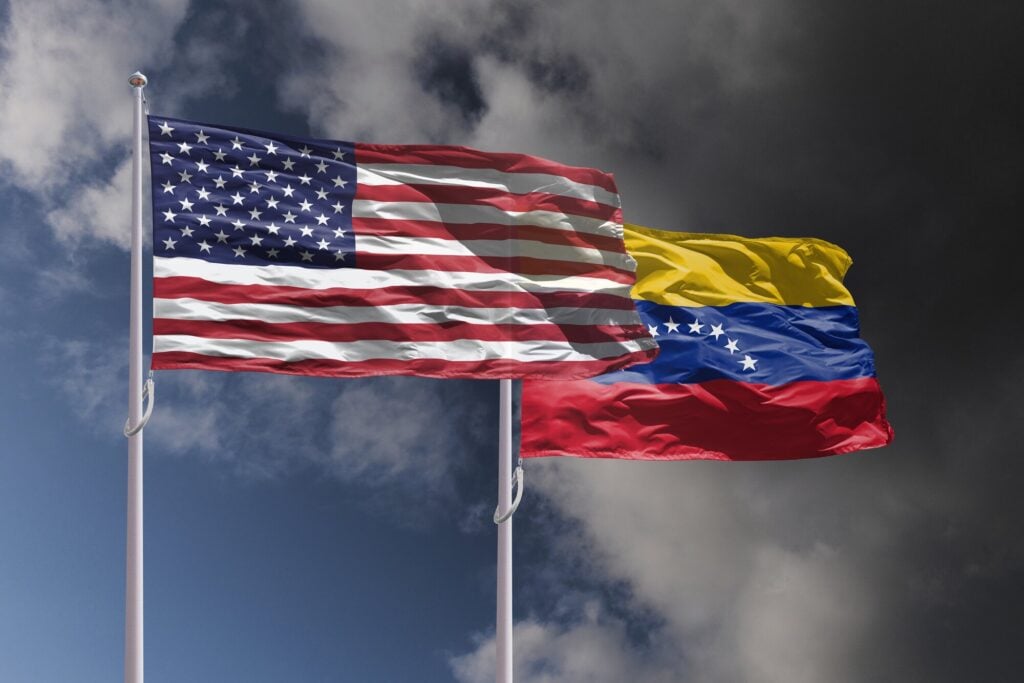
In late August, U.S. President Donald Trump announced the “biggest oil deal in history” – an agreement granting majority control of more than 65 billion barrels of Venezuela’s proven oil reserves, expanding U.S. current oil and natural gas reserves, estimated at 46 billion barrels in 2024, according to the International Energy Agency.
Three days later, U.S. Secretary of State Marco Rubio and Secretary of War Pete Hegseth signed the deal with North American Blue Energy Partners, a privately held oil company based in Barbados.
NABEP’s oil production, estimated at approximately 180,000 barrels per day, is second only to Chevron, whose production averages 200,000 bpd.
The White House provided additional details in the days following the signing.
According to the report, the Pentagon’s Office of Strategic Capital takes a 35-percent stake in NABEP’s parent company, the U.S. State Department has the right to buy 20 percent of output at production cost and NABEP commits to invest up to $100 billion in new infrastructure. The agreement is governed by U.S. law with jurisdiction in U.S. courts.
The White House statement celebrated the agreement, publishing the statement “This deal secures our energy dominance for the next century – all at zero cost to the United States.”
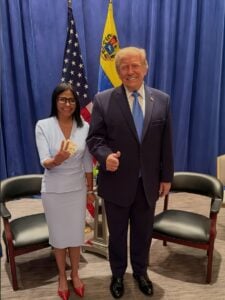
Venezuelan President Delcy Rodriguez described the agreement as “historic” and said it would generate $100 billion (U.S.) in investment and $200 million in tax revenue for Venezuela.
Skeptics
Despite both presidents’ public optimism, the deal also brought questions and criticism.
Shortly after the signing, questions surfaced about NABEP and its controversial leader, Alejandro Betancourt López, a 46-year-old Caracas native who has been doing business with the Venezuelan government since the late President Hugo Chávez ruled the country in the early 2000s.
Betancourt is one of several young businessmen nicknamed “bolichicos,” a slang term combining the words “Bolivarian” (referring to Chavez’s socialist revolution) and “chico” (“boy” in Spanish).
Though he never allied formally with the Chavez or Maduro governments, he benefitted financially during their mandates.
Betancourt came into fortune at height of the Venezuelan energy crisis in the 2010s when he founded Derwick Associates, an electrical company that received $5 billion in no-bid government contracts to build power plants throughout the country.
Watchdog group Transparency Venezuela accused Betancourt and Derwick Associates of price gouging and corruption in articles published on its website.
“(Betancourt) secured 12 contracts in less than 14 months to build power plants in various states across the country, despite his company having no proven track record in executing civil engineering projects. The approval came from the government of then-President Hugo Chávez, which paid the company $2.9 billion in alleged overcharges, according to the organization’s calculations,” the site reported.
The site also connects Betancourt with other Venezuelan businessmen accused of embezzling funds from PDVSA.
In a Sept. 17 letter directed to Secretary of State Marco Rubio and Attorney General Todd Blanche, democratic representatives Robert Garcia, Gregory Meeks and Jared Huffman, ranking members of the U.S. House of Representatives Oversight and Government Reform, Foreign Affairs and Natural Resources Committees, respectively, demanded information on the negotiations that led to the deal with NABEP.
The letter referenced news reports of Betancourt being named in investigations for money laundering, bribery and tax evasion in the United States, Spain and Switzerland, and of senior U.S. officials contacting foreign governments and encouraging them to end criminal investigations so Betancourt could travel to the United States.
“Congress has a right to know who the President has chosen to conduct business with and whether he is collaborating with an alleged criminal with a history of white-collar misdeeds,” they wrote in the statement.
Betancourt has not been convicted of any crime, and supporters claim he is being judged unfairly.
Acting President Delcy Rodriguez defended Betancourt in a press conference held in Caracas on Sept. 2.
“Often, a person is tried in the media before being tried in court,” she said, adding that Betancourt “has no pending case” against him in the United States.
Rubio defended the oil agreement with NABEP in a podcast interview with Venezuelan journalist Sergio Novelli on Sept. 1.
Rubio also noted that Betancourt has no open investigations in the United States, and NABEP has a track record of producing oil in Venezuela – a key factor in ensuring continued development of Venezuela’s energy sector.
Rubio also emphasized that the U.S. government signed the agreement with a private company, not with the interim Venezuelan government led by Rodriguez, and that the system put in place will allow the company to produce more and make payments to the current Venezuelan government, and a government that will be elected democratically in the future.
Forbes contributor and economist James Broughel wrote on Sept. 5 that U.S. government involvement provides assurance to companies who might be skeptical about doing business in Venezuela.
“What makes this agreement different is that investors do not have to trust Venezuela itself. They can trust the outside institutions Venezuela has agreed to rely on,” he wrote.
Broughel described the agreement as a “‘commitment device,’ an arrangement that raises the cost of breaking a promise so that the promise becomes believable.”
He explained how countries with weak institutions have used such devices for a long time. Dollarization, for example, ties a central bank’s hands by taking away its ability to print its own currency.
“The oil deal does the same thing to Venezuela’s habit of rewriting contracts. Venezuela’s new hydrocarbons law, amended in January with what the White House calls U.S. support, already lets disputes go to international arbitration,” Broughel said.
“The new deal goes a step further by making the U.S. government a party with money at stake, which is perhaps the strongest guarantee a small country can offer a skittish investor.”
Dissecting the Deal
But what did the U.S. government sign with NABEP? And how will the deal benefit the people of Venezuela and the United States?
Leopoldo Olavarría, Venezuelan lawyer and partner at Fisher Broyles Bravo, read the announcements closely so he could provide advice to his clients, companies interested in investing in Venezuela.
“I was surprised, as many others surely were, by the magnitude of the deal and its bold character,” he said.
“The agreement could support a substantial recovery in Venezuelan oil production, generate government revenue, and create business for equipment suppliers, engineering companies, logistics providers and refiners. However, its economic value depends on financing, enforceable contracts and actual production rather than on the volume of oil reportedly underground.”
Olavarría said the most credible commercial opportunities are likely to emerge in stages: rehabilitating existing operations first, followed by larger developments once investors have greater confidence in costs, legal protections and payment arrangements.
“At this stage, any announced investment and fiscal revenue projections should be treated as conditional projections,” he said.
Benefits for the United States
Olavarría said the agreement could benefit the United States through three principal channels:
1. Access to oil: The announced terms give the Department of State the right to purchase 20 percent of NABEP’s production at cost and first refusal over the remaining output. These rights could support strategic stockpiling and other government supply needs.
2. Potential financial returns: The announced 35-percent economic interest in NABEP’s corporate parent could generate dividends and appreciation, depending on profitability and the definitive financing arrangements.
3. Business opportunities: Development could create demand for American oilfield equipment, engineering, technology, logistics and refining services.
Olavarría clarified that benefits will depend on successful investment and production.
“Preferential purchasing rights still require payment, and substantial investment may delay shareholder distributions,” he said. “Additional production could eventually ease oil prices, but rapid reductions in U.S. gasoline prices should not be assumed: many covered fields require extensive rehabilitation or new infrastructure.”
Impact on Venezuelans
Olavarría also addressed a second question: How will the deal benefit the Venezuelan people?
If successful, the agreement could benefit Venezuelans through public revenue, employment and demand for local businesses.
“Venezuelan authorities have projected approximately $209 billion in fiscal receipts over 25 years, using a $65-per-barrel reference price. These are conditional estimates, rather than guaranteed payments. If realized and effectively allocated, the receipts could help finance infrastructure and public services,” he said.
- Workers and local suppliers could gain from construction, maintenance and operating activity; the extent would depend on local hiring, training and procurement.
- Households would benefit most if additional public revenue provides better services and broader economic opportunities.
- Producing communities would need effective environmental management so that increased activity does not impose costs that outweigh local benefits.
“For communities to benefit, the distribution of those benefits is crucial,” he said.
“Higher oil revenue alone will not ensure improved living standards. Transparent spending, effective institutions and accountability will determine how widely the gains are shared.”
Payment controls also matter.
Applicable U.S. sanctions licenses direct certain government receipts into designated accounts, so revenue generated is not necessarily immediately available for unrestricted spending by Caracas.
“In short, the United States could gain supply security and commercial returns, while Venezuelans could gain revenue and economic activity. The scale and fairness of those benefits depend on implementation, financing and governance,” he said.
Evaluating Success
In his Sept. 5 Forbes article, Broughel identified specific ways to determine if the NABEP agreement is successful over time:
- A full contract text will be published – a demand voiced by opposition leaders.
- ExxonMobil and ConocoPhillips, companies that experienced expropriation in 2007, will bid on the greenfield blocks the government has offered for private investment.
- A freely elected National Assembly will ratify the deal in 2027
- Production will reach the 1.5 million-barrels-a-day target President Rodríguez has set by the end of the decade.
“If those things happen, the deal will have shown that the Venezuelan government can make a promise investors believe and that its own citizens stand behind it,” Broughel wrote.
For now, the deal is moving forward, and NABEP is contracting technical professionals in Venezuela.
Another chapter in Venezuela’s oil and gas history has begun.