
“Hey, can you take that strike reading a little quicker?” asked Taylor, holding a steady map board in a three- ridge limestone bedding plane for nearly a minute.
It was hot. They’d been mapping for nearly six hours. They had hiked a couple thousand feet uphill. It was an hour-long hike to the base of Barres de Chine on a fire road before they had a half-hour van ride home to their cottage north of Digne-les-Bains, France.
“Hold on, I’ve almost got the bubble in the center,” replied Sam, holding the Brunton, trying to take a strike of the bed which was dipping at less than 10 to 15 degrees.
Anyone who has mapped in the field understands the struggle. Especially if you were without a teammate trying to get in the plane of bedding to take an accurate measurement.
Teammates make life better. From the relatively simple, yet non-trivial tasks associated with training geoscientists who will answer Burgum’s call to “Map, map, map!” to the very complex equations required for sub-salt AVO, teammates fill in the gaps in our understanding, provide an alternative interpretation of the same data, add companionship and – most of all – give us an edge in exploration.
While students are introduced to geoscience teamwork through collaborative field mapping exercises, the exploration business demands that you thrive in a team setting. With regard to the transition from school to the industry, Derek Adams said it best: “The biggest difference between my academic career and my professional career is that in academia, you were your own team whereas in industry, it is literally impossible to achieve the things (at scale) alone. Collaboration and teamwork is key.”
Adams continued in the highlighted quote of this installment of The Explorer’s Mindset: “To develop a great team, the team needs to have common goals. They need to all be pulling in the same direction. No selfishness. That is key. You also need a diverse team. You need diversity of thought, different backgrounds, life experiences, etc. There is nothing worse than a team that all agrees with each other. That probably means you’re missing something. You need disagreement, but not dysfunction. Everyone needs to feel comfortable enough to disagree, to be comfortable with being vulnerable in front of their teammates and having the trust that that vulnerability won’t be taken advantage of. It’s a deeper level of teamwork.”
“The Power of the Team” is one of the key themes discussed in the book, “The Explorer’s Mindset.” When preparing the book, I didn’t plan on having an entire section on it. It came about because in every interview, every explorer discussed the importance of their teammates.
The fundamental principles underlying the Power of the Team are:
- Be a good teammate.
- Give credit.
- Link arms to serve each other.
- Run to the challenge.
- Offer perspective.
- Be an MVP.
‘People Would Follow You Over a Cliff’
Why be a good teammate?
The best explorers are such good teammates that, over time they’re typically recruited to build exploration teams. Good team members unite people.
At many companies, a lot of people want to be the leader. But companies select top performers who can build a team and effectively lead the team.
Elijah White, Jr., retired executive from ExxonMobil, explained:
“I didn’t want to be a supervisor. A lot of people come in with aspirations. What we had was a global ranking system. All leaders come from high in the global ranking. I’ve never been the smartest guy in a room in any room at ExxonMobil. So, it can’t be smarts. It can be how you relate to people. When I was talking to an executive in Irving, he said to me, ‘You have loyal followers Elijah – your people would follow you over a cliff.’”
White added the critical caveat: “People do trust you enough to know that you would never lead them over a cliff.”
White builds such a rapport with his teammates, that once he’s taken out of a team (he retired), there is a leadership gap that needs to be filled.
Good teammates continue to be good teammates, even after they’ve moved on to other phases of life.
Give Credit
The best geoscientists value teammates and are quick to give thanks to their team.
Describing the Conjugate Basins, Tectonics and Hydrocarbons Research Group at the University of Houston, Paul Mann said, “Although I am the primary supervisor of many students in the CBTH group that has included up to 21 students at one point, with such large numbers I quickly reach my limits in both my time and my skill sets. We involve many UH faculty members on the thesis committees like Dale Bird, John Suppe, Jonny Wu, Julia Wellner, Stuart Hall, Jiajia Sun, Mike Murphy, and John Castagna. I have encouraged the participation of subject matter experts like Charles Sternbach and Kurt Rudolph to become adjunct professors at UH and have a closer link to our project.”
F. J. Hernández-Molina gave credit, too, to the students and their essential traits that enable The Drifters to have so much success in understanding contourite and mixed deepwater systems that are the recent deepwater exploration craze: “We have had a productive teamwork effort in the group, where the students involved have been essential for its success. Most of the credit goes to these students. All the students have been exceptional. All of them. Very motivated, very hardworking students, which makes it easy on me to coordinate work.”
Hernández-Molina continued on the aim of the collaborative effort: “In the beginning, around 2017-18, one of my aims was to have a student working in a specific topic in the ancient and another student working the same scientific problem in the modern ocean, in order for students to collaborate together over two to three years to find out what is common and what is uncommon in a deepwater sedimentary system.”
Linked Arms, Servants to Each Other
We’ve all observed teams that are like listening to a symphony tune its instruments prior to a performance. Before the final note that signals the first song of the night, there’s a lot of discordance. A cacophony of sound. But when the instruments sing in unison is when they finally link key and tone, producing nirvana for the ears.
Diane Woodruff explained what this is like in the exploration business: “You can have the most talented people in the world, but you need the right mix. Team members need passion and humility, which is very important as I think back to Anadarko. These were the core values we had as a company. Trust and integrity are important. Work ethic is so important. It is summarized in servant leadership, which means everyone on your team has to be thinking about each other and what they can do for the greater good of the team. All the pieces of the puzzle are needed to make a good and complete team when it’s assembled. You don’t want a team with too many leaders, but a team with linked arms to move forward as one. Those are the components to make a great team.”
Mark Shann thought this was such an important point by Woodruff, he emphasized it in the foreword of “The Explorer’s Mindset.” Take it from the best in the business that good teamwork is crucial to the success of the project.
Try Running to the Problem
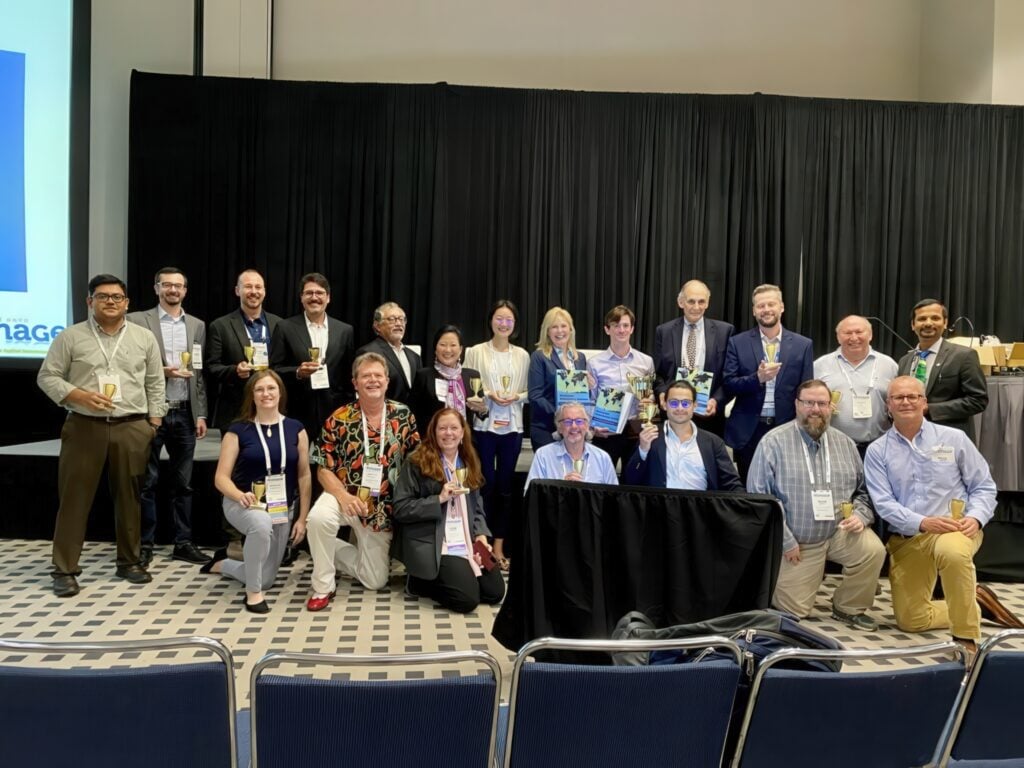
Cindy Yeilding, Rich Sears, Lori Fremin, Lisa Goggin, Ryan Weber and I were huddled around our campfire, talking about what we talk about the most: deepwater exploration. And by “campfire,” I don’t mean a real, live campfire. It is projected from my laptop onto the big screen. This is our “fireside chat,” where I get to ask candid questions to these executives on teamwork and leadership. We are halfway through leading another workshop on The Explorer’s Mindset, this time at IMAGE a few years back.
We got on the topic of imploding employees – those who are just having the roughest of times. Whereas many people run from them, my teammates have a different approach.
“Cindy, how do you approach members of your team and encourage them when it’s all going wrong for them?” someone asked.
“We need to recognize that we all go through rough patches. Many people run from or ignore people who seem to be imploding. They might not want to be associated with the person, or take on their stress, which is kind of awful when you think about it. If you sense that your colleague is struggling, be sure to offer your support by inquiring about how they are doing, or asking if there is anything you can do to help them out. Your listening, support and advocacy are important. Your teammate may not choose to take you up on this offer, but they will know that you care and are invested in their well-being as both a person and a co-worker,” she answered.
So, the next time you see a teammate having a rough time, don’t be afraid to be a compassionate friend. It might pay dividends immediately or down the line – not just for the company and shareholders, but when you are having a monumental challenge.
Teammates Give Perspective
Like Alex Cranberg mentioned in a previous installment (see April 2026, “100-percent-it is”), showing your prospect to teammates – both at your company and outside the company to potential working interest owners – gives perspective. They’ll show you what’s wrong with your prospect and fill in the gaps in your understanding.
Teammates allow you the perspective to solve big, complex challenges, like those in energy.
Scott Tinker described the team at the Bureau of Economic Geology working to solve these big energy challenges: “We have a very diverse group of nations represented at the BEG: 25 nations from six continents – it’s a bit like a United Nations meeting when we all get together. Different cultural, religious, educational and socioeconomic backgrounds. This diversity helps us to achieve big goals. Diversity sounds great, but true diversity is not easy. You have to be open to different perspectives and upbringings … My goal is to create an environment that supports the team.”
“Many people wouldn’t even like each other working together back in their home countries,” he joked.
That’s great teamwork, Scott.
Are You the MVP?
Many of you have experienced the interview process with major exploration and production companies. So many scholastic tests evaluate how much you know and your cognitive abilities, like the SAT, GMAT, GRE and LSAT. Interviewing at exploration and production companies is a different process. Some evaluate your ability as an explorer, to be able to interpret seismic profiles or a seismic-scale outcrop. Still other companies take you through behavioral interviews, testing your emotional intelligence and how you respond and recover from setbacks. Another set of companies use interviews to evaluate your ability to contribute as a teammate. These interviews test your understanding of how you value the Power of the Team.
The candidates who perform the best in these group interviews ask questions of their teammates, find out their skills and how to apply their skills towards an outcome that benefits the company and shareholders. These most-valuable players integrate the team’s skillsets. No surprise – MVPs are great listeners, too, the topic of the May 2026 installment (see “The Best Explorers Listen”).
The real MVP is the one who knows the value of their teammates in the process of finding and producing oil and gas. My challenge to you, AAPG membership, is to be the MVP to lead your teams in successful exploration.
Go on, be the MVP.
This article is the ninth of the monthly articles on The Explorer’s Mindset prepared for AAPG Explorer. This column is based on the second edition of the book “The Explorer’s Mindset: Lessons in Leadership in Applied Geoscience and the Energy Industry.” Over the course of the series, we’ll be looking at the traits of the successful explorer, their leadership qualities and what has enabled them to make game changing discoveries.