
Venezuela’s hydrocarbon law reforms implemented this year are intended to attract foreign investment, and signs indicate the industry is in recovery.
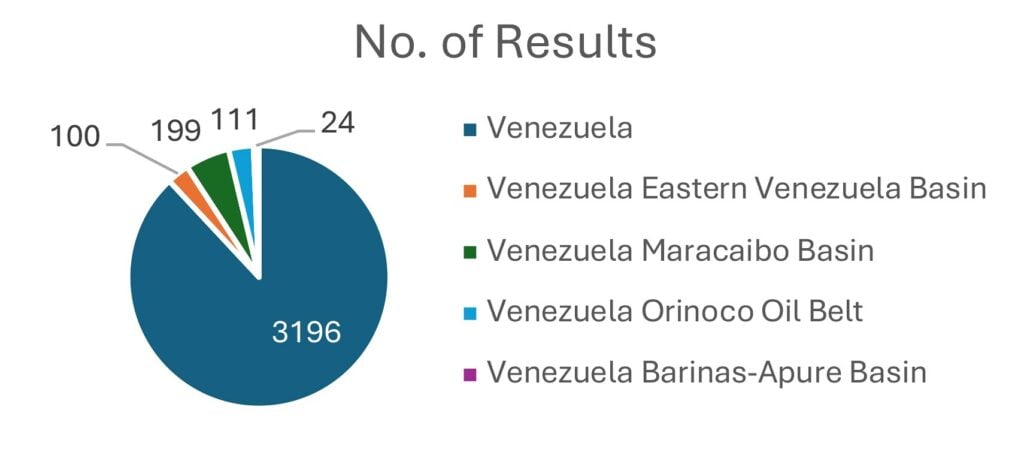
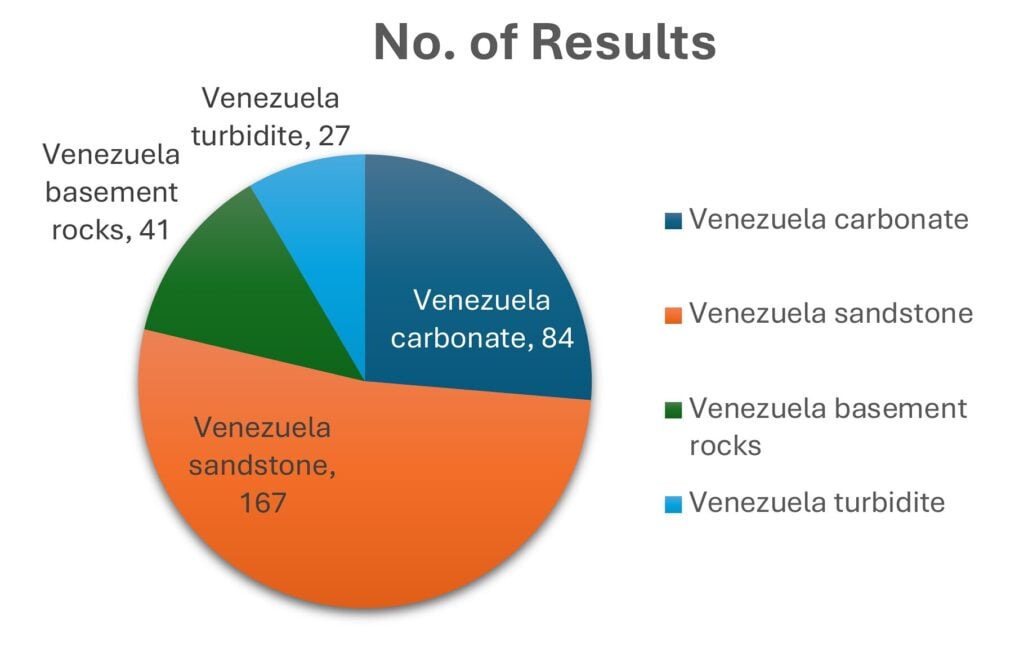
With this topic in mind, I began searching the Datapages Archives to see what publications there are for geoscientists interested in Venezuela. See the ‘Number of Publication Results per Basin’ and the ‘Number of Publication per Rock Type’ graphs.
Venezuela has a long history of oil and gas exploration with a diverse set of plays. With emerging technology and better petroleum systems insights, the potential is there for a successful revitalization.
The Main Producing Areas
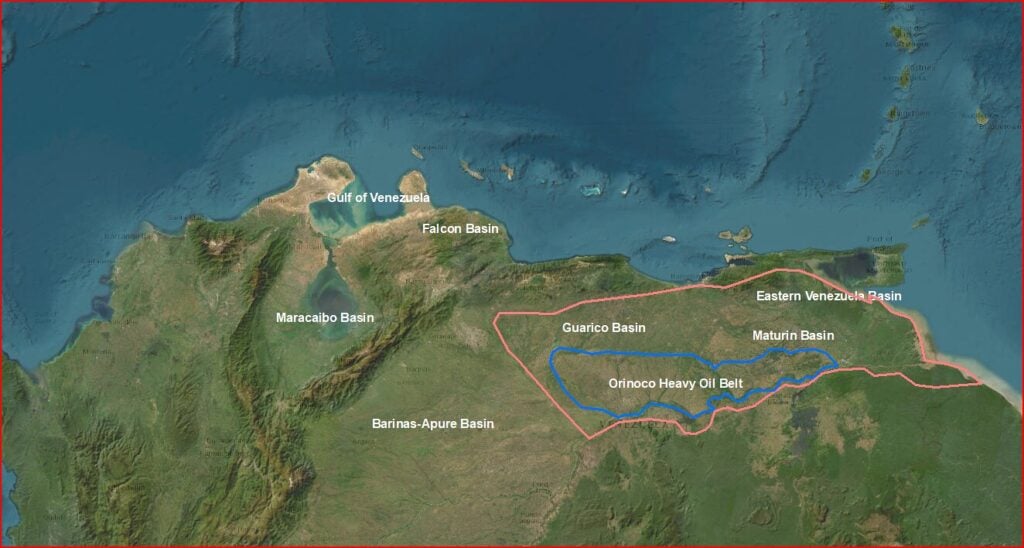
The coal-dominated Eastern Venezuela Basin has the largest known deposit of heavy crude oil in the world with a surface area of 54,000 square kilometers. The southern part of this basin holds the Orinoco Oil Belt. Within the OOB is the Miocene Morichal Formation reservoir. The reservoir is comprised of alternating fine-grained sandstones, mudstones, and siltstones. The reservoir porosity is about 30 percent, with permeability values ranging between 500 to 5,000 millidarcies. The source rocks in the EVB are the primary Cretaceous Querecual Formation (total thickness of about 5,500 to 7,500 feet), Oligocene Merecure Group (total thickness about 5,500 to 7,500 feet), and the Miocene age Oficina Formation. The oil has a viscosity ranging from 2,000 to 6,000 centipoise (think honey) and an API of 7.6 degrees.
The Maracaibo Basin commercial oil production began in 1914. The Late Cretaceous La Luna Formation is the primary source rock in the basin with an area of 59,570 square kilometers. It and equivalent units have generated more than 2.3 trillion barrels of oil. It is the source of 98 percent of the total oil reserves in the basin. The La Luna has total organic carbon values that range from 2.2 to 5.7 percent. It has a high brittleness index and is in the oil window.
Almost like a checklist for known reservoir types; the Maracaibo Basin reservoir rocks consist of fractured metamorphic basement rocks, sub-Eocene Cretaceous limestone, Paleocene sandstone, Eocene stacked distributary channels and tidal bars, and Miocene fluvial sandstone facies.
The foredeep Barinas-Apure Basin is in western Venezuela, southeast of the Mérida Andes Range. The reservoir rocks are Cretaceous delta-plain sandstones of the Escandalosa Formation and Eocene barrier-beach sandstones of the Gobernador Formation. The main source rocks are the Cretaceous Quevedo, La Morita, and Escandalosa Formations, which are marine shales. The average total organic carbon is approximately 1.5 percent. The organic matter is mostly marine Type II kerogen with low thermal maturation. The traps in the basin are structural including: faulted domes, anticlines, and normal faults trending east to west and northeast to southwest, but the heterogeneity of the stratigraphic column suggests combination (stratigraphic / structural) traps exist as well.
Publications, about offshore exploration in Venezuela, are few, but the topic is important, and trending. For a wonderful review of offshore basins and fields, see the April 2026 Explorer article written by Emily Smith Llinas, “From Geology to Opportunity in Venezuela.”