
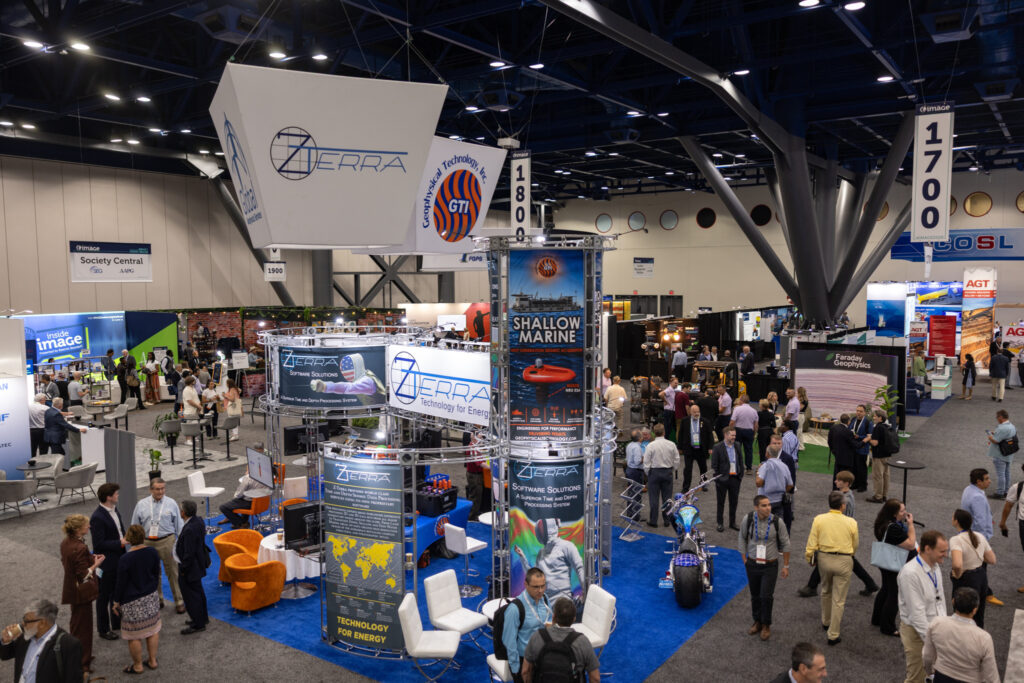
I attended the 2026 IMAGE Conference, co-organized by the American Association of Petroleum Geologists (AAPG) and the Society of Exploration Geophysicists (SEG). More than 8,000 geoscientists and other energy professionals attended this year’s event, including many enthusiastic and energized students and young professionals!
The presentations and discussions this year were quite rich in insights! I wish I could split myself into multiple parts to enjoy even more talks! I was also pleased to see real trend-setting deals being done at IMAGE, including the Hunt Oil contract with Venezuela.
In case you couldn’t make it to the event this year, here are some key things I heard during the discussions and key takeaways from the event. We hope to see you next year! Also, be sure to renew your AAPG membership for exclusive discounts! You can do so here. Not a member yet? Become one here.
What I Heard at IMAGE ‘26
From the opening session, entitled: “Exploration: shortening the cycle from idea to production.”
From Bob Fryklund, Chief Upstream Strategist, S&P Global:
“With energy shares performing well, we are now 7 percent of the S&P 500 index—not 4 percent as before.”
“Long cycle time used to be a big issue in our industry; as ideas would take some 15 years to become production.”
“There are three stages in the cycle of an E&P project:
From idea to acreage capture
Seismic survey and exploration drilling
From first discovery to first oil/gas.”
Each stage used to take about five years, according to Fryklund’s estimation.
From John Ardill, Vice President, Global Exploration, ExxonMobil:
“Our experience in Trinidad shows that we were able to move from an idea to acreage capture in seven months. Now, seismic survey is ongoing. Drilling could happen soon after that. If successful, we could reach first production in a few years,” cutting down cycle time by five years or more.
“In Guyana, we are deploying six drilling rigs at the same time—three for exploration, and three for development.”
“At ExxonMobil, we ask our teams:
How many new ideas are you moving forward?
How many new exploration wells are you drilling?
How much capital at scale are you deploying?”
“People were asking us ‘Are you drilling for oil or gas?’ Our answer is: ‘We are drilling for money,”’ he said, emphasizing the value side of the oil and gas business.
From Kevin McLachlan, Vice President, Exploration, Chevron:
“In the past decade, Chevron was focusing on the Permian Basin. In the past two years, we have been rejuvenating our international portfolio with an increased exploration budget.”
“We now have a centralized (exploration) team and have already made a couple of discoveries this year, including one in Angola.”
From Andrea Lovatini, Vice President, Exploration Data and Geosolutions, SLB:
“We are focusing on better data, better interpretations, to help our clients shorten their cycle time.”
With AI, “Imaging can be produced now in days vs months.”
“[We have a] steady flow [of work requirements] from ExxonMobil; more from Chevron.”
“We are where the exploration cycle starts (for many of our clients),” said Andrea Lovatini, Vice President for Exploration Data and Geosolutions, SLB.
From Various Other Sessions Throughout IMAGE
On geothermal:
“Most geothermal opportunities in Basin and Range are blind,” Nils Caliandro, geologist, Zanskar Geothermal.
“We are using AI-aided models to help identify blind systems,” Caliandro.
“We are very forward-looking when it comes to AI. We use AI to help us organize and store our data, so as to free up our people to focus on deep thinking,” Emma McConville, Director of Resources, Fervo Energy.
“We are using AI for basin-scale evaluation; the results are not just faster, they are better,” Valérian Guillot, AI Lead-Wellbore, SLB. “For example, AI helped us identify a missing mineral in formation evaluation.”
On South Atlantic conjugate margins:
“[Aptian] source rocks are deposited around the [Orange] Basin,” said Aurélie Tassy, Exploration Geologist, TotalEnergies, confirming source rock presence on the Namibia and South Africa sides of the Basin.
“The Outer High is a first-order geological control for reservoir distribution in the Orange Basin,” Tassy.
“There two types of deepwater fans in the Orange Basin: lobe-dominated and delta-dominated,” Tassy.
“South Africa might be more gas-prone [than Namibia],”Andrew Pepper, Adjunct Professor, University of Houston.
“In Uruguay, we only drilled three exploration wells in the past 50 years,” Pablo Gristo, Head of E&P, ANCAP of Uruguay. By comparison, there have been 40 exploration wells drilled in Namibia.
“Deep Cretaceous reservoirs have not yet been tested in Uruguay,” and “Aptian source rocks are even thicker (in our country) than in Namibia,” Gristo.
“There are about 30 Cretaceous drilling targets in our blocks,” Gristo.
“Apache (aka APA) will drill the Bonanza Chaleco prospect in 2027, with a stock tank original oil in place of 4 billion barrels of oil,” Gristo.
Other comments and thoughts:
“I am most excited about using our data, new technology, and expertise to help our customers make better decisions and drill more successful wells,” Mohamad Hagazy, Executive Vice President, Imaging at TGS during an interview I had with him at IMAGE.
From my presentation entitled “Five Emerging Trends in Upstream Business” at the inaugural Exploration Risk and Decision Frameworks session.
I was pleasantly surprised by an enthusiastic audience of some 80 people on a Thursday afternoon, as IMAGE was winding down.
After my presentation, some audience members invited me to speak at their companies and universities.
If your company or university is interested in my humble view, please feel free to reach out to the AAPG team to help arrange. You can email media@aapg.org.
My hopes for the next IMAGE:
I would love to see more geologists and geophysicists share their success stories from working together, rather than talking to peers in their respective specialties.
I hope even more senior leaders from leading energy companies will find time to present at IMAGE to share their bigger-picture views for our industry.