
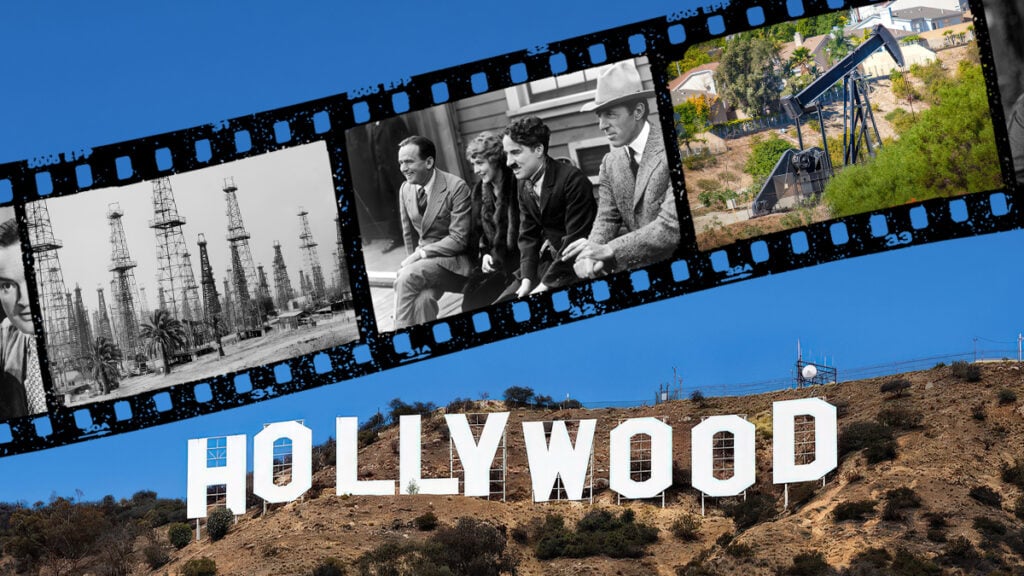
In the popular imagination, Hollywood and the oil industry occupy opposite ends of today’s cultural spectrum. One produces entertainment; the other, fuel. One is now often associated with environmental activism; the other with roughnecks, drilling rigs and TV series from “The Beverly Hillbillies” to “Landman.”
But you must remember this: from the earliest days of Hollywood, the two industries grew up and prospered together.
Visitors to Los Angeles today are often surprised to learn that some of the world’s most famous movie studios, including 20th Century Fox, were built atop active oil fields. During much of the 20th century, derricks stood beside homes, schools, beaches, and boulevards. Petroleum wealth helped finance the banks, real estate ventures, and investment syndicates that fueled the growth of both Los Angeles and its emerging motion picture industry.
The relationship was not merely geographic. It was foundational, financial, and sometimes deeply personal.
The Two Forests
The discovery of the Los Angeles City Oil Field by Edward L. Doheny in 1892 heralded the transformation of Southern California from an agricultural center to an industrial powerhouse. Additional strikes at Huntington Beach, Signal Hill, and Wilmington from the late teens to the 1930s followed, making the Los Angeles Basin one of the world’s great petroleum provinces. There were two man-made forests – one of orange trees, the other of oil derricks – side-by-side in early Los Angeles.
At almost the same moment, a fledgling film industry was migrating westward from New York. Independent filmmakers sought distance (and legal relief) from Thomas Edison’s patent-enforcement campaigns, and they found year-round shooting in the sunny weather, inexpensive land (often above oil fields), and a welcoming business climate in Southern California.
The timing was no coincidence. Before the rise of modern banking and capital markets in Los Angeles, petroleum provided one of the region’s largest sources of investment capital. Oil fortunes flowed into banks, land companies, and speculative ventures that helped support the rapid expansion of Hollywood.
The city that became synonymous with movies was, in many respects, built on oil.
Oil Men and Movie Moguls
Several early Hollywood financiers had ties to the petroleum business. Oil wealth circulated through the same investment networks that funded studios, theaters, and production companies.
Joseph M. Schenck, an influential producer and studio executive with ties to Edward Doheny, invested in California oil ventures before Charlie Chaplin, Douglas Fairbanks, and Mary Pickford brought him in to take control as chairman of United Artists in 1924. He served later as a director of Richfield Oil Co., a predecessor of ARCO. Howard Hughes inherited Hughes Tool Company, whose rotary drill-bit business generated the fortune that enabled his film ventures (including the introduction of Jean Harlow and Jane Russell) and eventual takeover of RKO Pictures in 1948.
Meanwhile, the petroleum industry continued reshaping the landscape around Hollywood. The Beverly Hills Oil Field became one of the most productive urban oil fields in the United States, operating largely out of public view beneath “the homes of the stars” in some of the world’s most valuable real estate. It’s not a large field, by L.A. Basin standards, but it has produced more than 150 million barrels of oil.
The Golden Age of Movies and California Oil
Many of Hollywood’s biggest stars in the middle of the 20th century were not merely observers of the oil business, nor actors in dramas with oilfield themes – they were substantial investors.
Gene Autry, the “Singing Cowboy,” might have been the most successful. His films often featured themes of protecting American oil interests, such as 1939’s “South of the Border,” in which our hero is sent by the U.S. government to Mexico to prevent foreign powers from gaining control of Mexican oil refineries and fomenting ¡la revolución! Following his entertainment career, Autry built substantial wealth through oil and gas investments, mineral ownership, real estate, broadcasting, and professional sports. By the time of his death in 1998, his fortune was estimated at $320 million, making him one of the richest men in the country.
Bob Hope and Bing Crosby also invested in oil and gas properties and partnerships in California, Texas and Oklahoma. They partnered with legendary Fort Worth oilman W. A. “Tex” Moncrief in West Texas ventures and, by 1949, their Scurry County leases had yielded at least two successful oil wells, including a reported 1,000-barrel-per-day producer.
Why were risky oilfield investments so attractive to Hollywood stars? For two decades from the mid-1940s to the early 1960s, the top federal marginal income tax rates exceeded 90 percent. Petroleum investments offered both passive income and attractive tax advantages. Royalty payments from producing properties quietly supplemented the stars’ earnings generated by radio, film, and television.
Other midcentury celebrities with oil and gas investments include Will Rogers, who owned producing properties in Oklahoma during the Sooner State’s early 20th-century boom. John Wayne accumulated a diversified portfolio of ranch, real estate, and mineral holdings. Biographers note that oil and gas royalties formed part of the income stream that helped make “The Duke” one of Hollywood’s wealthiest stars.
Their involvement reflected a broader pattern. For much of the 20th century, successful entertainers viewed oil investments much as some modern celebrities view venture capital or technology startups: a pathway to diversification and generational wealth.
A Complicated Legacy
The public relationship between Hollywood and petroleum changed dramatically after the 1969 Santa Barbara offshore oil spill. Environmental concerns gained prominence, Earth Day was established, regulations proliferated, oil-field abandonments increased, and opposition to fossil fuel development became increasingly visible within the entertainment industry.
Probably the most visually documented Hollywood anti-oil protesters have been Jane Fonda and Leonardo DiCaprio. Other prominent critics of the petroleum sector include Mark Ruffalo, Ed Begley, Jr., Julia Louis-Dreyfus, Daryl Hannah and Martin Sheen.
Even as public attitudes shifted, California remained one of America’s most productive oil-producing regions. Urban drilling operations became less visible, though production continued. Los Angeles County still has about 3,000 active wells, but production dropped from about 12 million barrels in 2024 to roughly 10 million barrels in 2025. Royalties still flow to the state and local governments, institutional landowners, trusts, investment funds and private mineral rights holders.
Today, some of Hollywood’s most vocal critics of fossil fuels operate within landscapes, histories and financial systems that remain connected – directly or indirectly – to energy production. The relationship has become less visible, but it has not disappeared.
Final Reel
I thank Don Gautier for fact-checking the oilfield aspects of my oral presentation on this topic, given at the annual Oil History Symposium of the Petroleum History Institute in Bakersfield, Calif., in April 2026.
Closing Credits
To hear more about Tinseltown and the oil patch, come to the History of Petroleum Geosciences Special Session at IMAGE in Houston on August 19, 2026.
Hollywood’s connection to petroleum is not simply a historical curiosity. It is a reminder that industries often portrayed as adversaries might share common origins and intertwined narratives.
In addition to agriculture and real estate, the growth of Los Angeles was powered by both movies and oil. One supplied stories; the other provided energy, capital, commercial expertise and broader opportunity. Together they helped create one of the most influential cultural centers and two of the most powerful industries in the world.
Hollywood has long been known as the “dream factory.” Many of those dreams were financed by oil wealth, shot above oil fields, and featured stars with substantial oil interests of their own.