
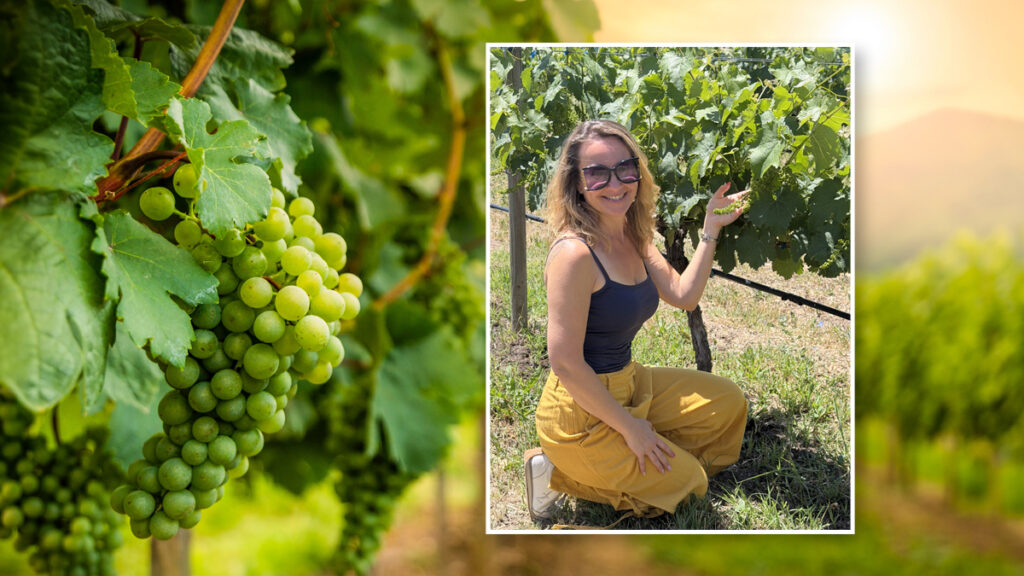
To hear Diana Khandilyan explain it, great wine begins long before the grape.
Which is exactly something you’d expect someone with her credentials as a level-3 Wine & Spirit Education Trust sommelier to say.
But Khandilyan isn’t just a wine sommelier.
She’s also a geophysicist and upstream specialist for S&P Global.
“It begins with the land … in bedrock, in mineral layers formed millions of years ago,” she explained.
That journey, though it starts with the land, includes mineral composition, drainage, heat retention, porosity, and other factors, including vineyard development, and what Khandilyan calls, “wine expression” depending on its region.
And some of those regions are volatile, which, she believes, makes the grapes and ultimately the wine take on the characteristics of the people of that land.
Here’s a sample from her newsletter about wine and war called: “Lost Grapes: Forgotten Varieties Making a Comeback.”
“In Lebanon’s Bekaa Valley, Château Musar has been harvested through decades of conflict, pickers working within earshot of shelling. In Armenia, recent vintages were brought in while artillery echoed from nearby borders. In Georgia during unrest, and, during the Artsakh War, in Bosnia and Herzegovina in the 1990s, vintages were salvaged against the odds. These wines don’t just carry terroir, they carry resilience. When you pour them, you taste not only the year’s weather and geology, but the courage of those who made them.”
(“Terroir” is a French term for the influence of a specific region’s environment – its soil, topography, climate and other local features – on the flavor of a crop that is grown there.)
The Grapes of Curiosity
She wants people to see and feel that history, that passion.
“I translate geology, climate, and craft into approachable, memorable wine insights,” she added.
The wine club she created, Pour Across America, showcases such diversity, primarily in the United States.
“I travel state by state, meeting winemakers, selecting small-batch wines, and telling the stories of the land and the people behind each bottle,” she explained.
There is her day job, of course, which consists of researching and analyzing data on oil, gas and minerals in North and South America for S&P, which could, conceivably, take time away from her love for wine.
But that’s what weekends and nights are for.
Besides, she loves both her avocation and occupation and says her life’s bifurcation is something she relishes.
“The pivot,” when she’s asked about the two worlds, “wasn’t really a pivot.”
She never stopped being a geophysicist.
“I just found a new application for the same curiosity,” said Khandilyan.
This convergence of wine and geology, for her, started after traveling to the Finger Lakes in New York.
When she returned to her hometown of Houston and told friends and colleagues about the enormous variety and quality of wines in the region, she noticed something.
“Almost nobody, even among certified wine people, knew much about American wines outside California, Washington, and Oregon,” she said.
It felt like an opportunity – to introduce more of the country’s wines to more people, especially those who love wine, adventure, and a good backstory, which Khandilyan said describes her as well. She had, by that time in her 25-year career of geoscience experience, a passion for travel and the narrative of places, and a belief that American wine had a geological story worth telling.
And one she wanted to tell.
“I built Pour Across America around exactly that: going state by state, finding small-production, sustainable wineries in unexpected places, and connecting the rocks beneath the vines to what’s in the glass,” Khandilyan said.
Members of Pour Across America get a quarterly curated selection of American wines from a featured state or region, as well as limited-production bottles not found in stores, educational tasting notes explaining flavor, terroir, and winemaking, food pairing suggestions to elevate every bottle, and stories from the wineries and winemakers behind the wines.
Her first attempt at showcasing the connection between wine and the land, how and where the intersect, was at the Geophysical Society of Houston, where she featured six wines from her collection, paired not with meat, fish, or chicken but “with their geological backstories.”
She said the response from the Society was remarkable, which gave her the confidence to bring the presentation to this year’s International Meeting for Applied Geoscience and Energy in Houston in August during an event called “From Bedrock to Bottle: Geology in the Glass.”
Something Between Science and Intuition
To ask a sommelier to name her favorite wine is like asking a grandmother to name her favorite grandchild.
You get the same response, too.
“I’ll be honest,” she said, “I can’t pick one.”
But in Khandilyan’s case, there’s good reason for that.
“As a geophysicist, I’m constitutionally unable to declare one soil superior to another.”
Every substrate, volcanic basalt, limestone, granite, clay, gives the vine a different set of problems to solve, and those solutions show up in the glass, she said.
“That’s the whole point of the tasting.”
What she finds most fascinating, though, is the adventure.
“Geophysics is a highly technical discipline: equations, models, statistics, probabilities. And yet every experienced geophysicist knows that the best work doesn’t happen on equations alone. Intuition matters. Gut feeling matters. That sense of something being right or wrong that you can’t fully articulate but can’t ignore.”
The same is true in winemaking.
“You can do everything correctly by the book and still produce a wine that falls flat,” she said.
It works in reverse, too: “And you can break every rule and produce something transcendent.”
Both disciplines reside at the space between rigorous science and irreducible intuition.
“I think that’s why geoscientists respond to wine so viscerally when the geological story is properly told. They recognize the territory,” she said.
When she speaks of wine, speaks of geology, the joy in her voice is conspicuous.
“I see it every time, that look of someone encountering something they never expected,” she said.
She talks of Arizona wines, which come from high-altitude vineyards, structured and robust in ways that surprise people who only know desert, as well as Pennsylvania wines, which are planted on ancient tobacco fields, where some of those reds still carry a whisper of tobacco in the finish.
“When participants taste those wines, and understand why they taste the way they do, you can see it happen in real time: the curiosity, the delight, the questions that start coming fast,” she explained.
In short: geology affects taste.
Those two worlds – at least in the hands, mind, and imagination of Diana Khandilyan – coexist without distinction.
“That kid-discovering-something-new energy in a room full of seasoned scientists is one of my favorite things in the world,” she said.