
Sometimes, the results of inspiration emerge like the taste of a fine wine: Time is needed before the process blends raw elements toward perfection.
But at other times … at other times, you might sense early and clearly a moment that could define a lifetime. An awareness of something special – an inspiring moment today that could be the start of a remarkable journey.
That realization – and the impact of those special moments – is at the heart of the AAPG Foundation’s Inspirational Geoscience Educator Award, presented annually to university and college level educators who creatively and with excellence inspire their geoscience students.
But what do you call it when a moment of inspiration comes full circle? When an inspiring moment leads to something that itself becomes an inspiration?
You just might call it perfect.
Meet Matthew Malkowski, assistant professor in the Department of Geological Sciences at the University of Texas at Austin, and the recipient of the Foundation’s 2026 IGEA.
Malkowski, the IGEA program’s 15th recipient, was surprised when he learned in June that he would be receiving the award. Heck, he was surprised to learn that he had even been nominated.
And yet, Malkowski is a close-to-perfect example of an educator drawing on his own youthful moments of inspiration to fuel his own young students today toward their own inspiring moment.
He knows – grasping the beauty of and powerful connection to geosciences as a young person can impact an entire career.
He knows, because it happened to him. And his record as a professor clearly indicates, he’s making it happen for his students.
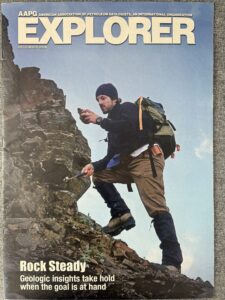
Longtime Explorer readers may recall that they first met “Matt” in December 2009, on a cover photo that become iconic in AAPG circles.
“Rock Steady,” the cover caption read. “Geologic insights take hold when the goal is at hand.”
The results of that moment of inspiration on the outcrop? In part, just listen to what his students say about his teaching and impact on their lives – testimonials like:
• “His course changed the trajectory of my career.”
• He “encourages you to learn, but also feel like you are part of a community.”
• “The profound manner in which he explained the sedimentological history significantly impacted my understanding of sedimentary basin analysis.”
• Without his “encouraging and considerate” teaching and concern, one student said, “I may have given up on this degree – his willingness to sit with me and answer questions … has been incredibly valuable.”
• How he “laid the foundation to develop my skills as a field geologist.”
• “I cannot think of a professor more dedicated to field geology, sedimentology and his students.”
Others speak frankly not only of his passion for the geosciences but also his concern for their development and connection to geology.
“Dr. Malkowski was there with me for every step, guiding me through what has become one of my favorite experiences in graduate school,” one student said.
“After years of feeling like a fake geologist on the fringe of the field of study, I finally felt like I belong with my peers – and I felt sure that I had made the right decision pursuing a graduate degree in geology.”
Malkowski, as the Foundation’s IGEA recipient, will receive a $10,000 prize and will be honored at this year’s IMAGE event in Houston, during the Foundation’s Chairman’s Reception.
“Recognizing, rewarding and celebrating excellence in geoscience education is one of our main priorities at the Foundation,” said AAPG Foundation Chair Jim McGhay. “It’s an important part of who we are, and we are very proud to be honoring Dr. Malkowski with this award.
“The student testimonials he received are very moving,” McGhay added, “and his dedication to his students, based on their admiration and respect for him, is obvious.
“Dr. Malkowski is an excellent example of an inspiring educator – and I’m sure we’ll see the fruits of his efforts in the success of his students for years to come.”
What Goes Around …
Coincidentally, Malkowski has had an important connection to AAPG and the AAPG Foundation for just about all of geology-focused life.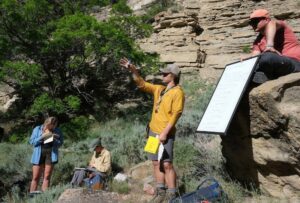
A longtime AAPG member, in 2009 he received the Foundation’s Merril W. Haas Memorial Student Research Grant-in-Aid while pursuing his master’s degree at Michigan State University – and he was quick to share how important that was in his life.
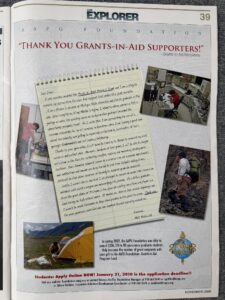
His letter of thanks to the Foundation eventually was included in the AAPG Explorer.
“Thanks to your generosity, I will soon be traveling to Alaska to conduct my field research and collect data,” he wrote. “Your financial support comes at a crucial time, as academic departments and institutions nationwide are being forced to cut their budgets, making it very difficult to find other sources of funding …
“I would like to say that I am privileged to receive an award that honors an individual with such a unique and encouraging life journey.”
Malkowski eventually received his bachelor’s degree in environmental geosciences and his master’s in geological sciences, both from Michigan State University, and his doctorate in geological sciences from Stanford University.
He held research and teaching positions at both Michigan State and Stanford universities before becoming an assistant professor at the University of Texas at Austin in 2021.
At UT, his current teaching responsibilities include:
• Earth Surfaces Process Through Time.
• Field and Stratigraphic Methods.
• Field Camp.
• Clastic Depositional Systems (graduate course).
He also previously taught UT’s Sedimentary Basin Analysis.
Recognizing his importance to geology and his impact on the school’s geoscience program goes well beyond his students.
“We are proud that in the last five years, the (Department) has modernized our curriculum, and that we have doubled the size of our undergraduate program,” said Peter Flemings, the interim chair of the Department of Earth and Planetary Sciences at UT’s Jackson School of Geosciences.
“The extraordinary class that Matt has developed has played a large role in this modernization,” Fleming said.
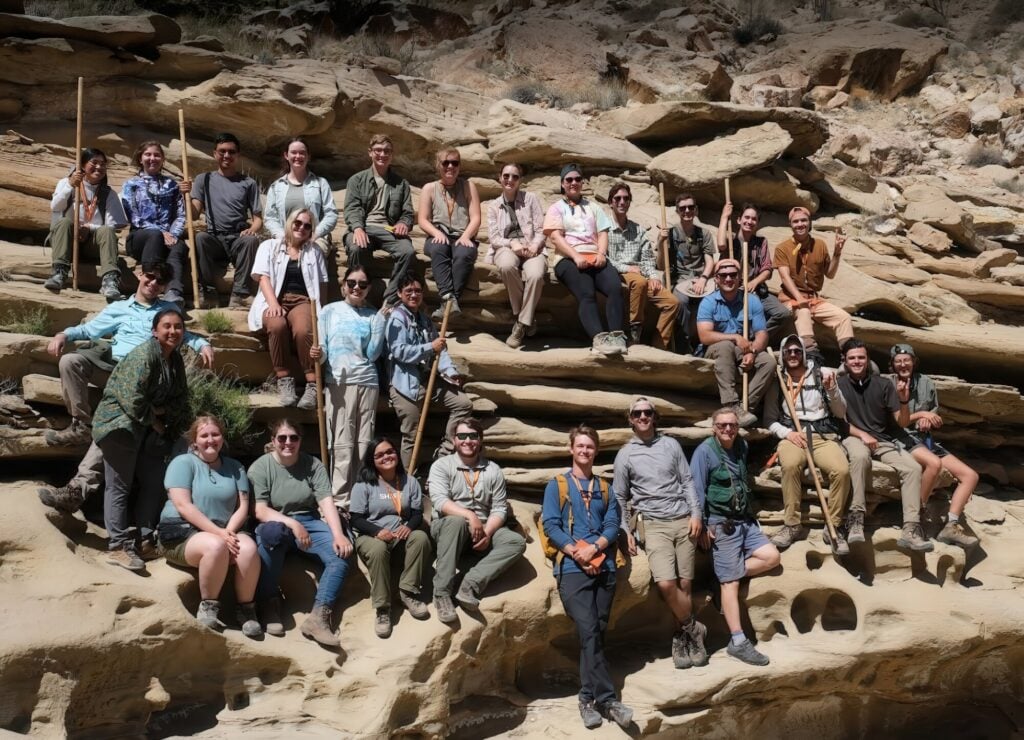
Fleming also praised Malkowski’s developing and then refining their summer field camp mapping and measuring Cretaceous siliciclastic stratigraphy in Utah’s Book Cliffs.
“Matt has extraordinary organization,” Fleming said. “He emphasizes systemically building a foundation of knowledge – I have watched numerous undergraduates change their subdiscipline after a month in the field with Matt.
“He is a force and is entraining the next generation of geoscientists,” he added.
In other words, the result of past inspiration is now making future inspirations possible.
Waiter, another glass of wine, please.