
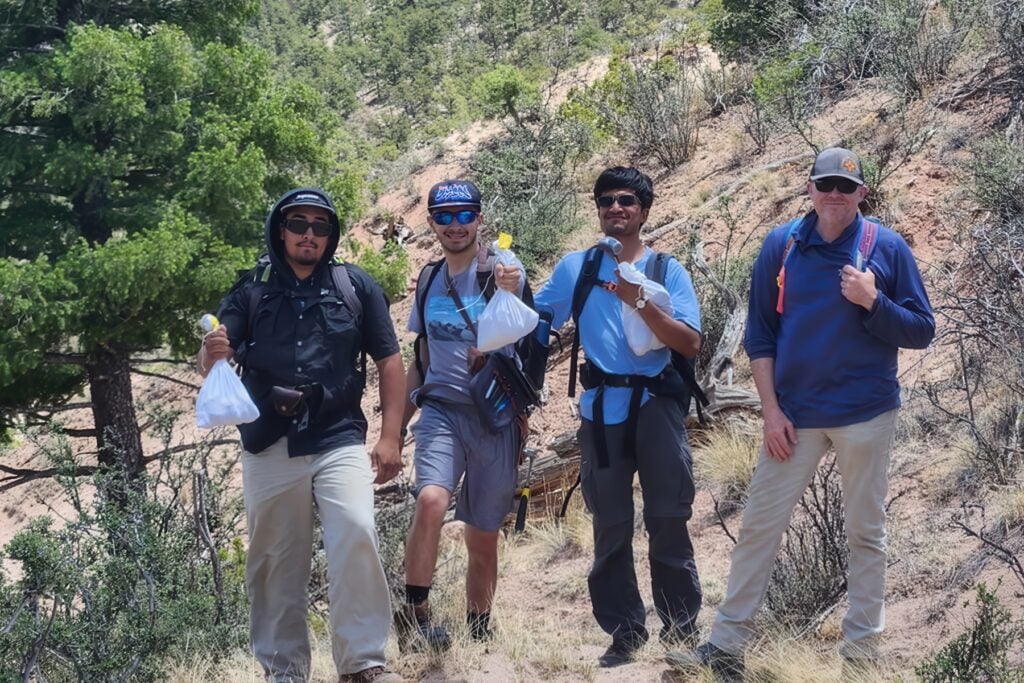
Among industry professionals, there are concerns that geological students entering the profession are missing out on an important part of the transition from academia to industry – specifically, an environment where focused, intensive, classroom knowledge can be put to use in real-world environments.
Namely: Geological field camps.
A-Lan Reynolds, who owns and runs the Reynolds Field Station for Education and Science Research in Catron County, west-central New Mexico, said it’s time that both industry and academia rethink and rededicate their commitment to geological field camps, even while understanding how the situation got to this point.
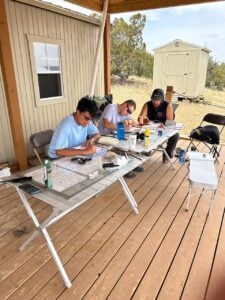
“We can plainly see that the current model for field camps is just broken. It’s not sustainable, it’s charging too much, and not attracting enough students,” she said.
The “We” she’s talking about are a group called Friends of Field Camps, which came about after a meeting with AAPG Foundation’s Trustee Associates in which the current state of the camps was discussed.
Along with Dick Bishop, Mark Leonard, Bruce Appelbaum, and Christopher Keane — all current and former industry professionals – she decided something, many things, actually, had to be done.
“I was new to the TAs,” said Reynolds, “and when I was introduced, I described the field station I started in New Mexico, and stated my belief that many university field camps in the United States were failing and in need of support.”
The Camp Crisis
But first, the question of “Why?” had to be addressed.
“It’s a complex question with many facets,” said Appelbaum, a retired geologist from Texaco.
The move away from field camps, he said, wasn’t just because of fewer students.
“While some portion is due to the shrinking geo enrollment, other factors are the increasing pressure on university funding, students’ money and time constraints, some viewpoints that technology has lessened the need for field skills and a growing shortage of field-trained faculty willing to spend time teaching in the field,” he explained.
Reynolds, who has master’s degrees in geophysics from Stanford University and electrical engineering from the University of Texas at Austin, agreed with Appelbaum and said that the changing reality of students and education also played, and still plays, a big part.
“Camps are expensive and they take up a lot of time,” she said.
When she reviewed students’ applications for the AAPG Foundation Scholarships for Field Camps, she noticed a trend, she said.
“I did not see a single application where the applicant was not working close to full-time and going to school full-time. Some of them are supporting families – whether it’s supporting their parents or whether they’re supporting children; but they can’t afford to be gone and not earning money for a large portion of the summer,” Reynolds explained.
The Collaboration Challenge
The goal for FOFC, then, was to understand the new realities for working students, as well as how students view geoscience education in general, and how university educators view students.
“There’s this tension between professors who are focused on research and students who need to have jobs and get certification. These those two things have to come together,” said Reynolds.
FOFC wants to enable the co-existence between research and workforce preparation.
As for her own camp, she knows it’s not a working model for everyone, as hers is a public charity.
University camps, by comparison, are expensive and time-consuming and no two camps are structured alike.
“We have to find a way to suggest changes gracefully, not barge right in and say ‘You guys are all screwed up, you know. You ought to be doing it this way.’”
Appelbaum said, in studying the issue, it seemed prudent to go back to the beginning.
“We found that there has been little to no communication among schools and camps to address common problems,” he said.
None of the solutions is going to be a boilerplate.
“There’s one thing to run a business case model on paper and a whole other thing to actually implement it – it has to be piloted to verify its solvency,” said Reynolds.
Working together, she emphasized, is not just a slogan, nor are the answers solely going to come from an industry workgroup.
“It’s not like we’re going to pull a genie out of the hat. We’re going to learn something, as well,” she said.
The problem is bad.
How bad?
Appelbaum isn’t sure.
“I don’t know if we have reached a steady state, but all of our component groups, including the State Geologists Association and our own industry survey, recognize the growing problem,” he said.
An All-Hands Effort
Finding the solution, he believes, will eventually pay dividends for the entire industry.
As someone who was a vice president of Texaco and president of the company’s Worldwide Exploration and New Ventures department, as well as someone who held positions for several independent oil and gas companies, including exploration manager with Sun Oil and Texas Eastern, domestic exploration manager for SEDCO Energy, and division exploration manager for Union Pacific Resources, Appelbaum knows the importance of finding good, capable, trained people.
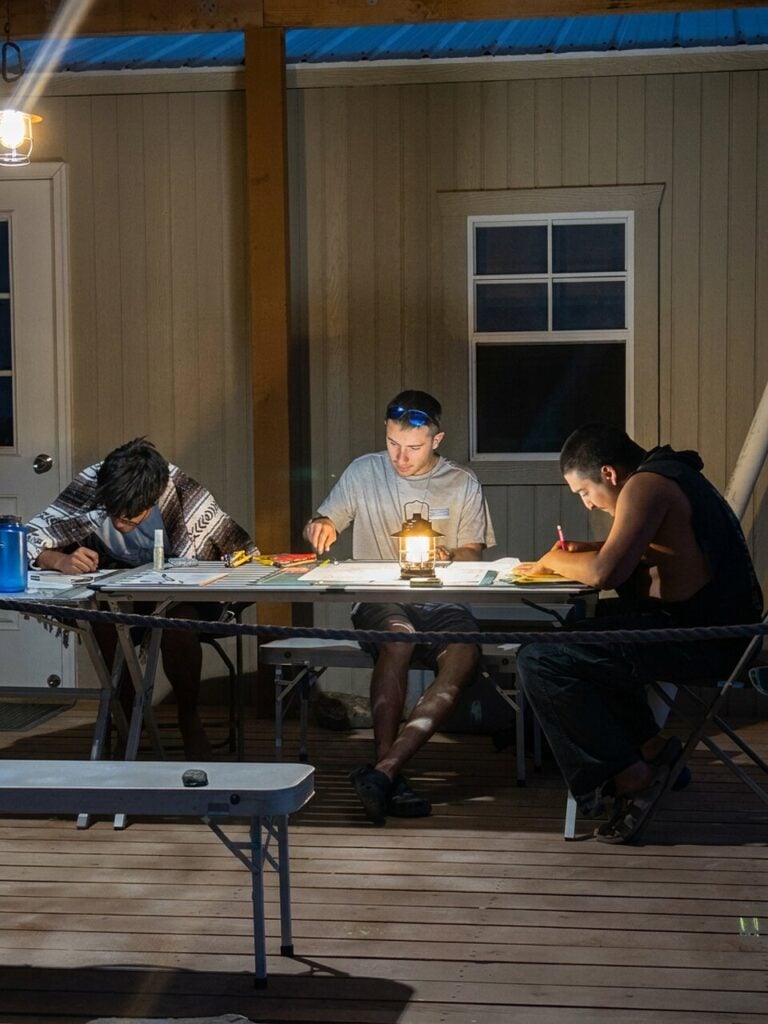
“University administrators seem unaware that industry still looks for employees with field skills and problem-solving abilities,” he said.
“Many, if not most geo professionals consider field camp a capstone event for their schooling,” said Appelbaum. “I don’t think field camp is properly highlighted at many schools. Many don’t require the coursework for graduation anymore. That could be key.”
Reynolds, for instance, wants more emphasis on digital techniques. Her camp includes working groups and partnerships with Perot Museum of Nature and Science and New Mexico State University Geology.
“What,” she wants to know, “does the term ‘geologist’ mean now?”
And here she talks about geologists, hydrogeologists, environmental scientists, as well as demographic shifts.
“When I was in school, our classes were 25-percent female, 75-percent male. It’s the other way around completely now – 70/30,” she said.
Appelbaum said, “I think this is an ‘all hands’ opportunity to get the AAPG membership aware and involved with their schools and our efforts.”
“In January 2026 we established three committees to pursue the recommended paths forward: Communications (to develop the student and faculty web resources); Advocacy (to educate faculty and university administrators, students, parents and legislators about the need for and value of field mapping instruction), Financial (to raise additional funds for field camp scholarships, faculty needs, and communication resources),” he explained.
Appelbaum knows that while external hurdles – funding, enrollment – will remain, as the internal obstacles can and should be dealt with. At the moment, he and FOFC are soliciting information from AAPG members about field programs currently in crisis, which the organization might be able to help through direct communication to administrators.
“Getting the camps to help each other rather than compete will help, as well a concerted effort to get students aware of filed camp options,” he said.
How important is survival of geological field camps to FOFC?
“To anybody who reads this,” said Reynolds, “if your program is in trouble – in other words on the brink of termination, and field camps are being cancelled – please contact us because we will put you at the top of the list for our advocacy committee efforts.”
They can be reached at bappelbaum69@gmail.com and a-lan@comcast.net.