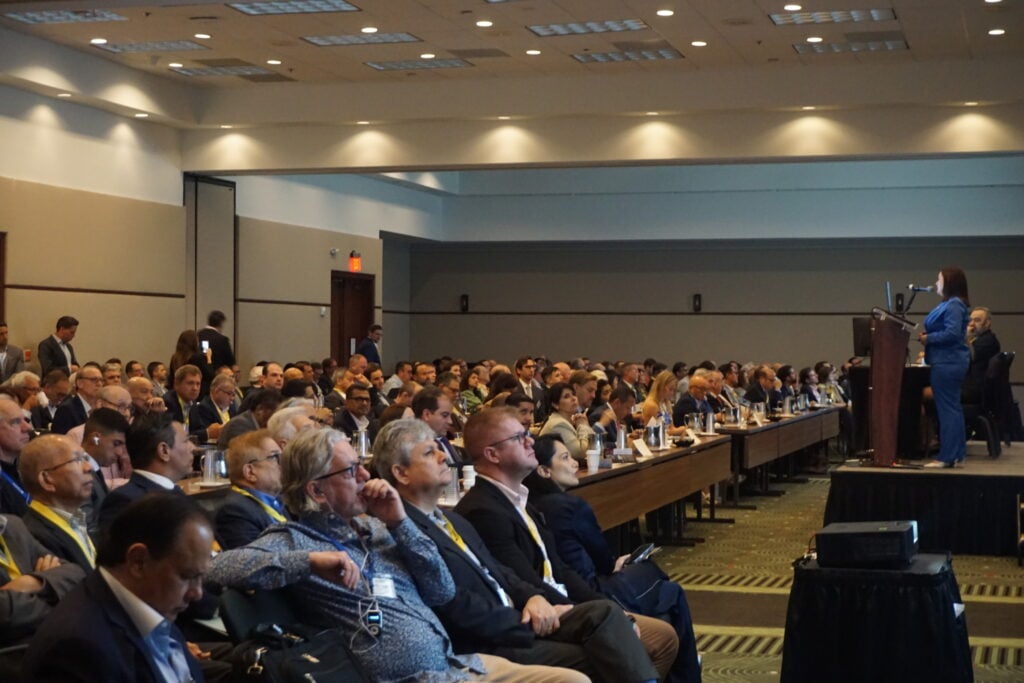
This week, I attended AAPG’s Venezuela 2026 Technical Symposium and E&P Summit in The Woodlands, Texas. The historic event was AAPG’s first major event dedicated to oil and gas opportunities in Venezuela in quite some time and featured expert technical, government, and business speakers.
Special guests included Kyle Haustveit, assistant secretary of the U.S. Department of Energy’s Hydrocarbons and Geothermal Energy Office, as well as a delegation from Venezuela. The delegation included Venezuela’s Minister of Hydrocarbons Paula Henao, Vice President at PDVSA, Jovanny Martinez, and other representatives from the Venezuelan embassy in Washington D.C., PVDSA, and the Ministry of Hydrocarbons.
Here are five important takeaways I learned at the event.
1) Venezuela is known for having the world’s largest oil reserves, but gas monetization presents one potential “low-hanging mango.”
According to Martinez, Venezuela has the world’s ninth-largest gas reserves, with 192 trillion cubic feet.
Venezuela holds 70 percent of Latin America’s gas reserves.
Unfortunately, nearly 40 percent of Venezuela’s gas production is wasted by flaring.
Non-associated offshore gas potential is 90 trillion cubic feet.
- Private investors can hold 100 percent equity in projects to develop gas.
ENI and Repsol are considering FLNG and other gas monetization routes in Venezuela.
Domestic gas utilization and regional suppliers to Colombia and LNG plants in Trinidad and Tobago represent near-term opportunities.
2) Many companies might choose to invest in (offshore) exploration, in addition to the 300 billion barrels of discovered resources.
Venezuela has more than 2,800 kilometers of coastline, and there are many light oil and gas prospects in the offshore.
There have been a small number of exploration wells drilled offshore, especially in recent years. Offshore basins are still very underexplored.
International investments and technology are the most-needed factors to further exploration, as PDVSA and local companies don’t have much offshore experience.
Offshore E&P operations are less subject to disruptions than onshore operations. The offshore Perla gas/condensate field, with more than 20 trillion cubic feet of gas, that is being developed by ENI and Repsol is an excellent example of this.
3) Some companies have already placed Venezuela as a top priority in their strategic goals.
Despite much political, legal, and fiscal uncertainty, “Venezuela has escalated to the top of our corporate (growth) strategy,” said Carlos Chiquello, KBR’s Senior Director for Latin America.
Members of the KBR team visited Venezuela in March with DoE Secretary of Energy Chris Wright.
There is a major opportunity for companies to invest and help in “asset integrity” and “work-over,” as more than 28,000 wells have been shut in and can be brought back onstream.
4) Venezuela’s oil reserve numbers got a significant boost after a Ryder Scott certification in 2010.
Numbers doubled from roughly 150 billion barrels to more than 300 billion barrels. This was mainly due to the belief that new technology could develop some of the heavy oil resources.
5) There are hundreds of Venezuela-based AAPG members. Many are students and young professionals.
There are 150 AAPG student members in Venezuela, according to Keyla Gonzalez, a Young Professional AAPG chapter representative from Venezuela.
- Apply to become a student member here.
There are six student chapters and one young professional AAPG chapter in Venezuela.
- Learn how to start a student chapter at your university here.
This year, Venezuelan students won the “Imperial Barrel Award” and will represent the Latin America region in the global competition in August 2026 in Houston, hosted by Murphy Oil.
Learn more about the event and Minister Henao’s speech and message in the coverage by Argus, Reuters, and Upstream.