
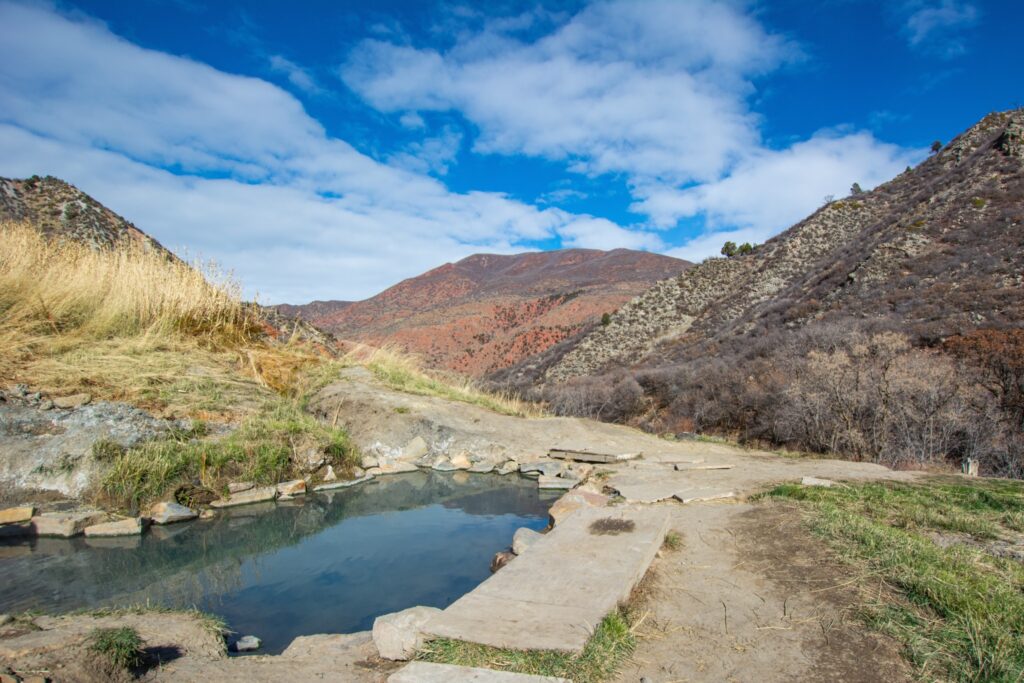
The April issue of Outcrop, published by the Rocky Mountains Association of Geologists, has an interesting article on a quantitative analysis of fault-controlled permeability in geothermal systems in the Rocky Mountains.
Data distribution: Moones Alamooti from the University of North Dakota conducted this study on 47 documented geothermal systems in 11 states:
- Nevada (18), Utah (5), New Mexico (3), Idaho (4), Montana (3), Wyoming (3), Colorado (3), Arizona (2), North Dakota (3), South Dakota (2), and Minnesota (1).
- Temperatures in these geothermal fields range from 50 to 240 degrees Celsius.
Data analysis: Data input in the study included two sets of data:
- Location, temperature, heat flow, and production data of geothermal systems
- Strike, dip, displacement, and stresses of faults
Tectonic setting: The geothermal fields studied come from diverse tectonic settings:
- The Basin-and-Range province with active crustal extension (10–15 millimeters per year) and a high heat flow of 70 to 100 megawatts per square meter (mW/m2)
- The Snake River Plain-Yellowstone, which hosts a magmatic heat source reaching a heat flow of 300 mW/m2
- The Rio Grande Rift, which is similar to the Basin-and-Range province
- The Colorado Plateau, which has generally low heat flows of 40 to 60 mW/m2 but with localized systems along reactivated basement faults, such as the Paradox Basin
- The Northern Rockies, which host Laramide structures with moderate heat flows of 60 to 80 (mW/m2)
- The Williston Basin, which has reactivated Precambrian basement faults with low-to-moderate temperatures of 50 to 120 degrees Celsius
- The Midcontinent Rift, which has low temperature systems, mainly in Minnesota, associated with Precambrian basement faults
What the study found: Some major findings from the study are outlined below.
Faults: 91 percent of systems are associated with mapped faults consisting of:
- Normal faults (74 percent). Normal faults cluster within plus/minus 20 degrees, perpendicular to the minimum horizontal stress, and with preferred dip angles of 60 to 70 degrees.
- Strike-slip faults (19)
- Reverse faults (7)
Fault intersection:
- Forty-five percent of the systems occur at fault intersections.
- High temperatures occur at intersection angles of 40 to 80 degrees.
Slip and dilation tendency: Slip and dilation tendencies were estimated from fault stresses. Slip tendency measures how close a fault is to frictional failure. Dilation tendency measures fracture opening tendency.
- Geothermal systems have a high slip tendency (0.68) compared to background faults (0.43).
- High temperatures (more than 120 degrees Celsius) exhibit the highest slip tendency values (0.73).
- Dilation tendency values average 0.42 for high-temperature systems.
Permeability and displacement: Data from 23 systems yielded a strong power-law correlation between permeability and fault displacement.
- Normal faults show higher permeability than other faults.
- Systems with active seismicity plot above the regression line.
Why it matters: Fracture permeability is a key contributor to geothermal systems. This paper is a first-step comprehensive assessment of fracture and tectonic controls on the efficiency of geothermal fields in the Rockies.