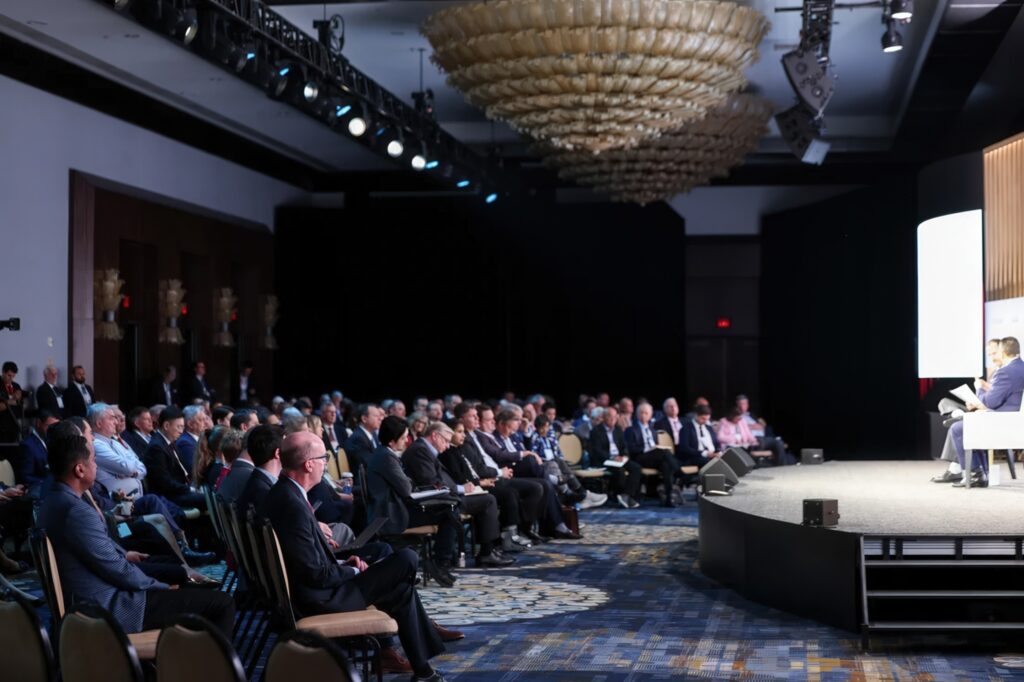
CERAWeek by S&P Global, the biggest annual gathering of global energy leaders, was held in Houston from March 23–27, amid major geopolitical turbulence as the war in Iran continues. Energy security became the dominant theme throughout the event. There is also excitement around energy growth, spurred by the rapid growth of AI and data centers, especially in the United States. Gas and nuclear power appear to be the early winners. The energy world needs to adjust first to the crisis at hand, and dialogue will be key to finding solutions.
Here are some key insights and takeaways from the CERAWeek 2026 conference.
1. CERAWeek brought together energy leaders, albeit with significant absences.
According to official statistics from CERAWeek, the meeting drew roughly 11,000 attendees from more than 85 countries. The current U.S. administration was well represented. Secretary of Energy Chris Wright, Secretary of the Interior Doug Burgum, and EPA Administrator Lee Zeldin all gave keynote speeches and shared their views on U.S. energy policy. U.S. Federal Energy Regulatory Commission Chair Laura Swett and Nuclear Regulatory Commission Chairman Ho K. Nieh also spoke.
Another prominent speaker was María Corina Machado, the Nobel Peace Prize winner and Venezuela’s opposition leader. Her vision on the future of the Venezuelan oil and gas industry and call for investments were enthusiastically received.
The Japanese and Indian delegations were larger than usual, partly because Japan’s Prime Minister Sanae Takaichi and her team just visited Washington, D.C., and partly because the ongoing conflict in Iran has impacted these two countries most severely.
There were several noteworthy absences:
- China did not send any top leaders.
- No leaders from Russia and Iran were present, for obvious reasons.
- The leaders from the International Energy Agency and OPEC did not show up.
- Leaders from Saudi Arabia and the United Arab Emirates could not attend in person but delivered speeches virtually. Qatar’s energy leaders had to deal with the emergency at home.

2. The energy industry is not just a “price taker.” It is also a “decision taker.”
As the war in Iran continues, oil and gas prices rise amid much uncertainty. No matter how senior you are, or how big your company is, in this crisis time, we in the energy industry all have to adjust, much more so than the rest of the world.
Some are affected directly: Two of QatarEnergy and Shell’s LNG trains were hit. To bring two damaged LNG trains back into operation will take years and billions of dollars. Asian countries, from South Korea to Thailand, are installing emergency energy policies to cope with the current crisis. There is a consensus that even if the war ended today, it would take weeks, months, and years (for example, Ras Laffan Industrial City in Qatar) to return to normal. Daniel Yergin, Vice Chairman of S&P Global and CERAWeek Chairman, suggested it might even become “a different world.”
3. Energy security concerns have become more pressing.
The famous energy trilemma – security, accessibility (to reliable and affordable energy), and sustainability – has become increasingly important. “It is not because the importance of sustainability has gone down, but the other two have gone up,” said one of the delegates.
Ripple effects from the war in Iran extended first to the Middle East, then Southeast Asia, Northeast Asia, and now, they are on their way to Europe and the rest of the world.
Oil, gas, and petrochemical producers are scrambling to increase production and find “physical molecules” to help their customers. I can understand the anxiety of delegates from Japan, India, and Indonesia around how long the war will continue.
4. Energy and technology are becoming increasingly intertwined.
Technology companies used to find growth opportunities from servicing energy companies. Now, energy companies are growing because of the extraordinary level of energy demand growth from AI and data centers. As Yergin reflected, “Last time, Ruth (Porat, the president and chief investment officer of Alphabet and Google) and John (Ketchum, CEO of NextEra Energy) hardly knew each other. This year, they are revitalizing a nuclear plant together!”
5. The future for gas and nuclear energy is very bright.
Japan thought it did a good job of balancing its oil supply by importing 90 percent of its oil from Gulf countries and having more than 250 days’ worth of stockpiles. And yet, they are anxiously hoping the war will end soon.
For gas, only 10 percent of Japan’s imports come through the Strait of Hormuz. Japanese leaders said repeatedly during CERAWeek, “We need more gas – especially from the west coast of North America.” An Indian delegate also emphasized, “We need to build more gas storage,” another hard lesson from the war in Iran.
U.S. LNG producers are set to see more long-term contracts signed. Keep an eye on Canada and Australia, as they will take big steps to increase LNG supply from their vast gas resources, leveraging their direct access to Asian customers in the Pacific Basin.
During CERAWeek, sessions on nuclear energy drew standing-room-only audiences. The United States, Canada, and other countries are talking about the need for more nuclear energy, especially small modular reactors. High-tech companies such as Google are helping to bring back shut-in nuclear plants, fully funding these revitalization projects, partly to alleviate energy price hikes in local communities.
6. The center of gravity is shifting toward the Americas.
Yes, Middle Eastern and OPEC+ countries will continue to be key players in oil. For gas, supply diversification has made it less impacted by the war in Iran.
In the meantime, Venezuela is set to become a significant global oil player over the coming years, and perhaps decades. Will Corina Machado be able to win the next election? And if she does, how much and how fast can she deliver on the promises that she made during her electrifying speech at CERAWeek 2026?
The Americas are attracting investments, including:
- European and Japanese investments in Alaska
- ADNOC and Saudi Aramco investing in U.S. Gulf LNG
- ExxonMobil investing in Guyana and sending a team on the ground in Venezuela, and Chevron joining Shell to explore in Uruguay
- The Chinese investing in deepwater Brazil
- The British investing in Argentina
CERAWeek facilitates global dialogue. This is especially needed for the energy industry, as we are so closely connected. One delegate from Canada told me, however, that the current time reminded him of the “Cold War times,” when one would be suspicious of another just because he came from a different country. There is a real danger that we mistake partial conversations for complete dialogue and make decisions based on them.
What will the energy world look like when CERAWeek 2027 comes along?