The concept that present-day processes provide the key to understanding the past remains foundational to geology. For petroleum exploration, this principle translates into a powerful methodology: detailed characterization of modern depositional environments provides predictive templates for subsurface reservoir architecture. Drone-enabled remote sensing is revolutionizing how we capture and apply these surface-to-subsurface analogs.
John Holbrook of Texas Christian University has spent decades establishing quantitative relationships between surface geomorphology and resulting depositional architecture. His research emphasizes that the factors controlling fluvial and deltaic geomorphology, including gradient, discharge regime, sediment supply, and accommodation space directly determine the geometry, connectivity, and heterogeneity of preserved sedimentary bodies.
This work has profound implications for reservoir characterization. The hierarchy of bounding surfaces that partition fluvial strata reflects river-scouring processes at different scales, from individual channel scours through channel-belt boundaries to valley-form sequence boundaries. Each surface type creates potential permeability barriers or flow conduits that control fluid migration during production.
UAV Technology Enables Unprecedented Detail
Traditional analog studies relied on field mapping, aerial photography, and satellite imagery with resolution measured in meters. Modern unmanned aerial vehicle platforms equipped with light detection and ranging (lidar) and photogrammetric cameras achieve centimeter-scale resolution, capturing geomorphic features at scales directly relevant to reservoir heterogeneity.
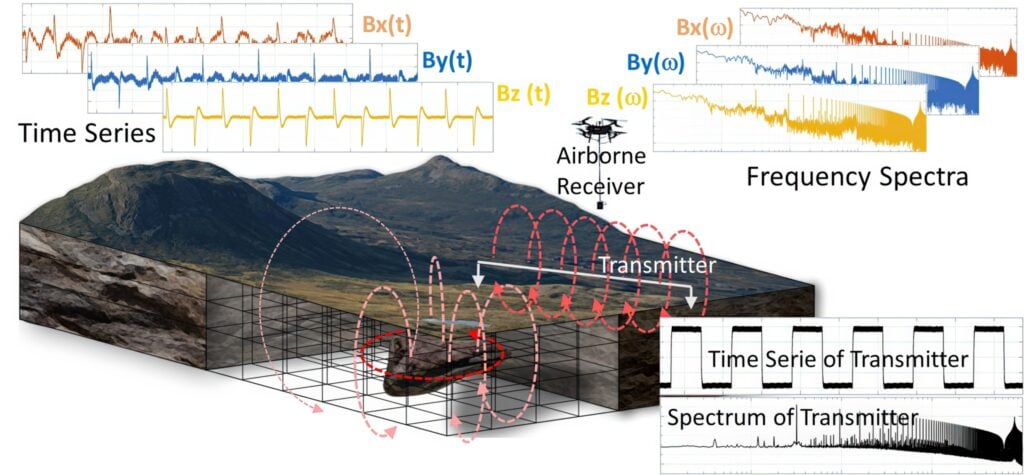
They can also be used for detecting and mapping hazards. Ron Bell of Drone Geoscience, LLC, described one such experience using a semi-airborne electromagnetic method. This emerging technology featured a drone configured with a broadband electromagnetic sensor deployed to quickly map the resistivity variations of the stratigraphic section to depths of more than 1,000 feet below ground surface. The resulting 3-D image of variation in subsurface electrical resistivity was calibrated using surface geologic mapping and borehole geophysical logs which increased the confidence in siting the exploratory drill.
Further, structure-from-motion photogrammetry generates dense point clouds and digital elevation models that reveal channel geometries, bar morphologies, levee dimensions, and crevasse splay extents with precision matching the scale of features observed in cores and outcrop. Lidar penetrates vegetation canopy, enabling terrain characterization in forested or densely vegetated environments where optical methods fail.
Research on the Montllobar fluvial fan in Spain’s Tremp Basin demonstrates the power of these methods. UAV surveys of exposed cliff sections spanning two square kilometers generated three-dimensional models of sandbody geometries that enabled extraction of probability density functions for width, thickness, and aspect ratio. These quantitative parameters directly inform stochastic reservoir modeling, replacing assumption-based distributions with measured values from appropriate analogs.
Fluvial Systems: From Modern Rivers to Ancient Reservoirs
Fluvial reservoirs present particular characterization challenges because their architecture reflects the complex interplay of channel migration, avulsion, and aggradation over time. Holbrook’s research on systems including the Mississippi/ Missouri River, Red River of the South, and De Grey River and Delta of Australia establishes how modern fluvial processes create stratigraphic records interpretable in ancient formations. Victorien Paumard, research fellow at the University of Western Australia, teamed up with Holbrook on the project as a part of the QRA consortium which includes Chevron, Woodside, Santos, and others.
“The 4-D drone-image processing Victorien is developing for the QRA is truly innovative and will give us a first glimpse into how bar reservoirs are built on scale of the individual flood,” said Holbrook.
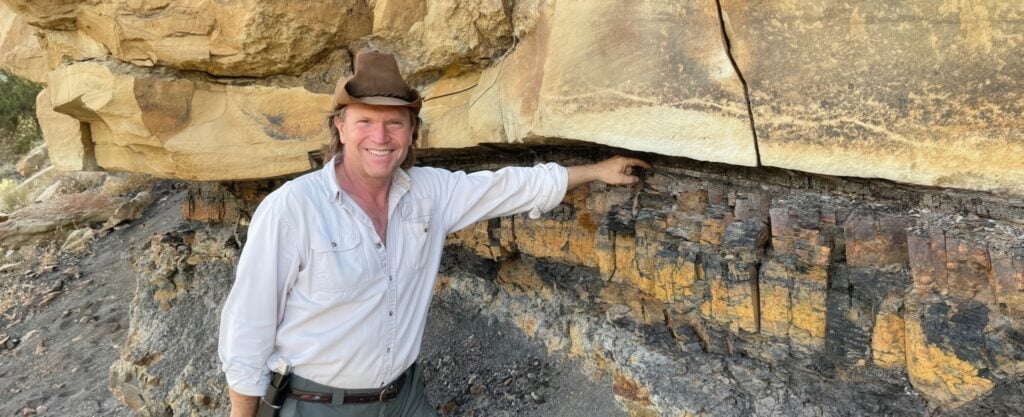
Key insights include the recognition that seemingly uniform fluvial sandstone sheets contain sharp lithologic contrasts across bounding surfaces. The mid-Cretaceous Muddy Sandstone of southeastern Colorado provides examples of potential permeability barriers invisible to conventional well-log correlation but critical for understanding reservoir compartmentalization.
Drone surveys of active river systems capture the full range of bar types, channel configurations, and overbank features that constitute modern fluvial environments. Repeated surveys over time document how these features evolve during flood events, providing direct observation of the processes that create stratigraphic architecture.
Deltaic Complexity Below Seismic Resolution
Low-gradient deltaic systems present particular challenges because their thin, amalgamated deposits often fall below seismic resolution. Holbrook’s work on the Cretaceous Mesa Rica Sandstone in New Mexico provides outcrop analog studies that illuminate the internal complexity of these systems.
Wave-influenced deltas exhibit characteristic facies asymmetry: homogeneous beach and shoreface sands accumulate on the updrift side of river mouths, while significantly more heterogeneous facies develop downdrift. This pattern, clearly visible in UAV surveys of modern wave-influenced deltas, has direct implications for predicting compartmentalization in subsurface analogs. Holbrook worked on the Mesa Rica over a number of years, and for him, the best insights came from the fluvial parts of at the University of Oslo, conducted extensive drone-level work in the wave-dominated delta when she was a graduate student working under the tutelage of Holbrook and Ivar Midtkandal at the University of Oslo. Van Yperen’s doctoral thesis incorporated her work with drone-based fluvial architecture.
The integration of surface morphology with shallow subsurface imaging through ground-penetrating radar extends analog characterization below the visible surface. GPR profiles across modern delta lobes reveal internal stratification patterns, mouth bar geometries, and distributary channel fills that match features observed in cores from ancient deltaic reservoirs.
Quantitative Parameters for Reservoir Modeling
The ultimate value of surface-to-subsurface analogs lies in providing quantitative constraints for reservoir models. The accompanying table summarizes key architectural parameters that can be extracted from UAV surveys of modern depositional systems.
These parameters feed directly into object-based and process-mimicking reservoir modeling approaches. Rather than relying on published compilations that might not match the specific depositional setting under study, explorationists can commission targeted analog surveys that capture variability within systems most similar to their subsurface targets.
Beyond Fluvial-Deltaic Systems
The analog methodology extends to other depositional environments important for petroleum systems. Alluvial fans at basin margins, sabkha and playa lake evaporite sequences, and shallow marine shoreface-shelf systems all benefit from detailed surface characterization.
Research distinguishing debris-flow-dominated alluvial fans from fluvial fans has direct reservoir implications. Debris-flow fans exhibit poor sorting and low lateral connectivity, making them generally poor reservoir targets. Fluvial fans feature hierarchically organized deposits with potentially excellent reservoir quality. UAV surveys combined with shallow geophysics enable reliable discrimination between these end members and characterization of intermediate types.
Coastal sabkha environments along the Persian Gulf provide the type analog for ancient evaporite-carbonate sequences that host significant hydrocarbon reserves. Drone surveys capturing the spatial distribution of supratidal, intertidal, and subtidal facies establish the context for interpreting diagenetic patterns that control reservoir quality in dolomitized equivalents.
Integration with Subsurface Data
The power of analog studies emerges fully when integrated with subsurface observations. Seismic attributes, well-log patterns, and core descriptions from the target formation provide constraints that guide analog selection and application. The iterative refinement between analog observations and subsurface calibration progressively improves model predictions.
Modern analytics platforms facilitate this integration. Software tools for digital outcrop modeling, training image generation, and multi-point statistics enable translation of UAV-derived surface data into formats compatible with standard reservoir modeling workflows. The result is geologically realistic models constrained by measured parameters from appropriate analogs.
For exploration geologists, the investment in targeted analog studies often provides returns exceeding the cost of additional wells or seismic acquisition. Improved understanding of reservoir architecture translates directly into better well placement, optimized completion designs, and more accurate reserve estimates. The drone-enabled analog revolution brings unprecedented precision to this foundational geological methodology.