
My career as a petroleum geoscientist involved Interpreting 2-D and 3-D seismic data to make prospect structure maps incorporating all available geologic data. My interest n astrogeology blossomed post- retirement. After participating in an AAPG convention astrogeology session in 2016, a colleague and I discussed Martian geology and waxed about the possibility of acquiring seismic data traverses on Mars in the future.
NASA’s Perseverance rover has been exploring Mars for five years, equipped with seven primary scientific instruments for advanced imaging, chemical analysis, and subsurface sounding designed to identify, analyze, and cut core samples. Previous Explorer articles have described how Perseverance brings these instruments to bear in selecting and discriminating outcrops to core in the search for possible past life on Mars.
That dream of acquiring seismic traverses on Mars is nearly realized with the Radar Imager for Mars Subsurface Experiment on the Perseverance rover. The RIMFAX ground-penetrating radar is used to investigate geological structures up to 10 meters below the surface. The processed data are shallow 2-D reflection images similar to 2-D seismic data. Signal strength in the GPR image is derived from dielectric “permittivity,” the subsurface property governing electromagnetic wave velocity, reflection strength, and signal attenuation. Higher permittivity means slower wave propagation.
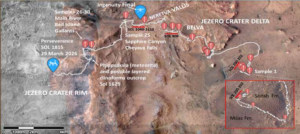
There are recent analyses and interpretations of RIMFAX GPR and geochemical data from Mars Perseverance rover that are available for review. Recent publications incorporating RIMFAX data have complementary interpretations of the geology on the Jezero crater rim.
Perseverance Mars Rover Status
NASA’s Perseverance rover successfully landed on Mars on Feb. 18, 2021.
Perseverance is currently exploring the rim of Jezero Crater on Mars. We last reported on the rover’s progress in the June 2025 Explorer. A Martian day, or Sol, is about 40 minutes longer than a day on Earth. As of April 8, 2026, Sol 1819, Perseverance has traveled 25.8 miles and drilled 27 core samples. Perseverance has used 33 out of 38 total sample tubes for the entire mission. Perseverance has collected 27 rock cores, two samples of regolith soil, and one atmospheric sample. The rover has returned more than 975,000 raw images from Mars that are publicly available in the mission multimedia catalog: Perseverance Raw Images.
Currently, due to budget cuts, the NASA’s Mars Sample Return mission to bring the Perseverance core samples back to Earth for detailed study is in jeopardy. No immediate plan exists to retrieve the samples. With costs projected to exceed $11 billion and delays pushing return to 2040, the MSR program was cancelled In the FY 2026 budget. Congress rejected full cancellation, directing $110 million toward technology development for future, more cost-effective retrieval methods. The Senate requested $400 million in the FY 2027 budget to save the mission. We remain hopeful that a cost-effective MSR mission will be redesigned, funded, and executed to bring the invaluable Mars samples back to Earth labs for detailed analysis.
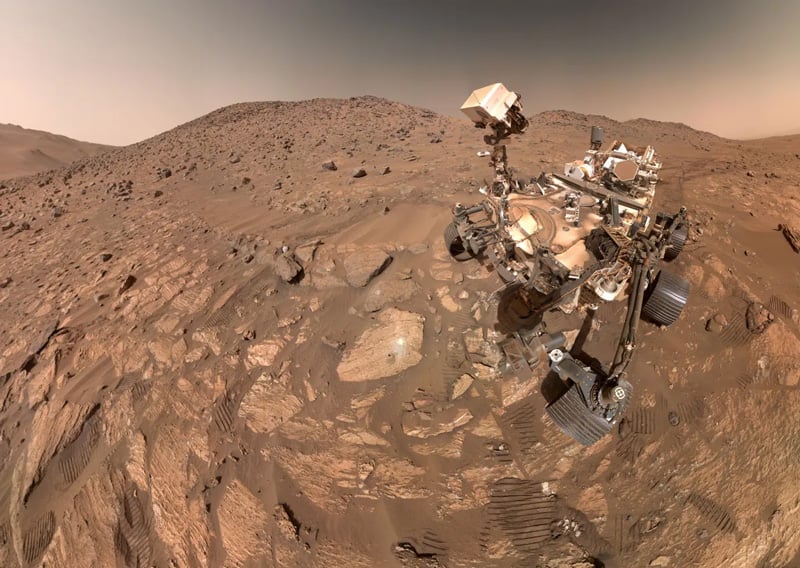
Perseverance took its latest selfie at Witch Hazel Hill near Neretva Vallis on Jezero crater’s rim on May 10, 2025 while celebrating Sol 1500 exploring Mars.
On the crater rim, the rover has cored five rocks, sealing samples from three of them in sample tubes. It has also performed up-close analysis of seven rocks and analyzed another 83 from afar with the SuperCam laser. This is the mission’s fastest science-collection pace since the rover landed on Mars five years ago.
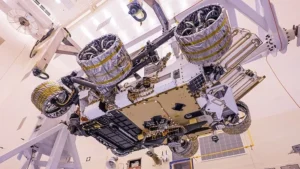
Perseverance operates RIMFAX continuously while driving, having operated regularly since landing in Jezero Crater in 2021. It uses the rover’s nuclear power source so RIMFAX can operate day or night.
Raw Perseverance RIMFAX traverse images are available at NASA’s Planetary Data Systems Geosciences Node. Processing involves mode merging, background removal, gain adjustment, topographic correction, and velocity modeling for migration.
Processed Perseverance RIMFAX imaging has appeared in several technical papers over the past few years. During the first year of the mission, Perseverance explored two important formations of the Jezero Crater floor identified from orbit: Máaz (“Mars” in Navajo language) overlies Séítah (among the sands). Séítah is part of the Nili Fossae regional olivine- carbonate unit observed from orbit. In situ Perseverance rover geochemistry measurements show that it has coarsely crystalline, olivine cumulate lithology that is more likely of primary igneous rather than sedimentary origin. In 2022, Hamran and colleagues published in Science Advances, that Perseverance RIMFAX “GPR detected several strong reflectors extending from the exposed section of the Séitah Formation with derived relative permittivity consistent with low-porosity mafic rocks.”
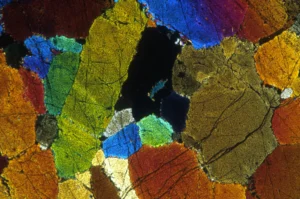
Mafic rocks are high in iron and magnesium-rich minerals such as olivine: (Mg,Fe)2SiO4. Ultramafic rocks contain a very high percentage of olivine.
In 2023, Beyssac and colleagues published that “The presence of olivine is key to understanding magmatic petrology and planetary evolution, and its association with carbonate and clay phases suggests that fluid-rock interaction may have occurred locally.”
Recent RIMFAX-Related Exploration
Perseverance RIMFAX GPR offers a view of the shallow Martian subsurface as a potential glimpse into past habitable environments. It has detected many subsurface structures in Jezero crater that can be interpreted as ancient landscapes. Emily Cardarelli is a science lead on the Mars 2020 Science Team. In March 2026, Cardarelli and colleagues published on RIMFAX “observations of ancient large- scale deltaic structures in Jezero crater, Mars” in the journal Science Advances. The publication caught this author’s interest as it was widely reviewed by Reuters, Physics World, Earth.com, Newsroom UCLA, Science Alert, and China’s CTGN.
The publication should be of great interest to Explorer geoscience readers who routinely work with seismic data in deltaic environments on Earth.
Cardarelli reviewed that Mars once had flowing liquid water and a warmer climate, with evidence of water-rock interactions recorded by surficial carbonate deposits. Mars surface shows widespread evidence of ancient water and paleolakes. Orbital and in-situ data confirm the presence of aqueous alteration minerals. Carbonate minerals indicate past interactions between CO2 and water. Jezero Crater contains a paleolake basin with fluvio-lacustrine delta deposits with the presence of secondary minerals like phyllosilicates and magnesium carbonates suggesting aqueous alteration. The Margin unit, where Perseverance has most recently been exploring, has the most exposed carbonate in Jezero, with strong orbital carbonate and olivine signatures.
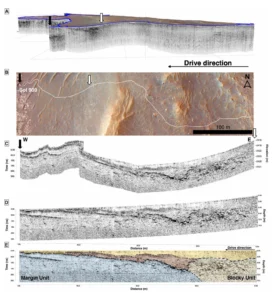
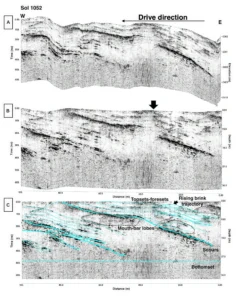
RIMFAX imaged subsurface structures in the Margin unit interpreted by Cardarelli as layered deltaic and fluvial features including cross-bedding and onlap relationships. Multiple reflectors are laterally extensive, dipping toward the basin at 3 to 15 degrees.
The Delta unit onlaps the Margin unit in stratigraphic succession. The Margin unit could be the oldest stratigraphic layer, dating back to Noachian time (about 4.1 to 3.7 billion years ago). The findings suggest extensive ancient water exposure and sedimentary processes, supporting the potential for habitable conditions and preserved biosignatures.
The Margin unit shares olivine and carbonate signatures with surrounding regions, suggesting igneous activity. Interpreted features like mouth-bar lobes, backsets, and layered bedding argue against an extrusive igneous origin.
The Jezero Crater-floor Séítah formation shares olivine signatures and layered geochemistry with the Margin unit, but indicating a possible intrusive origin as an olivine-cumulate layered body, several kilometers thick.
RIMFAX GPR in the Margin unit reveals the window of habitability and aqueous activity further back in time. “This instrument allows us to actually see structures beneath the ground of another planet,” Cardarelli said. “It’s not every day that you get to look underground on Mars.”
Cardarelli concluded, “RIMFAX has other active ongoing efforts focused on this area that will complement the findings of Cardarelli (and colleagues) so please also stay tuned for our forthcoming results!”
An Unexpected Treasure
“Phippsaksla” is the name given by NASA scientists to a strange, metallic-looking rock discovered on Mars by the Perseverance rover on Sept. 19, 2025, Sol 1629, in the Vernodden area of Jezero Crater. Preliminary analysis suggests Phippsaksla is an iron-nickel meteorite that originated elsewhere in the solar system and crashed into Mars. It is 31 inches wide, with a sculpted, shiny appearance that makes it stand out from the surrounding Martian bedrock.
It is rich in iron and nickel, which are rare on the surface of Mars, indicating it did not originate on Mars. It is the first potential meteorite discovered by the Perseverance rover.
What’s Next for Perseverance?
NASA’s Perseverance rover, well into its extended mission, has been extremely successful exploring Jezero crater for over five years and going strong. Katie Stack of NASA’s Jet Propulsion Laboratory said, “The rover is exploring very exciting, very ancient rocks (3.8 billion years and older) that predate the formation of Jezero Crater and may even predate the nearby Isidis impact basin. The rover has been exploring an impressive diversity of igneous and impactite rocks and has observed evidence for variable aqueous alteration of these rocks, including clay formation and serpentinization. These observations are providing insights into the formation and differentiation of the early Mars crust, and what record evidence of some of the earliest water-rock interactions preserved on a terrestrial planet.”
“Perseverance is really in excellent shape,” said Steve Lee, JPL Perseverance deputy project manager, at a December 2025 AGU press briefing. “The rover is capable of supporting this mission for many, many years to come. There are quite a number of very prime and juicy targets we’d love to go explore. There’s a lot to keep us busy.”
This entails an extended exploration of the crater rim before returning to a rendezvous site for a potential future sample return lander. Ongoing testing of the rover’s wheels, actuators and brakes, is intended to confirm it can travel at least 60 miles.