
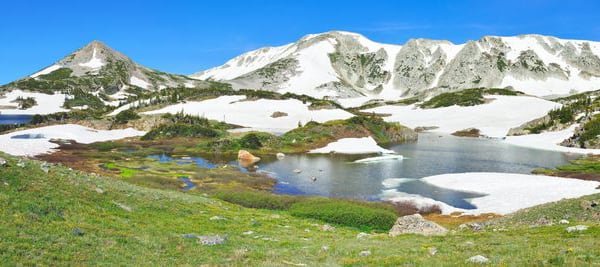
Home to Jackson Hole, the Grand Teton mountains, and herds of elk, bison, and moose, Wyoming may be the least-populated state in the United States, but that doesn’t mean it’s lacking in personality, adventure, or geological wonders. Among these geo-tourism sites to see is the Snowy Mountain Range located in southeastern Wyoming within Medicine Bow National Forest. The range is known for its stromatolites. Here are some tips from geologist Holly Brown (Trihydro Corp.) around how to visit them.
Read more of Brown’s tips for Wyoming must-see geo sites in the GeoLifestyle newsletter.
Geology of the Snowy Range:
Wyoming’s Snowy Range contains massive, well-exposed stromatolites within the Nash Fork Formation.
- The Nash Fork Formation is part of the Snowy Pass Supergroup, deposited on the southern edge of the Wyoming Craton. The Nash Fork is a tan siliceous carbonate (metadolomite) with black phyllite lenses. The formation is up to 6,500 feet thick and steeply dipping.
- The Proterozoic, 2.0–2.2 billion-year-old, orange-brown-to-white stromatolites (fossil microbial mounds) are among the most spectacular stromatolite bioherms in the United States
- The structures formed as microbial mats trapped and bound sediment. The mounds and reefs range from a few feet to thousands of feet long and up to 200 feet thick.
- Resistant to glacial scour and erosion, the carbonates stand out above the surrounding phyllite.
- The stromatolites record shallow-marine to tidal microbial communities that built laminated carbonate structures on an ancient shoreline or platform.
Trip tips: At an elevation of 10,847 feet, there is an observation point named Libby Flats off the Snowy Range Scenic Byway that offers panoramic views of the Snowy Range and more.
- A short walk brings you to an observation viewing platform where you can see hundreds of miles on a clear day into Rocky Mountain National Park in Colorado.
- Stromatolites can be found less than a mile off the scenic byway by following a dirt road off the byway for about half a mile until you see a lake on the left. The stromatolite field is to the north-northwest across the lake, following the shoreline as it turns north.
Why it matters: These stromatolites represent some of Earth’s earliest photosynthetic life, which played a major role in transforming the ocean and atmospheric chemistry.