
An
all-member survey of attitudes concerning AAPG products and
services showed an overwhelmingly positive result across the board.
A whopping 93.38 percent stated positive “overall
satisfaction” with AAPG member services, with 72.53 percent giving
“satisfied” or “extremely satisfied” marks.
David Anderson, of Anderson Marketing Services, the
firm that conducted the survey, pointed out this extremely positive
response was among the highest he’s experienced.
The survey was distributed in the February EXPLORER
and also was available to members on the AAPG Web site.
Of the 28,450 four-page, 95-question surveys distributed,
1,461, or 5.14 percent of the total distribution, were fully or
partially completed and returned.
Of that total, 1,233 were tallied from the printed
forms and 228 were collected and tabulated via the Internet.
Anderson noted the responses tracked very close to
the age and geographic distribution of the membership at large.
Findings included:
Overall Satisfaction —
Overall, members are “very satisfied” or “extremely satisfied”
with their AAPG membership. Less than seven percent of members
reported low satisfaction rating.Membership Importance —
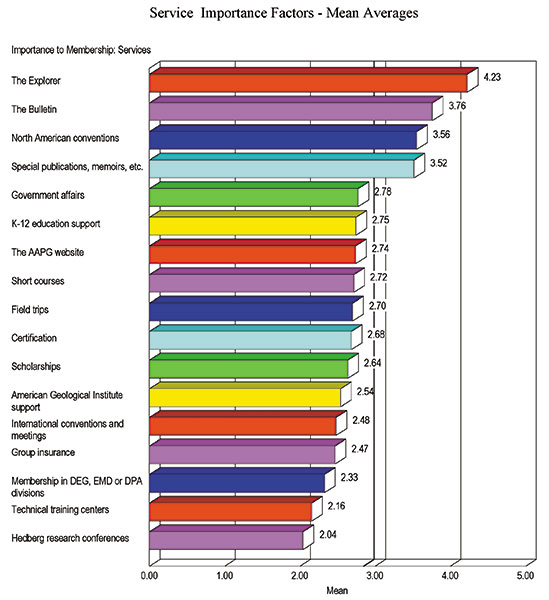
Members were asked to report the perceived level of importance
to their membership in two areas: general factors and services.- In the area of general factors, professional responsibility
and networking were deemed the most important factors. - The EXPLORER, BULLETIN and North American conventions were
the most important factors in terms of services.
- In the area of general factors, professional responsibility
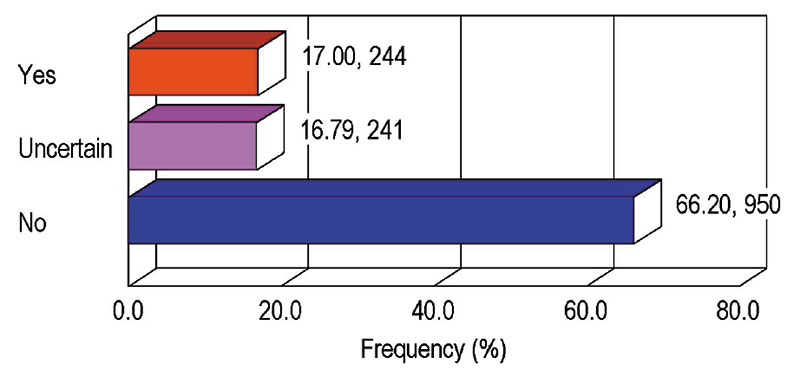
Three-Member Rule — When
asked if the “three-member sponsorship rule” should be reduced,
members overwhelmingly indicated “no,” with a minority reporting
they would like to see the ruling changed or are uncertain.Should the three-member sponsor
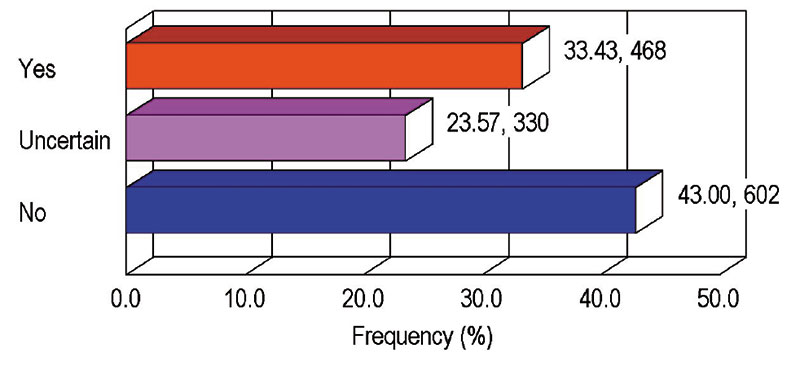
requirement for active membership be reduced?Fee Reduction — Member
responses were mixed concerning the question of a reduced dues
option, with 33 percent indicating dues should be reduced in
relation to services (receipt of the BULLETIN) reduction, with
about 24 percent being uncertain and the remaining 43 percent
indicating there should be no fee reduction option.Should there be a reduced dues
option for membership without access to the Bulletin, including
online?Headquarters Service —
Of the 40 percent responding who had contacted headquarters
in the past 12 months, most were satisfied with the services,
especially from the bookstore, publications, membership and
education.Section support, distinguished lecture and committee support
received the lowest rankings — however, no rankings fell below
2.7 on a scale of 5.BULLETIN — The BULLETIN
received extremely high marks, including readership and content,
with 89.24 percent responding the BULLETIN quality as good or
excellent.Special Publications —
86.7 percent have purchased special publications; cost is the
primary reason reported for non-purchase. About half of the
respondents indicated an interest in less-expensive publication
formats.EXPLORER — Ranking as the
number one service to members, the majority (86.61 percent)
felt the articles are either “good” or “excellent.” Readers
also felt the length of EXPLORER articles is “about right.”Continuing Education —
Most respondents (77 percent) have not participated in a continuing
education offering. Overall, two-three days and $100-$200 appear
to be the desired length and cost of a course, with a large
group indicating a preference for online course offerings. Location
and cost are the primary factors for members, outside of topic
and instructor, for attending a course and most preferred weekday
courses.Distinguished Lecture —
The majority of respondents had not attended a Distinguished
Lecture in the past year. Of those who have attended, most offered
very positive ratings regarding their experiences. In terms
of content, they preferred either half science and half industry,
or more industry than science.Web Site — About 70 percent
of the respondents have visited the AAPG Web site and most felt
it easy to navigate.Government Affairs — While
the majority of respondents are
in favor of AAPG actively pursuing government affairs in the
United States and, to a lesser extent internationally, Anderson
said “AAPG should note that there is not a ‘core message’ or
‘value statement’ that is evident from the membership.”Anderson suggested that “prior to undertaking any accelerated
activities in this area, AAPG should expose its platform to
the membership for comment and obtain a consensus of opinion.”Conventions — More than
half of the respondents have attended a convention in the past
three years and indicated that location, short courses, cost
of registration and travel costs were the most important factors
when considering attendance.Age & Tenure — Anderson
observed that “in 10 years, about 50 percent of the membership
will be over 65 years of age. New member recruitment must be
a major focus of AAPG as well as retention of older members
if present member levels are to be maintained.”
The survey was the result of a process that originated
in 1997. The scope of the proposed survey grew through the process
and evolved from a focus on the BULLETIN to include a broad spectrum
of AAPG activities.
Don Lewis, AAPG vice president in 2001-02, was named
chairman of the ad hoc Survey Committee in August 2001. The committee
formulated the topic areas to be surveyed and gave guidance to the
wording and question structure.
Ad hoc Survey Committee members, who represented
the major constituencies in AAPG, were:
- Katharine Lee Avery, Division of Professional Affairs.
- George Bole, Committee on Committees.
- Ron Grubbs, Energy Minerals Division.
- William Harrison, Division of Environmental Geosciences.
- Don Lewis, chairman, Executive Committee.
- John Lorenz, Advisory Council, AAPG Editor.
- Dwight “Clint” Moore, Advisory Council.
Lewis said the committee recognized that a statistical
sampling would suffice mathematically, but felt strongly that giving
every member an opportunity to respond would maximize interest and
usefulness of the result.
The responses to this survey were very much in-line
with the responses from a Member Satisfaction Survey by the Council
of Engineering and Scientific Society Executives in 1999, in which
AAPG products and services were ranked in the top 25 percentile
in every category as compared to other professional organizations.