
What’s the fastest way to leverage the knowledge accumulated over a century by the geoscience community?
Many of you know and use Datapages Search and Discovery, the free online service of extended abstracts, current posters and oral presentation slides, but might not realize that this is just a fraction of the knowledge in the full list of products available through Datapages. The Archives is the heart of Datapages and contains more than 100,000 peer-reviewed articles spanning more than a century of papers and articles from 70 geoscience publishers around the world. More than half are from sources outside the AAPG. The Datapages homepage has links to Search and Discovery, Archives, Digital Exploration Objects (DEO) and a wealth of free databases and map resources.
What Is Datapages?
Datapages is the product of a small group of forward-thinking geoscientists who conceived of digitizing the AAPG Bulletin along with related scientific and technical papers more than 30 years ago, to make them available to a wider audience. The Gulf Coast Association of Geological Societies was the first content partner, who signed on in 1998. And the collection has grown from there, broadening the family of content providers, adding new documents as they become available and back-filling historical records.
AAPG created Datapages as a for-profit company with AAPG as the sole shareholder. Datapages sells subscriptions to the Archives and DEO, as well as charges a per-download fee to non-subscribers. Datapages uses its funds to acquire new material and cover day-to-day operational expenditures. However, the primary draw on Datapages revenue is the royalty payments made quarterly to all our content providers, including the AAPG on a pro-rata basis. For several of our content providers, these royalty payments are their primary source of income.
The key to the Archives is a full-text search engine that returns relevant content based on multiple criteria. This search engine and results are open to all, while the underlying articles are available either to subscribers or for purchase on a pay-per-view basis. An option only available to AAPG members is an individual subscription to the Archives – this is at a significantly discounted rate to the minimum corporate subscription.
We at Datapages are firm believers in the value of the historical record and understand that there is a treasure trove of scientific and geological information in older documents. Recent additions include a large tranche of publications from Australian Energy Producers and the publications of the West Texas Geological Society stretching back to 1936, which are now available digitally in the Archives. While these were previously available to WTGS members as scanned files searchable by title, they were all reprocessed for the Archives and now the full-text of these WTGS documents is searchable.
Jeff Aldrich is currently principal geoscientist with Sproule ERCE and chairman of the Board of Directors of Datapages,
“I have used the online tools for decades as a fundamental part of my workflow,” he said. “I continue to mine its resources for my current work in helium, hydrogen, geothermal and CCS. Since 2021, I have been privileged to have been asked to be on the Datapages Board, which is composed of eight volunteers plus AAPG staff, who have provided tremendous time and insight as we have begun to transition the company into a platform that can best serve AAPG members and our clients for decades to come.”
I (Jackie Berryman) have been an AAPG member for more than 20 years and I am Datapages’ lead geoscientist and have been using the Datapages Archives as my go-to research venue. My favorite topics to peruse in the Archives are the Prudhoe Bay oil fields (713 results) on the North Slope of Alaska, the Arkoma Basin of Oklahoma (889 results), the Woodford Shale (1974 results), the geology of Scotland (2138 results), Nile delta sedimentation (676 results) and the varied research topics of Australia (11262 results) just to name a few.
What do you, as a geoscientist, need from a publications database? Are you looking to chase an Atoka sandstone? A full text search yields more than a thousand results covering Kansas, Oklahoma and Texas, with years ranging from 1919 to present. A review of the references shows the evolution of the stratigraphic nomenclature through time and how subsurface geologists have a need for further study and scientific methods and debate to solve the big question of “What is beneath our feet?” Full-text articles in the Archives have been peer-reviewed and are fully cited. The evidence to back up your research for the next pitch to the boss or the citations required for the next research paper for your professor is just a quick search away.
Who Is Datapages?
AAPG members and Datapages customers are fortunate to have a dedicated support team focused on the Datapages products.
Sandra PaskVan is the “keeper” of the Archives. When asked about Datapages and the Archives she said, “I have been employed with AAPG for 23 years as the digital products coordinator for Datapages. In that time, we have seen the shift from disc products (in all their various iterations) to digital download formats. Presently, the trend is to find our niche in the AI world and how that will impact our added value to our users. I was fortunate to work with those who had the vision to develop the concept of Datapages before it became an AAPG subsidiary. Those ideas and concepts continue to ensure the need for improving skills with the changing times. I look forward to the next chapter as we focus on the advancement of the Datapages platform. I am proud and fortunate to be a part of such a diversified team.”

The person closest to our existing customers is Valerie Lindsey, who said, “Having been associated with Datapages the longest, and as the customer service representative, I am proud of the longstanding relationships we have built directly with our customers who subscribe to the Archives. Many have been subscribers more than 20 years and I often hear from geologists, professors and students at those organizations how invaluable the Datapages Archives search database is and the fact they use it daily in their research.”
GIS Solutions
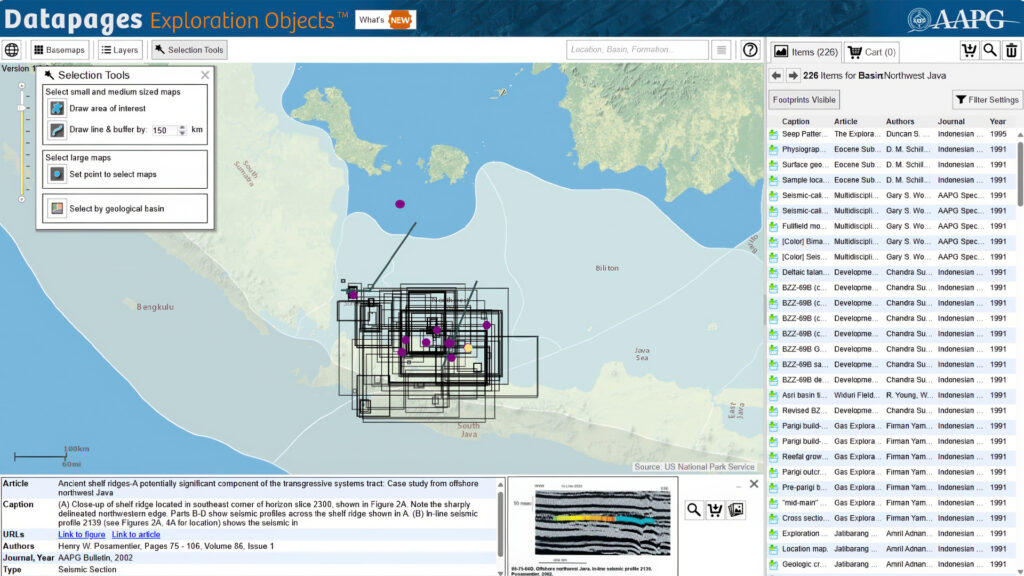
Datapages Exploration Objects is the premier GIS search engine for corporate users. Using a spatial search, DEO will allow a user to choose a geological basin or an area of interest. DEO then returns all the georeferenced objects such as maps, seismic sections, cross sections and well logs that are associated with that region (see figure 1).
There are several ways to filter the objects, such as by a specific journal, section type or text filter. Each object in the results list is accompanied by the supporting data that shows the user who, when and where the data comes from (see figure 2). A user can then download the georeferenced objects directly into the mapping software, and the document link is to the full text pdf in the Archives. Each object is accompanied by the article title, the caption, the URLs for both the figure and the article, the authors’ names, the journal and year, the figure number and a quality-control rating.
Eric Jones, senior GIS developer, said, “Datapages Exploration Objects are more than just map footprints – they’re intelligent spatial anchors that connect users directly to high-value geological content. With embedded metadata, dynamic linking to AAPG publications and seamless integration into ArcGIS Online, DEOs empower exploration teams to visualize subsurface insights in context. Whether you’re exploring for prospects or correlating regional trends, DEOs turn static maps into interactive research platforms.”
For example, an exploration geologist evaluating a basin uses DEOs to overlay well-data maps, stratigraphic columns, and cross sections directly into their mapping program of choice. By clicking on DEOs tied to specific formations they can instantly access seismic interpretations, depositional models and analog field studies – streamlining their evaluation process.
Vesna Vokins is our global sales lead. She offered the following when asked about her role at Datapages, and the value our customers generate from us: “I’m proud to represent AAPG Datapages, the premier source of trusted geological knowledge from published materials. Customers often tell me that Datapages is valuable because we brought together the world’s largest collection of trusted geoscience content for the energy industry and made it instantly accessible to our subscribers worldwide. Using Datapages, geoscientists gain the insights they need to reduce risk, accelerate projects and deliver stronger results. Our mission is clear: our customers’ success in their critical projects staying ahead in the competitive energy industry!”
AI: The Next Gamechanger?
A person would have to have spent the last few years doing field work in a very remote area not to have heard that artificial intelligence is upon us, and most headlines seem to suggest it will take over everything. As our colleague Sandra said above, at Datapages we are working to carve out our niche in this new world.
Clearly, AI’s potential ability to locate and summarize answers from a vast repository of curated data has real value, but we also have a responsibility to ensure that context is not lost and sources are always identified. In a world that seems increasingly demanding of quick answers, we plan to continue to evolve to address user needs while prioritizing the trustworthiness of the information we provide.
If you would like to subscribe to the Archives, as an AAPG member benefit there is a Single User Archives 1- or 3-year subscription available at the AAPG Store (store.aapg.org).
Would you like your company to inquire about a corporate subscription? Visit datapages.com/subscription-information, or email John Turvill: jturvill@aapg.org.